Thank you for visiting SNEWPapers!
Sign up free
Lancaster Daily Intelligencer
Lancaster, Lancaster County, Pennsylvania
What is this article about?
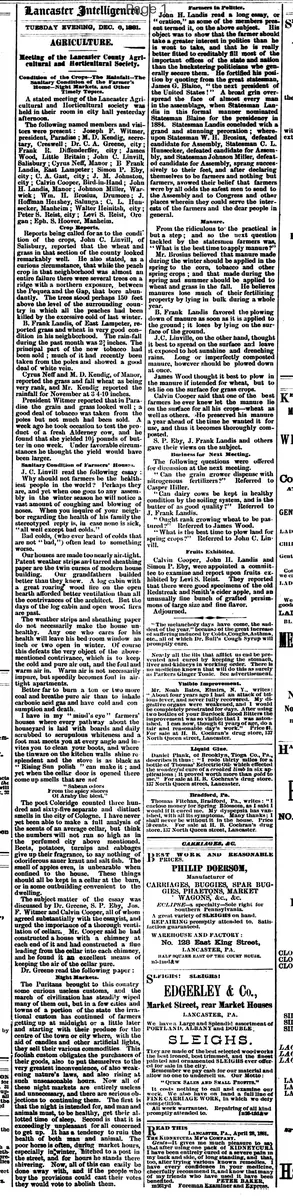
Report on the December 5, 1881, meeting of the Lancaster County Agricultural and Horticultural Society in Lancaster city hall. Discussions covered crop conditions, rainfall, sanitary issues in farm homes, night markets, farmers in politics, manure application, future topics, and fruit exhibitions.
Merged-components note: Continuation of the agriculture society meeting story across adjacent columns on the same page.
Clipping
OCR Quality
Full Text
AGRICULTURE.
Meeting of the Lancaster County Agricultural
and Horticultural Society.
Condition of the Crops—The Rainfall—The
Sanitary Condition of the Farmer's
Home—Night Markets, and Other
Timely Topics.
A stated meeting of the Lancaster Agricultural
and Horticultural society was
held in their room in city hall yesterday
afternoon.
The following named members and visitors
were present: Joseph F. Witmer,
president, Paradise; M. D. Kendig, secretary,
Creswell; Dr. C. A. Greene, city;
Frank R. Diffenderffer, city; James
Wood, Little Britain; John C. Linvill,
Salisbury; Cyrus Neff, Manor; B. Frank
Landis, East Lampeter; Simon P. Eby,
city; C. A. Gast, city; J. M. Johnston,
city; Calvin Cooper, Bird-in-Hand; John
H. Landis, Manor; Johnson Miller, War-
wick; Wm. H. Brosius, Drumore; J.
Hoffman Hershey, Salunga; C. L. Hun-
secker, Manheim; Walter Heinitsh, city;
Peter S. Reist, city; Levi S. Reist, Oregon;
Eph. S. Hoover, Manheim.
Crop Reports.
Reports being called for as to the condition
of the crops, John C. Linvill, of
Salisbury, reported that the wheat and
grass in that section of the county looked
remarkably well. He also stated, as a
curious circumstance, that while the peach
crop in that neighborhood was almost an
entire failure there were several trees on a
ridge with a northern exposure, between
the Pequea and the Gap, that bore abun-
dantly. The trees stood perhaps 150 feet
above the level of the surrounding coun-
try in which all the peaches had been
killed by the excessive cold of last winter.
B. Frank Landis, of East Lampeter, reported
grass and wheat in very good condition
in his neighborhood. The rain-fall
during the past month was 2 inches. The
principal part of the new tobacco had
been sold; much of it had recently been
taken from the poles and showed a good
deal of white vein.
Cyrus Neff and M. D. Kendig, of Manor,
reported the grass and fall wheat as being
very rank, and Mr. Kendig reported the
rainfall for November at 3 4-10 inches.
President Witmer reported that in Paradise
the grain and grass looked well; a
good deal of tobacco was taken from the
poles but not much had been sold. A
week ago he took occasion to test the product
of a fresh Alderney cow, and he
found that she yielded 10 pounds of butter
in one week. Under favorable circumstances
he thought the yield would have
been larger.
Sanitary Condition of Farmers' Houses.
J. C. Linvill read the following essay:
Why should not farmers be the healthiest
people in the world? Perhaps they
are, and yet when one goes to any assembly
in the winter season he will notice a
vast amount of coughing and blowing of
noses. When you inquire of your neighbor
regarding the health of his family the
stereotyped reply is, in case none is sick,
"all well except bad colds."
Bad colds, (who ever heard of colds that
are not "bad,"), often lead to something
worse.
Our houses are made too nearly air-tight.
Patent weather strips and tarred sheathing
paper are the twin curses of modern house
building.
Our grandfathers builded
better than they knew. A log cabin with
a great roaring wood fire on the open
hearth afforded better ventilation than all
the contrivances of the architect. But the
days of the log cabin and open wood fires
are past.
The weather strips and sheathing paper
do not necessarily make the house un-
healthy. Any one who cares for his
health will leave his bed-room window an
inch or two open in winter. Of course
this defeats the very object of the above-
mentioned contrivance, which is to keep
the cold and pure air out, and the foul and
warm air in. "Warm air is not necessarily
impure, but speedily becomes foul in air-
tight apartments.
Better far to burn a ton or two more
coal and breathe pure air than to inhale
carbonic acid gas and have cold and consumption
and death.
I have in my "mind's eye" farmers'
houses where every pathway about the
houseyard is laid with boards and daily
scrubbed to scrupulous whiteness and a
foot mat meets you at every angle and invites
you to clean your boots, and where
the tinware on the kitchen walls shine resplendent
and the stove is as black as
Rising Sun polish can make it; and
yet when the cellar door is opened there
come up smells that are not
"Sabean odors
From the spicy shores
Of Araby the blest."
The poet Coleridge counted three hundred
and sixty-five separate and distinct
smells in the city of Cologne. I have never
yet been able to make a full analysis of
the scents of an average cellar, but think
the numbers will not run so high as in
the perfumed city above mentioned.
Beets, potatoes, turnips and cabbages
give up their fragrance, to say nothing of
odoriferous sauer kraut and salt fish. The
smell of apples even, is unbearable when
confined to the house. These things
should all be kept in a cellar at the barn,
or in some outbuilding convenient to the
dwelling.
The subject matter of the essay was
discussed by Dr. Greene, S. P. Eby, Jos.
F. Witmer and Calvin Cooper, all of whom
agreed substantially with the essayist, and
urged the importance of a thorough ventilation
of cellars. Mr. Cooper said he had
constructed a house with a chimney at
each end of it and had constructed a flue
leading from the cellar into each chimney.
and he found it an excellent means of
keeping the air of the cellar pure.
Dr. Greene read the following paper:
Night Markets.
The Puritans brought to this country
some curious useless customs, and the
march of civilization has steadily wiped
many of them out, but in a few cities and
towns of a portion of the state the irrational
custom has continued of farmers
getting up at midnight or a little later
and starting with their produce for the
centre of the town or city where, with the
aid of candles and other artificial lights,
they sell their various commodities. This
foolish custom obligates the purchasers of
their goods, also to put themselves to the
very greatest inconvenience, of also weakening
nature's laws, and also rising at
such unseasonable hours. Now all of
these night markets are entirely useless
and unnecessary, and there are serious objections
to continuing them. The first is
that the night is intended for, and man and
animals must, to be healthy, get their allotted
time of sleep. Second is that it is
exceedingly unpleasant for all concerned
to get up. It has a tendency to ruin the
health of both man and animal. The
poor horse is often, during market hours,
especially in winter, hitched to a post in
the street, and for hours he stands there
shivering. Now, all of this can easily be
done away with, and if the people who
buy the provisions could cast their votes
they would vote to abolish them.
John H. Landis read a long essay, or
"oration," as some of the members present
termed it, on the above subject. "His
object was to show that the farmer should
take a greater interest in politics than he
is wont to take, and that he is really
better fitted to creditably fill most of the
important offices of the state and nation
than the huckstering politicians who generally
secure them. He fortified his position
by quoting from the great statesman,
James G. Blaine, "the next president of
the United States!" A broad grin over-
spread the face of almost every man
in the assemblage, when Statesman Landis
in this formal manner nominated
Statesman Blaine for the presidency in
1884. Statesman Landis concluded with a
grand and stunning peroration; whereupon
Statesman W. H. Brosius, defeated
candidate for Assembly, Statesman C. L.
Hunsecker, defeated candidate for Assembly,
and Statesman Johnson Miller, defeated
candidate for Assembly, sprang successively
to their feet, and after declaring
themselves to be farmers and nothing but
farmers, avowed their belief that farmers
were by all odds the safest men to send to
the Assembly and to Congress and other
places wherein they could serve the interests
of the farmers and the dear people in
general.
Manure,
From the ridiculous to the practical is
but a step; and so the next question
tackled by the statesmen farmers was
"What is the best time to apply manure?"
Mr. Brosius believed that manure made
during the winter should be applied in the
spring to the corn, tobacco and other
spring crops; and that made during the
spring and summer should be applied to
wheat and grass in the fall. He believes
manures lose much of their fertilizing
property by lying in bulk during a whole
year.
B. Frank Landis favored the plowing
down of manure as soon as it is applied to
the ground; it loses by lying on the surface
of the ground.
J. C. Linvill, on the other hand, thought
it best to spread on the surface and leave
it exposed to hot sunshine and drenching
rains.
Long or imperfectly composted
manure, however should be plowed down
at once.
James Wood thought it best to plow in
the manure if intended for wheat, but to
let lie on the surface for grass crops.
Calvin Cooper said that one of the best
farmers he ever knew let the manure lie
on the surface for all his crops—wheat as
well as others. He preserved his manure
a year ahead of the time he wanted it for
use, and thus it becomes thoroughly composted.
S. P. Eby, J. Frank Landis and others
gave their views on the subject.
Business for Next Meeting,
The following questions were offered
for discussion at the next meeting.
"Can the grain grower dispense with
nitrogenous fertilizers?"
Referred to
Casper Miller.
"Can dairy cows be kept in healthy
condition by the soiling system, and is the
butter of as good quality?" Referred to
J. Frank Landis.
"Ought rank growing wheat to be pastured?"
Referred to James Wood.
"What is the best time to plow land for
spring crops?"
Referred to John C. Linvill.
Fruits Exhibited.
Calvin Cooper, John H. Landis and
Simon P. Eby, were appointed a committee
to examine and report upon fruits exhibited
by Levi S. Reist. They reported
that there were good specimens of the old
Redstreak and Smith's cider apple, and an
unusually fine bunch of grafted persimmons
of large size and fine flavor.
Adjourned.
What sub-type of article is it?
What keywords are associated?
What entities or persons were involved?
Where did it happen?
Story Details
Key Persons
Location
Lancaster City Hall
Event Date
December 5, 1881
Story Details
Members reported on crop conditions including wheat, grass, peaches, tobacco, and rainfall. Essays discussed sanitary conditions in farm houses emphasizing ventilation, opposition to night markets for health reasons, farmers' role in politics quoting James G. Blaine, best practices for applying manure, and future discussion topics. Fruits including apples and persimmons were exhibited.