Thank you for visiting SNEWPapers!
Sign up free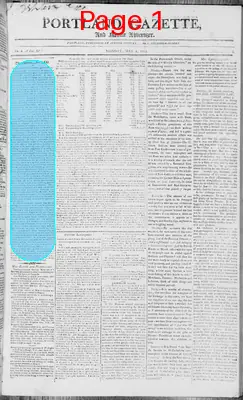
Literary
May 4, 1812
Portland Gazette, And Maine Advertiser
Portland, Cumberland County, Maine
What is this article about?
An essay from 'The Monitor' No. LXXI discusses biblical prohibitions on mixed marriages between believers and non-believers, citing scriptures like Moses' command and Paul's exhortation. It presents arguments on both sides, emphasizing risks of corruption versus potential sanctification of families, urging personal discernment.
Clipping
OCR Quality
92%
Excellent
Full Text
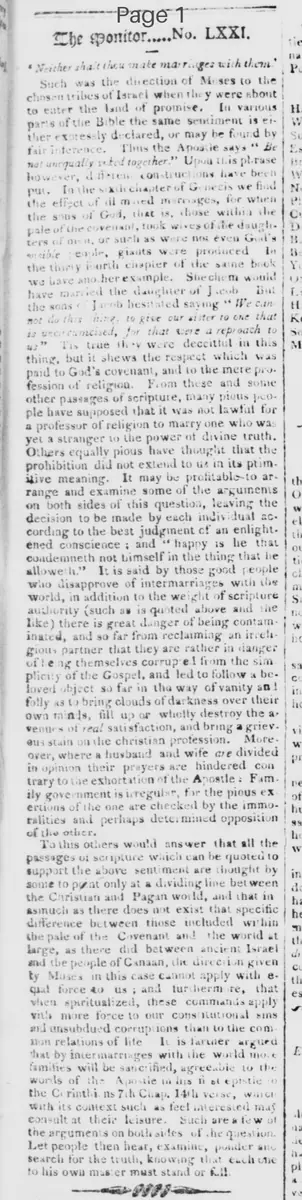
The Monitor.....No. LXXI.
"Neither shalt thou make marriages with them."
Such was the direction of Moses to the chosen tribes of Israel when they were about to enter the land of promise. In various parts of the Bible the same sentiment is either expressly declared, or may be found by fair inference. Thus the Apostle says "Be not unequally yoked together." Upon this phrase however, different constructions have been put. In the sixth chapter of Genesis we find the effect of mixed marriages. For when the sons of God, that is, those within the pale of the covenant, took wives of the daughters of men, or such as were not even God's people, giants were produced. In the thirty-fourth chapter of the same book we have another example. Shechem would have married the daughter of Jacob. But the sons of Jacob hesitated saying "We cannot do this thing, to give our sister to one that is uncircumcised, or that were a reproach to us." It is true they were deceitful in this thing, but it shows the respect which was paid to God's covenant, and to the mere profession of religion. From these and some other passages of scripture, many pious people have supposed that it was not lawful for a professor of religion to marry one who was yet a stranger to the power of divine truth. Others equally pious have thought that the prohibition did not extend to us in its primitive meaning. It may be profitable to arrange and examine some of the arguments on both sides of this question, leaving the decision to be made by each individual according to the best judgment of an enlightened conscience: and "happy is he that condemneth not himself in the thing that he alloweth." It is said by those good people who disapprove of intermarriages with the world, in addition to the weight of scripture authority (such as is quoted above and the like) there is great danger of being contaminated, and so far from reclaiming an irreligious partner that they are rather in danger of being themselves corrupted from the simplicity of the Gospel, and led to follow a beloved object so far in the way of vanity and folly as to bring clouds of darkness over their own minds, fill up or wholly destroy the avenues of real satisfaction, and bring a grievous stain on the Christian profession. Moreover, where a husband and wife are divided in opinion their prayers are hindered contrary to the exhortation of the Apostle: Family government is irregular, for the pious exertions of the one are checked by the immoralities and perhaps determined opposition of the other.
To this others would answer that all the passages of scripture which can be quoted to support the above sentiment are thought by some to point only at a dividing line between the Christian and Pagan world, and that inasmuch as there does not exist that specific difference between those included within the pale of the Covenant and the world at large, as there did between ancient Israel and the people of Canaan, that direction given by Moses in this case cannot apply with equal force to us; and further, that when spiritualized, these commands apply with more force to our constitutional sins and unsubdued corruptions than to the common relations of life. It is further argued that by intermarriages with the world more families will be sanctified, agreeable to the words of the Apostle 1 Cor. 7th Chap. 14th verse, which with its context such as feel interested may consult at their leisure. Such are a few of the arguments on both sides of the question. Let people then hear, examine, ponder and search for the truth, knowing that each one to his own master must stand or fall.
"Neither shalt thou make marriages with them."
Such was the direction of Moses to the chosen tribes of Israel when they were about to enter the land of promise. In various parts of the Bible the same sentiment is either expressly declared, or may be found by fair inference. Thus the Apostle says "Be not unequally yoked together." Upon this phrase however, different constructions have been put. In the sixth chapter of Genesis we find the effect of mixed marriages. For when the sons of God, that is, those within the pale of the covenant, took wives of the daughters of men, or such as were not even God's people, giants were produced. In the thirty-fourth chapter of the same book we have another example. Shechem would have married the daughter of Jacob. But the sons of Jacob hesitated saying "We cannot do this thing, to give our sister to one that is uncircumcised, or that were a reproach to us." It is true they were deceitful in this thing, but it shows the respect which was paid to God's covenant, and to the mere profession of religion. From these and some other passages of scripture, many pious people have supposed that it was not lawful for a professor of religion to marry one who was yet a stranger to the power of divine truth. Others equally pious have thought that the prohibition did not extend to us in its primitive meaning. It may be profitable to arrange and examine some of the arguments on both sides of this question, leaving the decision to be made by each individual according to the best judgment of an enlightened conscience: and "happy is he that condemneth not himself in the thing that he alloweth." It is said by those good people who disapprove of intermarriages with the world, in addition to the weight of scripture authority (such as is quoted above and the like) there is great danger of being contaminated, and so far from reclaiming an irreligious partner that they are rather in danger of being themselves corrupted from the simplicity of the Gospel, and led to follow a beloved object so far in the way of vanity and folly as to bring clouds of darkness over their own minds, fill up or wholly destroy the avenues of real satisfaction, and bring a grievous stain on the Christian profession. Moreover, where a husband and wife are divided in opinion their prayers are hindered contrary to the exhortation of the Apostle: Family government is irregular, for the pious exertions of the one are checked by the immoralities and perhaps determined opposition of the other.
To this others would answer that all the passages of scripture which can be quoted to support the above sentiment are thought by some to point only at a dividing line between the Christian and Pagan world, and that inasmuch as there does not exist that specific difference between those included within the pale of the Covenant and the world at large, as there did between ancient Israel and the people of Canaan, that direction given by Moses in this case cannot apply with equal force to us; and further, that when spiritualized, these commands apply with more force to our constitutional sins and unsubdued corruptions than to the common relations of life. It is further argued that by intermarriages with the world more families will be sanctified, agreeable to the words of the Apostle 1 Cor. 7th Chap. 14th verse, which with its context such as feel interested may consult at their leisure. Such are a few of the arguments on both sides of the question. Let people then hear, examine, ponder and search for the truth, knowing that each one to his own master must stand or fall.
What sub-type of article is it?
Essay
What themes does it cover?
Religious
Moral Virtue
What keywords are associated?
Mixed Marriages
Biblical Prohibition
Religious Intermarriage
Christian Piety
Scriptural Arguments
Literary Details
Title
The Monitor.....No. Lxxi.
Subject
On Intermarriages Between Believers And The World
Key Lines
"Neither Shalt Thou Make Marriages With Them."
"Be Not Unequally Yoked Together."
"We Cannot Do This Thing, To Give Our Sister To One That Is Uncircumcised, Or That Were A Reproach To Us."
Happy Is He That Condemneth Not Himself In The Thing That He Alloweth.
Each One To His Own Master Must Stand Or Fall.