Thank you for visiting SNEWPapers!
Sign up free
Staunton Spectator, And General Advertiser
Staunton, Virginia
What is this article about?
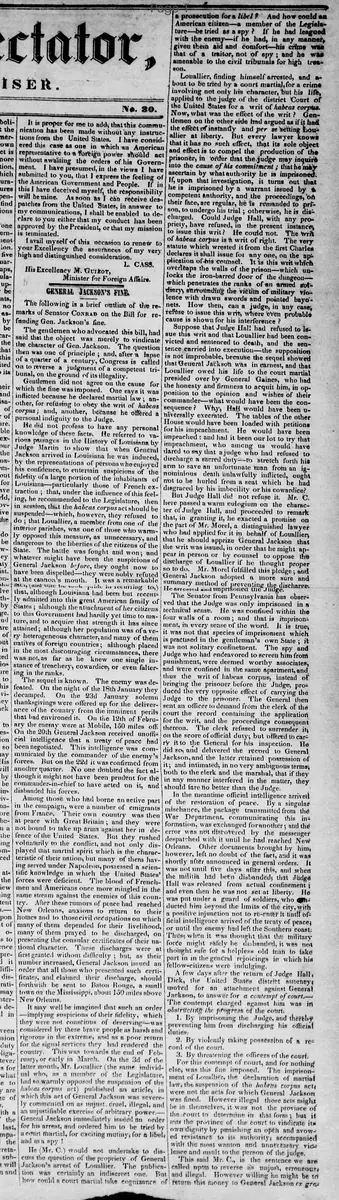
Senator Conrad opposes a bill to refund General Jackson's fine for contempt of court during the 1815 New Orleans events, recounting Jackson's arrest of critic Louallier, imprisonment of Judge Hall for issuing a habeas corpus writ, and the court's subsequent fine.
Merged-components note: Continuation of the article reporting on Senate remarks regarding General Jackson's fine, spanning page 1 to page 2; original labels were 'story' and 'editorial', merged under 'story' as it is a narrative political report.
Clippings
1 of 2
OCR Quality
Full Text
The following is a brief outline of the remarks of Senator Conrad on the Bill for refunding Gen. Jackson's fine.
The gentlemen who advocated this bill, had said that the object was merely to vindicate the character of Gen. Jackson. The question then was one of principle ; and, after a lapse of a quarter of a century, Congress is called on to reverse a judgment of a competent tribunal, on the ground of its illegality.
Gentlemen did not agree on the cause for which the fine was imposed. One says it was inflicted because he declared martial law; another, for refusing to obey the writ of habeas corpus; and, another, because he offered a personal indignity to the Judge.
He did not profess to have any personal knowledge of these facts. He referred to various passages in the History of Louisiana by Judge Martin to show that when General Jackson arrived in Louisiana he was induced, by the representations of persons who enjoyed his confidence, to entertain suspicions of the fidelity of a large portion of the inhabitants of Louisiana-particularly those of French extraction ; that, under the influence of this feeling, he recommended to the Legislature, then in session, that the habeas corpus act should be suspended-which, however, they refused to do ; that Louallier, a member from one of the interior parishes, was one of those who warmly opposed this measure, as unnecessary, and dangerous to the liberties of the citizens of the State. The battle was fought and won; and whatever might have been the suspicions of General Jackson before, they ought now to have been dispelled--they were nobly refuted at the cannon's mouth. It was a remarkable fact (and one he would pride in recurring to,) that, although Louisiana had been but recently admitted into this great American family of States; although the attachment of her citizens to this Government had hardly yet time to mature, and to acquire that strength it has since attained; although her population was of a very heterogeneous character, and many of them natives of foreign countries; although placed in the most discouraging circumstances, there was not, as far as he knew one single instance of treachery, cowardice, or even faltering in the ranks.
The sequel is known. The enemy was defeated. On the night of the 18th January they decamped. On the 23d January solemn thanksgivings were offered up for the deliverance of the country from the imminent perils that had environed it On the 12th of February the enemy were at Mobile, 150 miles off. On the 20th General Jackson received unofficial intelligence that a treaty of peace had been negotiated. This intelligence was communicated by the commander of the enemy's forces. But on the 22d it was confirmed from another quarter. No one doubted the fact although it might not have been prudent for the commander-in-chief to have acted on it, and disbanded his forces
Among those who had borne an active part in the campaign, were a number of emigrants from France. Their own country was then at peace with Great Britain; and they were not bound to take up arms against her in defence of the United States. But they rushed voluntarily to the conflict, and not only displayed that martial spirit which is the characteristic of their nation, but many of them having served under Napoleon, possessed a scientific knowledge in which the United States' forces were deficient. The blood of Frenchmen and Americans once more mingled in the same stream against the enemies of this country. After these rumors of peace had reached New Orleans, anxious to return to their homes and to those civil occupations on which many of them depended for their livelihood, many of them prayed to be discharged, on presenting the consular certificates of their national character. These discharges were at first granted without difficulty ; but, as their number increased, General Jackson issued an order that all those who presented such certificates, and claimed their discharge, should forthwith be sent to Baton Rouge, a small town on the Mississippi, about 150 miles above New Orleans.
It may well be imagined that such an order—implying suspicions of their fidelity, which they were not conscious of deserving—was considered by these brave people as harsh and rigorous in the extreme, and as a poor return for the signal services they had rendered the country. This was towards the end of February, or early in March. On the 3d of the latter month, Mr. Louallier (the same individual who, as a member of the Legislature, had so warmly opposed the suspension of the habeas corpus act) published an article, in which this act of General Jackson was severely commented on as unjust. cruel, illegal, and an unjustifiable exercise of arbitrary power.—
General Jackson immediately issued an order for his arrest, and ordered him to be tried by a court martial, for exciting mutiny; for a libel; and as a spy !
He (Mr. C.) would not undertake to discuss the question of the propriety of General Jackson's arrest of Louallier. The publication was certainly an indiscreet one. But how could a court martial take cognizance of a prosecution for a libel? And how could an American citizen-a member of the Legislature--be tried as a spy ? if he had leagued with the enemy-if he had, in any manner, given them aid and comfort--his crime was that of a traitor, not of spy; and he was amenable to the civil tribunals for high treason.
Louallier, finding himself arrested, and about to be tried by a court martial, for a crime involving not only his character, but his life, applied to the judge of the district Court of the United States for a writ of habeas corpus.
Now, what was the effect of the writ ? Gentlemen on the other side had argued as if it had the effect of instantly and per se setting Louallier at liberty. But every lawyer knows that it has no such effect, that its sole object and effect is to compel the production of the prisoner, in order that the judge may inquire into the cause of his commitment ; that he may ascertain by what authority he is imprisoned. If, upon that investigation, it turns out that he is imprisoned by a warrant issued by competent authority, and the proceedings, on their face, are regular, he is remanded to prison, to undergo his trial ; otherwise, he is discharged. Could Judge Hall, with any propriety, have refused, in the present instance to issue this writ? He could not. The writ of habeas corpus is a writ of right. The very statute which wrested it from the first Charles declares it shall issue for any one, on the application of his counsel. It is this writ which overleaps the walls of the prison-which unlocks the iron-barred door of the dungeon-- which penetrates the ranks of an armed soldiery surrounding the victim of military violence with drawn swords and pointed bayonets. How then, can a judge, in any case; refuse to issue this writ, where even probable cause is shown for his interference ?
Suppose that Judge Hall had refused to issue this writ and that Louallier had been convicted and sentenced to death, and the sentence carried into execution--the supposition is not improbable, because the sequel showed that General Jackson was in earnest, and that Louallier owed his life to the court martial presided over by General Gaines, who had the honesty and firmness to acquit him, in opposition to the opinion and wishes of their commander--what would have been the consequence? Why, Hall would have been universally execrated. The tables of the other House would have been loaded with petitions for his impeachment. He would have been impeached : and had it been our lot to try that impeachment, who among us would have dared to say that a judge who had refused to discharge a sacred duty--to stretch forth his arm to save an unfortunate man from an ignominious death unlawfully inflicted, ought not to be hurled from a seat which he had disgraced by his imbecility or his cowardice?
But Judge Hall did not refuse it. Mr. C. here passed a warm eulogium on the character of Judge Hall, and proceeded to remark that, in granting it, he exacted a promise on the part of Mr. Morel, a distinguished lawyer who had applied for it in behalf of Louallier that he should apprise General Jackson that the writ was issued, in order that he might appear in person or by counsel to oppose the discharge of Louallier if he thought proper so to do. Mr. Morel fulfilled this pledge; and General Jackson adopted a more sure and summary method of preventing the discharge. He arrested and imprisoned the Judge.
The Senator from Pennsylvania has observed that the Judge was only imprisoned in a technical sense. He was confined within the four walls of a room; and that is imprisonment, in every sense of the word. It is true; it was not that species of imprisonment which is practised in the gentleman's own State ; it was not solitary confinement. The spy and Judge who had endeavored to screen him from punishment, were deemed worthy associates, and were confined in the same apartment, and thus the writ of habeas corpus; instead of bringing the prisoner before the Judge, produced the very opposite effect of carrying the Judge to the prisoner: The General then sent an officer to demand from the clerk of the court the record containing the application for the writ, and the proceedings consequent thereon. The clerk refused to surrender it on the score of official duty; but offered to carry it to the General for his inspection. He did so and delivered the record to General Jackson, and the latter retained possession of it; and intimated; in no very ambiguous terms; both to the clerk and the marshal, that if they in any manner interfered in the matter, they should fare no better than the Judge:
In the meantime official intelligence arrived of the restoration of peace. By a singular mischance, the package transmitted from the War Department, communicating this information, was exchanged for another; and the error was not discovered by the messenger despatched with it until he had reached New Orleans. Other documents brought by him; however, left no doubt of the fact, and it was shortly after announced in general orders. It was not until five days after this, and when the militia had been disbanded; that Judge Hall was released from actual confinement ; and even then he was not set at liberty. He was put under a guard of soldiers, who conducted him beyond the limits of the city, with a positive injunction not to re-enter it until official intelligence arrived of the treaty of peace; or until the enemy had left the Southern coast:
Thus; when it was thought that the military force might safely be disbanded, it was not thought safe for a helpless old man to take part in the general rejoicings in which his fellow-citizens were indulging.
A few days after the return of Judge Hall, the United States district attorney moved for an attachment against General Jackson, to answer for a contempt of court. The contempt charged against him was in obstructing the progress of the court:
1. By imprisoning the Judge, and thereby preventing him from discharging his official duties:
2. By violently taking possession of a record of the court.
3. By threatening the officers of the court
For this contempt of court, and for nothing else, was this fine imposed.' The imprisonment of Louallier, the declaration of martial law; the suspension of the habeas Corpus act, were not the acts for which General Jackson was fined. However illegal those acts might be in themselves, it was not the province of the court to determine in that form; but it was the province of the court to vindicate its own dignity by punishing an open and avowed resistance to its authority; accompanied with the most wanton and unnecessary violence and insult to the person of the judge.
This said Mr. C., is the sentence we are called upon to reverse as unjust, erroneous and illegal. However willing he might be to return this money to General Jackson ex gratia
Right—however anxious he might be to do anything consistent with truth and principle, to gratify General Jackson or his friends on this floor and elsewhere—he could not do this; he could not do it, because he believed the judgment conformed to law and justice: he could not do it, because he would thereby sanction a dangerous precedent, that might hereafter be invoked by some chieftain less magnanimous than Gen. Jackson, to the subversion of the liberties of his country; he could not do it, because he would thereby contribute to revive an exploded calumny against a portion of his own constituents: he could not do it, because he would, in so doing, affix an unjust stigma upon the character of the upright magistrate by whom this sentence was pronounced. That Judge is, long since, consigned to that tomb to which, we are told, Gen. Jackson is fast hastening. No sculptured marble marks the spot where his ashes repose. Pilgrim patriots do not resort to his tomb, as they will one day to Gen. Jackson's, to breathe the inspiration that hovers around the grave of a departed hero.
What sub-type of article is it?
What themes does it cover?
What keywords are associated?
What entities or persons were involved?
Where did it happen?
Story Details
Key Persons
Location
New Orleans, Louisiana
Event Date
February March 1815
Story Details
Senator Conrad recounts General Jackson's actions post-Battle of New Orleans: arresting critic Louallier, imprisoning Judge Hall for issuing a habeas corpus writ, seizing court records, leading to Jackson's fine for contempt of court; opposes refunding the fine to uphold judicial authority.