Thank you for visiting SNEWPapers!
Sign up free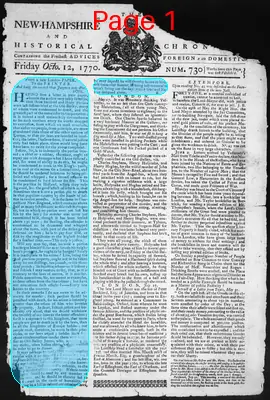
The New Hampshire Gazette And Historical Chronicle
Portsmouth, Greenland, Rockingham County, New Hampshire
What is this article about?
A letter critiques the severity of English criminal laws, lamenting frequent executions at Old Bailey for theft and robbery. It advocates alternatives like restitution, hard labor, and whipping, citing practices in Holland and Connecticut, and calls for parliamentary reform to align with justice and humanity.
Clipping
OCR Quality
Full Text
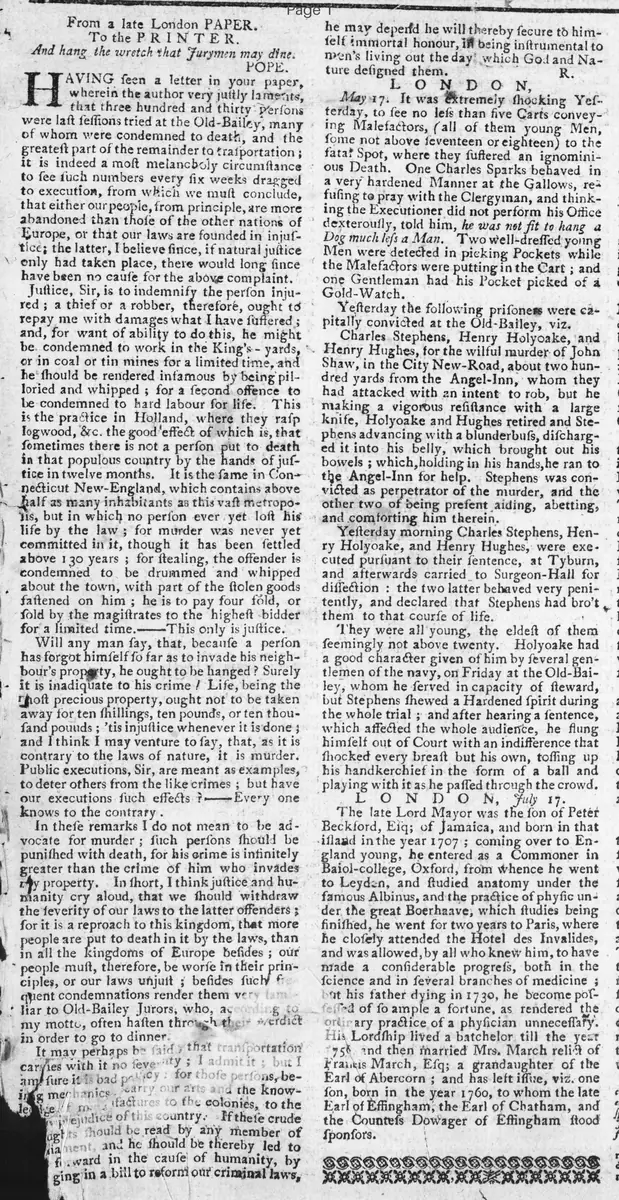
To the PRINTER.
And hang the wretch that Furymen may dine.
POPE.
HAVING seen a letter in your paper, wherein the author very justly laments, that three hundred and thirty persons were last sessions tried at the Old-Bailey, many of whom were condemned to death, and the greatest part of the remainder to transportation; it is indeed a most melancholy circumstance to see such numbers every six weeks dragged to execution, from which we must conclude, that either our people, from principle, are more abandoned than those of the other nations of Europe, or that our laws are founded in injustice: the latter, I believe since, if natural justice only had taken place, there would long since have been no cause for the above complaint.
Justice, Sir, is to indemnify the person injured; a thief or a robber, therefore, ought to repay me with damages what I have suffered: and, for want of ability to do this, he might be condemned to work in the King's yards, or in coal or tin mines for a limited time. and he should be rendered infamous by being pilloried and whipped; for a second offence to be condemned to hard labour for life. This is the practice in Holland, where they rap logwood, &c. the good effect of which is, that sometimes there is not a person put to death in that populous country by the hands of justice in twelve months. It is the same in Connecticut New-England, which contains above half as many inhabitants as this vast metropolis, but in which no person ever yet lost his life by the law; for murder was never yet committed in it, though it has been settled above 130 years; for stealing, the offender is condemned to be drummed and whipped about the town, with part of the stolen goods fastened on him: he is to pay four fold, or sold by the magistrates to the highest bidder for a limited time.- This only is justice.
Will any man say, that, because a person has forgot himself so far as to invade his neighbour's property, he ought to be hanged? Surely it is inadequate to his crime! Life, being the most precious property, ought not to be taken away for ten shillings, ten pounds, or ten thousand pounds; 'tis injustice whenever it is done; and I think I may venture to say, that, as it is contrary to the laws of nature, it is murder.
Public executions, Sir, are meant as examples, to deter others from the like crimes: but have our executions such effects?--Every one knows to the contrary.
In these remarks I do not mean to be advocate for murder; such persons should be punished with death, for his crime is infinitely greater than the crime of him who invades any property. In short, I think justice and humanity cry aloud, that we should withdraw the severity of our laws to the latter offenders: for it is a reproach to this kingdom, that more people are put to death in it by the laws, than in all the kingdoms of Europe besides; our people must, therefore, be worse in their principles, or our laws unjust; besides such frequent condemnations render them very familiar to Old-Bailey Jurors, who, according to my motto, often hasten through their verdict in order to go to dinner.
It may perhaps be said, that transportation carries with it no severity; I admit it; but in transporting mechanics carry our arts and the knowledge to the colonies, I am sure it is bad policy: for those persons, being sent, prejudice of this country. If these crude manufactures to the colonies, though this should be read by any member of parliament, and he should be thereby led to forward in the cause of humanity, by bringing in a bill to reform our criminal laws, he may depend he will thereby secure to himself immortal honour, in being instrumental to men's living out the day which God and Nature designed them.
R.
What sub-type of article is it?
What themes does it cover?
What keywords are associated?
What entities or persons were involved?
Letter to Editor Details
Author
R.
Recipient
To The Printer.
Main Argument
english criminal laws are unjustly severe in imposing death for theft and robbery; instead, offenders should face restitution, hard labor, pillory, and whipping, as practiced in holland and connecticut, to align with natural justice and humanity, while calling for parliamentary reform.
Notable Details
- quotes pope on hasty juries
- references practices in holland and connecticut new-england
- criticizes public executions as ineffective deterrents
- opposes transportation for carrying skills to colonies