Thank you for visiting SNEWPapers!
Sign up free
Jackson Advocate
Jackson, Hinds County, Mississippi
What is this article about?
The Oil and Gas Journal forecasts a record year for U.S. petroleum demand in 1957, up 5.1%, with total demand reaching over 10.4 million barrels daily by Q4. Long-term projections to 1961 show moderated growth at 4% annually, influenced by post-war shifts and future factors like atomic energy. Industry segments like drilling, production, refining, and pipelining expect continued expansion with challenges.
Clipping
OCR Quality
Full Text
For Nation's Petroleum Industry
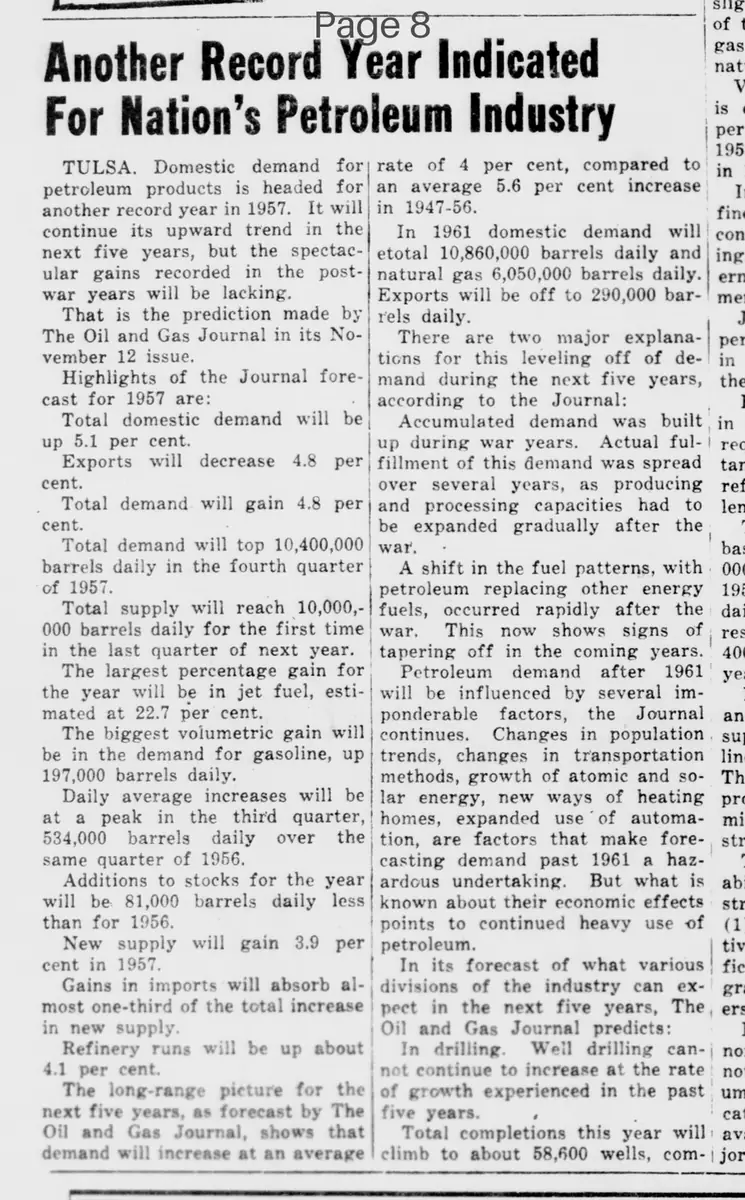
TULSA. Domestic demand for petroleum products is headed for another record year in 1957. It will continue its upward trend in the next five years, but the spectacular gains recorded in the post-war years will be lacking.
That is the prediction made by The Oil and Gas Journal in its November 12 issue.
Highlights of the Journal forecast for 1957 are:
Total domestic demand will be up 5.1 per cent.
Exports will decrease 4.8 per cent.
Total demand will gain 4.8 per cent.
Total demand will top 10,400,000 barrels daily in the fourth quarter of 1957.
Total supply will reach 10,000,000 barrels daily for the first time in the last quarter of next year.
The largest percentage gain for the year will be in jet fuel, estimated at 22.7 per cent.
The biggest volumetric gain will be in the demand for gasoline, up 197,000 barrels daily.
Daily average increases will be at a peak in the third quarter, 534,000 barrels daily over the same quarter of 1956.
Additions to stocks for the year will be 81,000 barrels daily less than for 1956.
New supply will gain 3.9 per cent in 1957.
Gains in imports will absorb almost one-third of the total increase in new supply.
Refinery runs will be up about 4.1 per cent.
The long-range picture for the next five years, as forecast by The Oil and Gas Journal, shows that demand will increase at an average rate of 4 per cent, compared to an average 5.6 per cent increase in 1947-56.
In 1961 domestic demand will total 10,860,000 barrels daily and natural gas 6,050,000 barrels daily.
Exports will be off to 290,000 barrels daily.
There are two major explanations for this leveling off of demand during the next five years, according to the Journal:
Accumulated demand was built up during war years. Actual fulfillment of this demand was spread over several years, as producing and processing capacities had to be expanded gradually after the war.
A shift in the fuel patterns, with petroleum replacing other energy fuels, occurred rapidly after the war.
This now shows signs of tapering off in the coming years.
Petroleum demand after 1961 will be influenced by several imponderable factors, the Journal continues,
Changes in population trends, changes in transportation methods, growth of atomic and solar energy, new ways of heating homes, expanded use of automation, are factors that make forecasting demand past 1961 a hazardous undertaking. But what is known about their economic effects points to continued heavy use of petroleum.
In its forecast of what various divisions of the industry can expect in the next five years, The Oil and Gas Journal predicts:
In drilling.
Well drilling cannot continue to increase at the rate of growth experienced in the past five years.
Total completions this year will climb to about 58,600 wells, compared to the total of 44,516 in 1951.
The rate of gain was 5.6 per cent a year for the five-year period.
If drilling were to increase at the same rate, total completions for 1973 would be 150,000 wells.
Total well completions from 1956 through 1973 would exceed all the 1,650,000 wells drilled since the Drake discovery.
Present outlook for drilling is for continuing increases but with smaller percentage gains per year.
Drillers may expect to drill 61,500 wells in 1957, cut 251,700,000 feet of hole. The annual drilling program will increase to 72,000 wells by 1961, with 308,200,000 feet of hole.
In production. Ratio of reserves to production is sliding. The over-all ratio is expected to decline slightly the next five years. Most of the reduction will be in natural gas with a smaller effect from natural-gas liquids.
Volume of new oil and gas found is expected to be 120,000 barrels per well in 1957, 118,000 barrels in 1958, and a dip to 114,000 barrels in 1961.
In refining. Big problem for refiners in the next five years will continue to be expanding processing. Processing plans will be governed by two expected developments in fuels:
Jet fuels will account for a fair percentage of the over-all increase in demand for motor fuels over the next five years.
Higher octane gasoline will be in great demand. As anti-knock requirements move above 100-octane for new cars on the road, the refiner will be faced with a problem.
Total capacity on a calendar day basis is expected to reach 10,000,000 barrels daily by the end of 1959, and almost 11,000,000 barrels daily by the end of 1961. This represents an addition of almost 2,400,000 barrels daily for the six-year period 1955-61.
In pipelining. Gas discoveries and potential gas markets could support four new major gas pipelines a year in the next five years.
This coupled with the growth of product lines adds up to an optimistic outlook for pipeline construction.
Two factors, besides pipe availability, may limit gas-pipeline construction over the next five years:
(1) A market for gas at competitive prices (2) Gas reserves sufficient to support a pipeline program to move the fuel to customers in high-demand areas.
But the potential market in the northern and eastern states has not been satisfied. And the volume of gas found each year indicates that the reserves will be available to support the four major pipelines a year.
What sub-type of article is it?
What keywords are associated?
What entities or persons were involved?
Where did it happen?
Story Details
Key Persons
Location
Tulsa
Event Date
1957
Story Details
Forecast indicates record petroleum demand in 1957 with 5.1% domestic increase, moderated growth to 1961, explanations for leveling off, and predictions for drilling, production, refining, and pipelining segments.