Thank you for visiting SNEWPapers!
Sign up free
The Key West Citizen
Key West, Monroe County, Florida
What is this article about?
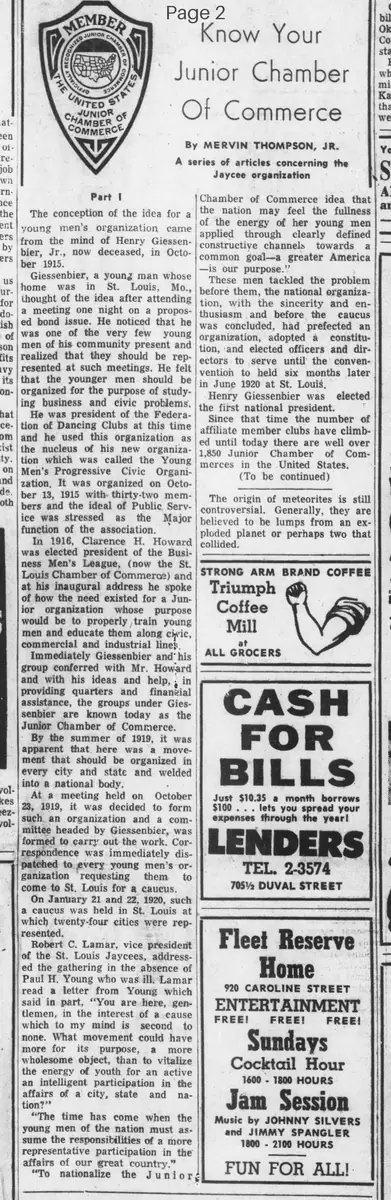
Henry Giessenbier Jr. conceived the idea for a young men's civic organization in St. Louis in October 1915, leading to the formation of the Young Men's Progressive Civic Organization. With support from Clarence H. Howard, it became the Junior Chamber of Commerce. By 1920, it was nationalized with over 1,850 affiliates today.
Merged-components note: Merged parts of the historical narrative on the Junior Chamber of Commerce, as it is a continued story on page 2.
Clipping
OCR Quality
Full Text
In 1916, Clarence H. Howard was elected president of the Business Men's League, (now the St. Louis Chamber of Commerce) and at his inaugural address he spoke of how the need existed for a Junior organization whose purpose would be to properly train young men and educate them along civic, commercial and industrial lines. Immediately Giessenbier and his group conferred with Mr. Howard and with his ideas and help, in providing quarters and financial assistance, the groups under Giessenbier are known today as the Junior Chamber of Commerce.
By the summer of 1919, it was apparent that here was a movement that should be organized in every city and state and welded into a national body. At a meeting held on October 23, 1919, it was decided to form such an organization and a committee headed by Giessenbier, was formed to carry out the work. Correspondence was immediately dispatched to every young men's organization requesting them to come to St. Louis for a caucus.
On January 21 and 22, 1920, such a caucus was held in St. Louis at which twenty-four cities were represented. Robert C. Lamar, vice president of the St. Louis Jaycees, addressed the gathering in the absence of Paul H. Young who was ill. Lamar read a letter from Young which said in part, "You are here, gentlemen, in the interest of a cause which to my mind is second to none. What movement could have more for its purpose, a more wholesome object, than to vitalize the energy of youth for an active an intelligent participation in the affairs of a city, state and nation?"
"The time has come when the young men of the nation must assume the responsibilities of a more representative participation in the affairs of our great country."
"To nationalize the Junior Chamber of Commerce idea that the nation may feel the fullness of the energy of her young men applied through clearly defined constructive channels towards a common goal--a greater America -is our purpose."
These men tackled the problem before them, the national organization, with the sincerity and enthusiasm and before the caucus was concluded, had perfected an organization, adopted a constitution, and elected officers and directors to serve until the convention to held six months later in June 1920 at St. Louis.
Henry Giessenbier was elected the first national president.
Since that time the number of affiliate member clubs have climbed until today there are well over 1,850 Junior Chambers of Commerce in the United States.
(To be continued)
What sub-type of article is it?
What themes does it cover?
What keywords are associated?
What entities or persons were involved?
Where did it happen?
Story Details
Key Persons
Location
St. Louis, Mo.
Event Date
October 1915 To June 1920
Story Details
Henry Giessenbier Jr. founded the Young Men's Progressive Civic Organization in St. Louis on October 13, 1915, emphasizing public service. Supported by Clarence H. Howard, it became the Junior Chamber of Commerce. Nationalized at a 1920 caucus in St. Louis, with Giessenbier as first president, growing to over 1,850 affiliates.