Thank you for visiting SNEWPapers!
Sign up free
Story
December 21, 1852
The Woodville Republican
Woodville, Wilkinson County, Mississippi
What is this article about?
Speculative article on comet collision risks with Earth, citing near-misses like Lexell's (1769-1779) and Biela's (1832) comets, potential for catastrophic flooding if comets are watery, and reflections on divine providence in the vast universe.
Clipping
OCR Quality
98%
Excellent
Full Text
Danger from Comets.
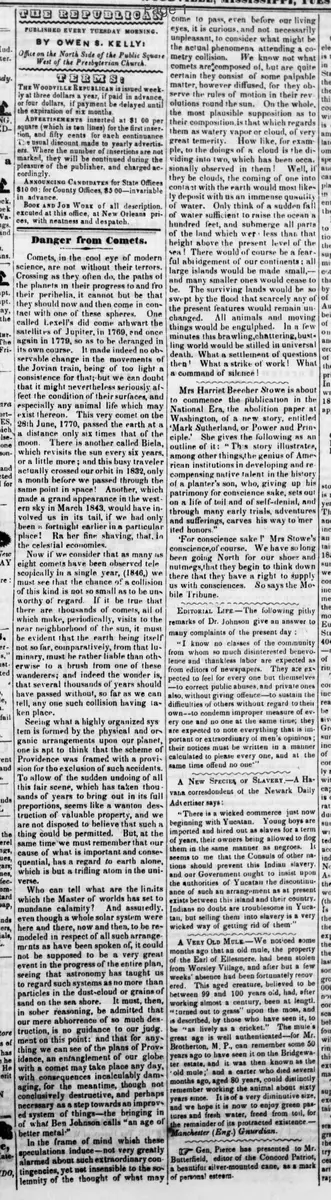
Comets, in the cool eve of modern science, are not without their terrors. Crossing as they often do, the paths of the planets in their progress to and fro their perihelia, it cannot but be that they should now and then come in contact with one of these spheres. One called Lexell's did come athwart the satellites of Jupiter, in 1769, and once again in 1779, so as to be deranged in its own course. It made indeed no observable change in the movements of the Jovian train, being of too light a consistence for that; but we can doubt that it might nevertheless seriously affect the condition of their surfaces, and especially any animal life which may exist thereon. This very comet on the 28th June, 1770, passed the earth at a distance only six times that of the moon. There is another called Biela, which revisits the sun every six years, or a little more; and this busy traveler actually crossed our orbit in 1832, only a month before we passed through the same point in space! Another, which made a grand appearance in the western sky in March 1843, would have involved us in its tail, if we had only been a fortnight earlier in a particular place! Rather fine shaving, that, in the celestial economies.
Now if we consider that as many as eight comets have been observed telescopically in a single year, (1846,) we must see that the chance of a collision of this kind is not so small as to be unworthy of regard. If it be true that there are thousands of comets, all of which make, periodically, visits to the near neighborhood of the sun, it must be evident that the earth being itself not so far, comparatively, from that luminary, must be rather liable than otherwise to a brush from one of these wanderers; and indeed the wonder is, that several thousands of years should have passed without, so far as we can tell, any one such collision having taken place.
Seeing what a highly organized system is formed by the physical and organic arrangements upon our planet, one is apt to think that the scheme of Providence was framed with a provision for the exclusion of such accidents. To allow of the sudden undoing of all this fair scene, which has taken thousands of years to bring out in its full proportions, seems like a wanton destruction of valuable property, and we are not disposed to believe that such a thing could be permitted. But, at the same time we must remember that our cause of what is important and consequential, has a regard to earth alone which is but a trifling atom in the universe.
Who can tell what are the limits which the Master of worlds has set to mundane calamity? And assuredly, even though a whole solar system were here and there, now and then, to be remodeled in respect of all such arrangements as have been spoken of, it could not be supposed to be a very great event in the progress of the entire plan, seeing that astronomy has taught us to regard such systems as no more than particles in the dust-cloud or grains of sand on the sea shore. It must, then, in sober reasoning, be admitted that our mere abhorrence of so much destruction, is no guidance to our judgment on this point: and that of any thing we can see of the plans of Providence, an entanglement of our globe with a comet may take place any day, with consequences incalculably damaging, or the meantime, though not conclusively destructive, and perhaps necessary as a step towards an improved system of things—the bringing in of what Ben Jonson calls "an age of better metal".
In the same frame of mind which these speculations induce—not very greatly alarmed about such extraordinary contingencies, yet not insensible to the solemnity of the thought of what may come to pass, even before our living eyes, it is curious, and not necessarily unpleasant, to consider what might be the actual phenomena attending a cometly collision. We know not what comets are composed of, but are quite certain they consist of some palpable matter, however diffused, for they observe the rules of motion in their revolutions round the sun. On the whole, the most plausible supposition as to their composition, is that which regards them as watery vapor or cloud, of very great tenuity. How like, for example, to the doings of a cloud is the dividing into two, which has been occasionally observed in them! Well, if they be clouds, the coming of one into contact with the earth would most likely deposit with us an immense quantity of water. Only think of a sudden fall of water sufficient to raise the ocean a hundred feet, and submerge all parts of the land which were less than that height above the present level of the sea! There would of course be a fearful abridgement of our continents: all large islands would be made small,—and many smaller ones would cease to be. The surviving lands would be so swept by the flood that scarcely any of the present features would remain unchanged. All animals and moving things would be engulfed. In a few minutes thus brawling, chattering, bustling world would be stilled in universal death. What a settlement of questions! What a strike of work! What a command of silence!
Comets, in the cool eve of modern science, are not without their terrors. Crossing as they often do, the paths of the planets in their progress to and fro their perihelia, it cannot but be that they should now and then come in contact with one of these spheres. One called Lexell's did come athwart the satellites of Jupiter, in 1769, and once again in 1779, so as to be deranged in its own course. It made indeed no observable change in the movements of the Jovian train, being of too light a consistence for that; but we can doubt that it might nevertheless seriously affect the condition of their surfaces, and especially any animal life which may exist thereon. This very comet on the 28th June, 1770, passed the earth at a distance only six times that of the moon. There is another called Biela, which revisits the sun every six years, or a little more; and this busy traveler actually crossed our orbit in 1832, only a month before we passed through the same point in space! Another, which made a grand appearance in the western sky in March 1843, would have involved us in its tail, if we had only been a fortnight earlier in a particular place! Rather fine shaving, that, in the celestial economies.
Now if we consider that as many as eight comets have been observed telescopically in a single year, (1846,) we must see that the chance of a collision of this kind is not so small as to be unworthy of regard. If it be true that there are thousands of comets, all of which make, periodically, visits to the near neighborhood of the sun, it must be evident that the earth being itself not so far, comparatively, from that luminary, must be rather liable than otherwise to a brush from one of these wanderers; and indeed the wonder is, that several thousands of years should have passed without, so far as we can tell, any one such collision having taken place.
Seeing what a highly organized system is formed by the physical and organic arrangements upon our planet, one is apt to think that the scheme of Providence was framed with a provision for the exclusion of such accidents. To allow of the sudden undoing of all this fair scene, which has taken thousands of years to bring out in its full proportions, seems like a wanton destruction of valuable property, and we are not disposed to believe that such a thing could be permitted. But, at the same time we must remember that our cause of what is important and consequential, has a regard to earth alone which is but a trifling atom in the universe.
Who can tell what are the limits which the Master of worlds has set to mundane calamity? And assuredly, even though a whole solar system were here and there, now and then, to be remodeled in respect of all such arrangements as have been spoken of, it could not be supposed to be a very great event in the progress of the entire plan, seeing that astronomy has taught us to regard such systems as no more than particles in the dust-cloud or grains of sand on the sea shore. It must, then, in sober reasoning, be admitted that our mere abhorrence of so much destruction, is no guidance to our judgment on this point: and that of any thing we can see of the plans of Providence, an entanglement of our globe with a comet may take place any day, with consequences incalculably damaging, or the meantime, though not conclusively destructive, and perhaps necessary as a step towards an improved system of things—the bringing in of what Ben Jonson calls "an age of better metal".
In the same frame of mind which these speculations induce—not very greatly alarmed about such extraordinary contingencies, yet not insensible to the solemnity of the thought of what may come to pass, even before our living eyes, it is curious, and not necessarily unpleasant, to consider what might be the actual phenomena attending a cometly collision. We know not what comets are composed of, but are quite certain they consist of some palpable matter, however diffused, for they observe the rules of motion in their revolutions round the sun. On the whole, the most plausible supposition as to their composition, is that which regards them as watery vapor or cloud, of very great tenuity. How like, for example, to the doings of a cloud is the dividing into two, which has been occasionally observed in them! Well, if they be clouds, the coming of one into contact with the earth would most likely deposit with us an immense quantity of water. Only think of a sudden fall of water sufficient to raise the ocean a hundred feet, and submerge all parts of the land which were less than that height above the present level of the sea! There would of course be a fearful abridgement of our continents: all large islands would be made small,—and many smaller ones would cease to be. The surviving lands would be so swept by the flood that scarcely any of the present features would remain unchanged. All animals and moving things would be engulfed. In a few minutes thus brawling, chattering, bustling world would be stilled in universal death. What a settlement of questions! What a strike of work! What a command of silence!
What sub-type of article is it?
Curiosity
Extraordinary Event
Disaster
What themes does it cover?
Catastrophe
Providence Divine
Fate Providence
What keywords are associated?
Comet Collision
Astronomical Peril
Divine Providence
Global Flood
Near Misses
Where did it happen?
Solar System, Earth
Story Details
Location
Solar System, Earth
Story Details
Speculation on comet collisions with planets and Earth, including historical near-misses with Lexell's comet (1769, 1779, 1770), Biela's (1832), and others (1843, 1846), positing comets as watery clouds that could cause global flooding and extinction, while considering divine providence in cosmic scale.