Thank you for visiting SNEWPapers!
Sign up free
The National Intelligencer And Washington Advertiser
Washington, District Of Columbia
What is this article about?
On January 20, 1808, the U.S. Senate debated a resolution to summon witnesses Elias Glover and William M'Farland to testify in the case of Senator John Smith's alleged involvement in Aaron Burr's conspiracy. Proponents argued for natural justice and cross-examination; opponents cited lack of Senate power and funding issues. The resolution failed 7-23.
Clipping
OCR Quality
Full Text
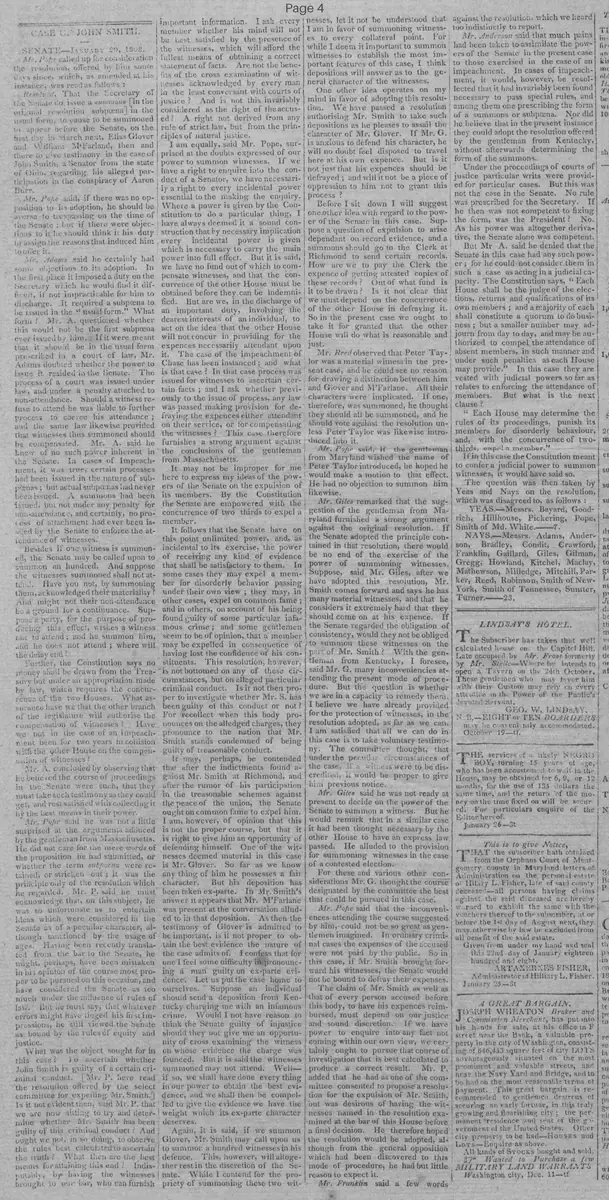
SENATE—JANUARY 20, 1808.
Mr. Porter called up for consideration the resolution, offered by him some days since, which, as amended at his instance, was read as follows:
Resolved, That the Secretary of the Senate do issue a summons [in the original resolution subpoena] in the usual form, to cause to be summoned to appear before the Senate, on the first day in March next, Elias Glover and William M'Farland, then and there to give testimony in the case of John Smith, a Senator from the state of Ohio, regarding his alleged participation in the conspiracy of Aaron Burr.
Mr. Pope said, if there was no opposition to its adoption, he should be averse to trespassing on the time of the Senate; but if there were objections to it he should think it his duty to assign the reasons that induced him to offer it.
Mr. Adams said he certainly had some objections to its adoption. In the first place it imposed a duty on the Secretary which he would find it difficult, if not impracticable for him to discharge. It required a subpoena to be issued in the "usual form." What form? Mr. A. questioned whether this would not be the first subpoena ever issued by him. If it were meant that it should be in the usual form prescribed in a court of law, Mr. Adams doubted whether the power to issue it resided in the Senate. The process of a court was issued under law, and under a penalty attached to non-attendance. Should a witness refuse to attend he was liable to further process to coerce his attendance; and the same law likewise provided that witnesses thus summoned should be compensated. Mr. A. said he knew of no such power inherent in the Senate. In cases of Impeachment, it was true, certain processes had been issued in the nature of subpoenas; but actual subpoenas had never been issued. A summons had been issued, but not under any penalty for non-attendance, and certainly, no process of attachment had ever been issued by the Senate to enforce the attendance of witnesses.
Besides if one witness is summoned, the Senate may be called upon to summon an hundred. And suppose the witnesses summoned shall not attend. Have you not, by summoning them, acknowledged their materiality? And might not their non-attendance be a ground for a continuance. Suppose a party, for the purpose of producing this effect, wishes a witness not to attend; and he summon him, and he does not attend; where will the delay end?
Further, the Constitution says no money shall be drawn from the Treasury but under an appropriation made by law, which requires the concurrence of the two Houses. What assurance have we that the other branch of the legislature will authorise the compensation of witnesses? Have we not in the case of an Impeachment been for two years in collision with the other House on the compensation of witnesses?
Mr. A. concluded by observing that he believed the course of proceedings in the Senate were such, that they must take such testimony as they could get, and rest satisfied with collecting it by the best means in their power.
Mr. Pope said he was not a little surprised at the arguments adduced by the gentleman from Massachusetts. He did not care for the mere words of the proposition he had submitted, or whether the term subpoena were retained, or stricken out; it was the principle only of the resolution which he regarded. Mr. P. said he must acknowledge that, on this subject, he was so unfortunate as to entertain ideas which were considered in the Senate as of a peculiar character, although sanctioned by the usage of ages. Having been recently translated from the bar to the Senate, he might, perhaps, have been mistaken in his opinion of the course most proper to be pursued on this occasion, and have considered the Senate as too much under the influence of rules of law. But he must say, that whatever errors might have tinged his first impressions, he still viewed the Senate as bound by the rules of equity and justice.
What was the object sought for in this case? To ascertain whether John Smith is guilty of a certain criminal conduct. Mr. P. here read the resolution offered by the select committee for expelling Mr. Smith.
Is it not evident then, said Mr. P. that we are now sitting to try and determine whether Mr. Smith has been guilty of this criminal conduct? And ought we not, in so doing, to observe the rules best calculated to ascertain the truth? What then are the best means for attaining this end? Indisputably, by having the witnesses brought to our bar, who can furnish important information. I ask every member whether his mind will not be best satisfied by the presence of the witnesses, which will afford the fullest means of obtaining a correct statement of facts. Are not the benefits of the cross examination of witnesses acknowledged by every man in the least conversant with courts of justice? And is not this invariably considered as the right of the accused? A right not derived from any rule of strict law, but from the principles of natural justice.
I am equally, said Mr. Pope, surprised at the doubts expressed of our power to summon witnesses. If we have a right to enquire into the conduct of a Senator, we have necessarily a right to every incidental power essential to the making the enquiry. Where a power is given by the Constitution to do a particular thing, I have always deemed it a sound construction that by necessary implication every incidental power is given which is necessary to carry the main power into full effect. But it is said, we have no fund out of which to compensate witnesses, and that the concurrence of the other House must be obtained before they can be indemnified. But are we, in the discharge of an important duty, involving the dearest interests of an individual, to act on the idea that the other House will not concur in providing for the expences necessarily attendant upon it. The case of the impeachment of Chase has been instanced; and what is that case? In that case process was issued for witnesses to ascertain certain facts; and I ask whether previously to the issue of process, any law was passed making provision for defraying the expences either attendant on their service, or for compensating the witnesses? This case therefore furnishes a strong argument against the conclusions of the gentleman from Massachusetts.
It may not be improper for me here to express my ideas of the powers of the Senate on the expulsion of its members. By the Constitution the Senate are empowered with the concurrence of two thirds to expel a member.
It follows that the Senate have on this point unlimited power, and, as incidental to its exercise, the power of receiving any kind of evidence that shall be satisfactory to them. In some cases they may expel a member for disorderly behavior passing under their own view; they may, in other cases, expel on common fame; and in others, on account of his being found guilty of some particular infamous crime; and some gentlemen seem to be of opinion, that a member may be expelled in consequence of having lost the confidence of his constituents. This resolution, however, is not bottomed on any of these circumstances, but on alleged particular criminal conduct. Is it not then proper to investigate whether Mr. S. has been guilty of this conduct or not? For recollect when this body pronounces on the alledged charges, they pronounce to the nation that Mr. Smith stands condemned of being guilty of treasonable conduct.
It may, perhaps, be contended that after the indictments found against Mr. Smith at Richmond, and after the rumor of his participation in the treasonable schemes against the peace of the union, the Senate ought on common fame to expel him. I am, however, of opinion that this is not the proper course, but that it is right to give him an opportunity of defending himself. One of the witnesses deemed material in this case is Mr. Glover. So far as we know any thing of him he possesses a fair character. But his deposition has been taken ex-parte. In Mr. Smith's answer it appears that Mr. M'Farlane was present at the conversation alluded to in that deposition. As then the testimony of Glover is admitted to be important, is it not proper to obtain the best evidence the nature of the case admits of. I confess that for one I feel some difficulty in pronouncing a man guilty on ex-parte evidence. Let us put the case home to ourselves. Suppose an individual should send a deposition from Kentucky charging me with an infamous crime. Would I not have reason to think the Senate guilty of injustice should they not give me an opportunity of cross examining the witness on whose evidence the charge was founded. But it is said the witnesses summoned may not attend. Well—if so, we shall have done every thing in our power to obtain the best evidence, and we shall then be compelled to give the evidence we have the weight which its ex-parte character deserves.
Again, it is said, if we summon Glover, Mr. Smith may call upon us to summon a hundred witnesses in his defence. This, however, will altogether rest in the discretion of the Senate. While I contend for the propriety of summoning these two witnesses, let it not be understood that I am in favor of summoning witnesses to every collateral point. For while I deem it important to summon witnesses to establish the most important features of this case, I think depositions will answer as to the general character of the witnesses.
One other idea operates on my mind in favor of adopting this resolution. We have passed a resolution authorising Mr. Smith to take such depositions as he pleases to assail the character of Mr. Glover. If Mr. G. is anxious to defend his character, he will no doubt feel disposed to travel here at his own expence. But is it not just that his expences should be defrayed; and will it not be a piece of oppression to him not to grant this process?
Before I sit down I will suggest one other idea with regard to the power of the Senate in this case. Suppose a question of expulsion to arise dependant on record evidence, and a summons should go to the Clerk at Richmond to send certain records. How are we to pay the Clerk the expence of getting attested copies of these records? Out of what fund is it to be drawn? Is it not clear that we must depend on the concurrence of the other House in defraying it. So in the present case we ought to take it for granted that the other House will do what is reasonable and just.
Mr. Reed observed that Peter Taylor was a material witness in the present case, and he could see no reason for drawing a distinction between him and Glover and M'Farlane. All their characters were implicated. If one, therefore, was summoned, he thought they should all be summoned, and he should vote against the resolution unless Peter Taylor was likewise introduced into it.
Mr. Pope said, if the gentleman from Maryland wished the name of Peter Taylor introduced, he hoped he would make a motion to that effect. He had no objection to summon him likewise.
Mr. Giles remarked that the suggestion of the gentleman from Maryland furnished a strong argument against the original resolution. If the Senate adopted the principle contained in that resolution, there would be no end of the exercise of the power of summoning witnesses. Suppose, said Mr. Giles, after we have adopted this resolution, Mr. Smith comes forward and says he has many material witnesses, and that he considers it extremely hard that they should come on at his expence. If the Senate regarded the obligation of consistency, would they not be obliged to summon these witnesses on the part of Mr. Smith? With the gentleman from Kentucky, I foresee, said Mr. G. many inconveniencies attending the present mode of procedure. But the question is whether we are in a capacity to remedy them. I believe we have already provided for the protection of witnesses, in the resolution adopted, as far as we can. I am satisfied that all we can do in this case is to take voluntary testimony. The committee thought, that under the peculiar circumstances of the case, if a witness were to be discredited, it would be proper to give him previous notice.
Mr. Giles said he was not ready at present to decide on the power of the Senate to summon a witness. But he would remark that in a similar case it had been thought necessary by the other House to have an express law passed. He alluded to the provision for summoning witnesses in the case of a contested election.
For these and various other considerations Mr. G. thought the course designated by the committee the best that could be pursued in this case.
Mr. Pope said that the inconveniences attending the course suggested by him, could not be so great as gentlemen imagined. In ordinary criminal cases the expenses of the accused were not paid by the public. So in this case, if Mr. Smith brought forward his witnesses, the Senate would not be bound to defray their expenses. The claim of Mr. Smith as well as that of every person accused before this body, to have his expences reimbursed, must depend on our justice and sound discretion. If we have power to enquire into any fact not coming within our own view, we certainly ought to pursue that course of investigation that is best calculated to produce a correct result. Mr. P. added that he had as one of the committee consented to propose a resolution for the expulsion of Mr. Smith, but was desirous of having the witnesses named in the resolution examined at the bar of this House before a final decision. He therefore hoped the resolution would be adopted, although from the general opposition which had been discovered to this mode of procedure, he had but little reason to expect it.
Mr. Franklin said a few words against the resolution, which we heard too indistinctly to report.
Mr. Anderson said that much pains had been taken to assimilate the powers of the Senate in the present case to those exercised in the case of an impeachment. In cases of impeachment, it would, however, be recollected that it had invariably been found necessary to pass special rules, and among them one prescribing the form of a summons or subpoena. Nor did he believe that in the present instance they could adopt the resolution offered by the gentleman from Kentucky, without afterwards determining the form of the summons.
Under the proceedings of courts of justice particular writs were provided for particular cases. But this was not the case in the Senate. No rule was prescribed for the Secretary. If he then was not competent to fixing the form, was the President? No. As his power was altogether derivative, the Senate alone was competent. But Mr A. said he denied that the Senate in this case had any such power; for he could not consider them in such a case as acting in a judicial capacity. The Constitution says, "Each House shall be the judge of the elections, returns and qualifications of its own members; and a majority of each shall constitute a quorum to do business; but a smaller number may adjourn from day to day, and may be authorized to compel the attendance of absent members, in such manner and under such penalties as each House may provide." In this case they are vested with judicial powers so far as relates to enforcing the attendance of members. But what is the next clause?
"Each House may determine the rules of its proceedings, punish its members for disorderly behaviour, and, with the concurrence of two-thirds, expel a member."
If in this case the Constitution meant to confer a judicial power to summon witnesses, it would have said so.
The question was then taken by Yeas and Nays on the resolution, which was disagreed to, as follows:
YEAS.—Messrs. Bayard, Goodrich, Hillhouse, Pickering, Pope, Smith of Md. White.—7.
NAYS.—Messrs. Adams, Anderson, Bradley, Condit, Crawford, Franklin, Gaillard, Giles, Gilman, Gregg, Howland, Kitchel, Maclay, Mathewson, Milledge, Mitchill, Parker, Reed, Robinson, Smith of New York, Smith of Tennessee, Sumter, Turner.—23.
What sub-type of article is it?
What themes does it cover?
What keywords are associated?
What entities or persons were involved?
Where did it happen?
Story Details
Key Persons
Location
Senate
Event Date
January 20, 1808
Story Details
Debate on resolution to summon witnesses Elias Glover and William M'Farland (and possibly Peter Taylor) to testify before the Senate on March 1 regarding Senator John Smith's alleged role in Aaron Burr's conspiracy, for potential expulsion. Supporters emphasized equity, cross-examination, and incidental powers; opponents questioned Senate authority, subpoena form, enforcement, and funding without House concurrence. Resolution rejected 7-23.