Thank you for visiting SNEWPapers!
Sign up free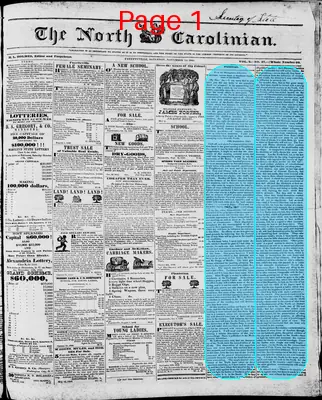
Editorial
November 14, 1840
The North Carolinian
Fayetteville, Cumberland County, North Carolina
What is this article about?
A Southern gentleman's 1840 letter from the North urges Southern Democrats to support Van Buren in the presidential election, highlighting Northern Democratic efforts against abolition, tariffs, and banks at a massive Poughkeepsie rally, warning of Whig alliances with abolitionists threatening Southern rights.
Clipping
OCR Quality
95%
Excellent
Full Text
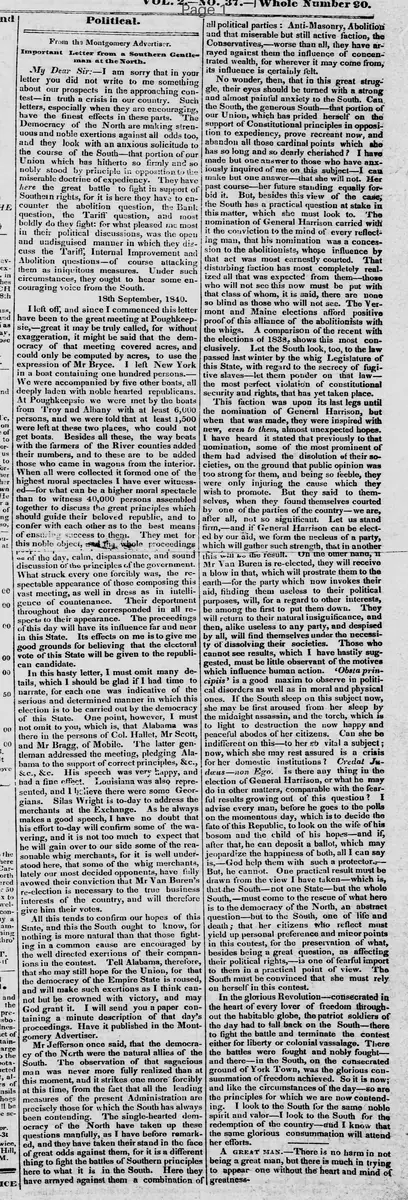
Political.
From the Montgomery Advertiser.
Important Letter from a Southern Gentleman at the North,
My Dear Sir:--I am sorry that in your letter you did not write to me something about our prospects in the approaching contest--in truth a crisis in our country. Such letters, especially when they are encouraging, have the finest effects in these parts. The Democracy of the North are making strenuous and noble exertions against all odds too, and they look with an anxious solicitude to the course of the South---that portion of our Union which has hitherto so firmly and so nobly stood by principle in opposition to the miserable doctrine of expediency. They have here the great battle to fight in support of Southern rights, for it is here they have to encounter the abolition question, the Bank question, the Tariff question, and most boldly do they fight: for what pleased me most in their political discussions, was the open and undisguised manner in which they discuss the Tariff, Internal Improvement and Abolition questions--of course attacking them as iniquitous measures. Under such circumstances, they ought to hear some encouraging voice from the South.
18th September, 1840.
I left off, and since I commenced this letter have been to the great meeting at Poughkeepsie,--great it may be truly called, for without exaggeration, it might be said that the democracy of that meeting covered acres, and could only be computed by acres, to use the expression of Mr Bryce. I left New York in a boat containing one hundred persons.-- We were accompanied by five other boats, all deeply laden with noble hearted republicans. At Poughkeepsie we were met by the boats from Troy and Albany with at least 6,000 persons, and we were told that at least 1,500 were left at these two places, who could not get boats. Besides all these, the way boats with the farmers of the River counties added their numbers, and to these are to be added those who came in wagons from the interior. When all were collected it formed one of the highest moral spectacles I have ever witnessed--for what can be a higher moral spectacle than to witness 40,000 persons assembled together to discuss the great principles which should guide their beloved republic, and to confer with each other as to the best means of ensuring success to them. They met for this noble object, and the whole proceedings of the day, calm, dispassionate, and sound discussion of the principles of the government.
What struck every one forcibly was, the respectable appearance of those composing this vast meeting, as well in dress as in intelligence of countenance.
Their deportment
throughout the day corresponded in all respects to their appearance. The proceedings of this day will have its influence far and near in this State. Its effects on me is to give me good grounds for believing that the electoral vote of this State will be given to the republican candidate.
In this hasty letter, I must omit many details, which I should be glad if I had time to narrate, for each one was indicative of the serious and determined manner in which this election is to be carried out by the democracy of this State. One point, however, I must not omit to you, which is, that Alabama was there in the persons of Col. Hallet, Mr Scott, and Mr Bragg, of Mobile. The latter gentleman addressed the meeting, pledging Alabama to the support of correct principles, &c., &c., &c. His speech was very happy, and had a fine effect. Louisiana was also represented, and I believe there were some Georgians. Silas Wright is to-day to address the merchants at the Exchange. As he always makes a good speech, I have no doubt that his effort to-day will confirm some of the wavering, and it is not too much to expect that he will gain over to our side some of the reasonable whig merchants, for it is well understood here, that some of the whig merchants, lately our most decided opponents, have fully avowed their conviction that Mr Van Buren's re-election is necessary to the true business interests of the country, and will therefore give him their votes.
All this tends to confirm our hopes of this State, and this the South ought to know, for nothing is more natural than that those fighting in a common cause are encouraged by the well directed exertions of their companions in the contest. Tell Alabama, therefore, that she may still hope for the Union, for that the democracy of the Empire State is roused, and will make such exertions as I think cannot but be crowned with victory, and may God grant it. I will send you a paper containing a minute description of that day's proceedings. Have it published in the Montgomery Advertiser.
Mr Jefferson once said, that the democracy of the North were the natural allies of the South. The observation of that sagacious man was never more fully realized than at this moment, and it strikes one more forcibly at this time, from the fact that all the leading measures of the present Administration are precisely those for which the South has always been contending. The single-hearted democracy of the North have taken up these questions manfully, as I have before remarked, and they have taken their stand in the face of great odds against them, for it is a different thing to fight the battles of Southern principles here to what it is in the South. Here they have arrayed against them a combination of all political parties : Anti-Masonry, Abolition and that miserable but still active faction, the Conservatives,--worse than all, they have arrayed against them the influence of concentrated wealth, for wherever it may come from, its influence is certainly felt.
No wonder, then, that in this great struggle, their eyes should be turned with a strong and almost painful anxiety to the South. Can the South, the generous South--that portion of our Union, which has prided herself on the support of Constitutional principles in opposition to expediency, prove recreant now, and abandon all those cardinal points which she has so long and so dearly cherished ? I have made but one answer to those who have anxiously inquired of me on this subject--I can make but one answer--that she will not. Her past course--her future standing equally forbid it. But, besides this view of the case; the South has a practical question at stake in this matter, which she must look to. The nomination of General Harrison carried with it the conviction to the mind of every reflecting man, that his nomination was a concession to the abolitionists, whose influence by that act was most earnestly courted. That disturbing faction has most completely realized all that was expected from them--those who will not see this now must be put with that class of whom, it is said, there are none so blind as those who will not see. The Vermont and Maine elections afford positive proof of this alliance of the abolitionists with the whigs. A comparison of the recent with the elections of 1836 shows this most conclusively. Let the South look, too, to the law passed last winter by the whig Legislature of this State, with regard to the secrecy of fugitive slaves--let them ponder on that law-- the most perfect violation of constitutional security and rights, that has yet taken place.
This faction was upon its last legs until the nomination of General Harrison, but when that was made, they were inspired with new, even to them, almost unexpected hopes. I have heard it stated that previously to that nomination, some of the most prominent of them had advised the dissolution of their societies, on the ground that public opinion was too strong for them, and being so feeble, they were only injuring the cause which they wish to promote. But they said to themselves, when they found themselves courted by one of the parties of the country--we are, after all, not so insignificant: Let us stand firm,--and if General Harrison can be elected by our aid, we form the nucleus of a party, which will gather such strength, that in another four years, this will be the result. On the other hand, if Mr Van Buren is re-elected, they will receive a blow in that, which will prostrate them to the earth--for the party which now invokes their aid, finding them useless to their political purposes, will, for a regard to other interests, be among the first to put them down. They will return to their natural insignificance, and then, alike useless to any party, and despised by all, will find themselves under the necessity of dissolving their societies. Those who cannot see results, which I have hastily suggested, must be little observant of the motives which influence human action. 'Obsta principiis' is a good maxim to observe in political disorders as well as in moral and physical ones. If the South sleep on this subject now, she may be first aroused from her sleep by the midnight assassin, and the torch, which is to light to destruction the now happy and peaceful abodes of her citizens. Can she be indifferent on this--to her so vital a subject; now, which she may rest assured is a crisis for her domestic institutions? Credat Judæus--non Ego. Is there any thing in the election of General Harrison, or what he may do in other matters, comparable with the fearful results growing out of this question? I advise every man, before he goes to the polls on the momentous day, which is to decide the fate of this Republic, to look on the wife of his bosom and the child of his hopes--and if, after that, he can deposit a ballot, which may jeopardize the happiness of both, all I can say is,--God help them with such a protector.-- But, he cannot. One practical result must be drawn from the view I have taken--which is, that the South--not one State--but the whole South, -must come to the rescue of what here is to the democracy of the North, an abstract question--but to the South, one of life and death; that her citizens who reflect must yield up personal preference and minor points in this contest, for the preservation of what. besides being a great question, as affecting their political rights,--is one of fearful import to them in a practical point of view. The South must be convinced that she must rely on herself in this contest.
In the glorious Revolution--consecrated in the heart of every lover of freedom throughout the habitable globe, the patriot soldiers of the day had to fall back on the South--there to fight the battle and terminate the contest either for liberty or colonial vassalage. There the battles were fought and nobly fought--- and there--in the South, on the consecrated ground of York Town, was the glorious consummation of freedom achieved. So it is now; and like the circumstances of the day--so are the principles for which we are now contending. I look to the South for the same noble spirit and valor--I look to the South for the redemption of the country--and I know that the same glorious consummation will attend her efforts.
A GREAT MAN.--There is no harm in not being a great man, but there is much in trying to appear one without the heart and mind of greatness--
From the Montgomery Advertiser.
Important Letter from a Southern Gentleman at the North,
My Dear Sir:--I am sorry that in your letter you did not write to me something about our prospects in the approaching contest--in truth a crisis in our country. Such letters, especially when they are encouraging, have the finest effects in these parts. The Democracy of the North are making strenuous and noble exertions against all odds too, and they look with an anxious solicitude to the course of the South---that portion of our Union which has hitherto so firmly and so nobly stood by principle in opposition to the miserable doctrine of expediency. They have here the great battle to fight in support of Southern rights, for it is here they have to encounter the abolition question, the Bank question, the Tariff question, and most boldly do they fight: for what pleased me most in their political discussions, was the open and undisguised manner in which they discuss the Tariff, Internal Improvement and Abolition questions--of course attacking them as iniquitous measures. Under such circumstances, they ought to hear some encouraging voice from the South.
18th September, 1840.
I left off, and since I commenced this letter have been to the great meeting at Poughkeepsie,--great it may be truly called, for without exaggeration, it might be said that the democracy of that meeting covered acres, and could only be computed by acres, to use the expression of Mr Bryce. I left New York in a boat containing one hundred persons.-- We were accompanied by five other boats, all deeply laden with noble hearted republicans. At Poughkeepsie we were met by the boats from Troy and Albany with at least 6,000 persons, and we were told that at least 1,500 were left at these two places, who could not get boats. Besides all these, the way boats with the farmers of the River counties added their numbers, and to these are to be added those who came in wagons from the interior. When all were collected it formed one of the highest moral spectacles I have ever witnessed--for what can be a higher moral spectacle than to witness 40,000 persons assembled together to discuss the great principles which should guide their beloved republic, and to confer with each other as to the best means of ensuring success to them. They met for this noble object, and the whole proceedings of the day, calm, dispassionate, and sound discussion of the principles of the government.
What struck every one forcibly was, the respectable appearance of those composing this vast meeting, as well in dress as in intelligence of countenance.
Their deportment
throughout the day corresponded in all respects to their appearance. The proceedings of this day will have its influence far and near in this State. Its effects on me is to give me good grounds for believing that the electoral vote of this State will be given to the republican candidate.
In this hasty letter, I must omit many details, which I should be glad if I had time to narrate, for each one was indicative of the serious and determined manner in which this election is to be carried out by the democracy of this State. One point, however, I must not omit to you, which is, that Alabama was there in the persons of Col. Hallet, Mr Scott, and Mr Bragg, of Mobile. The latter gentleman addressed the meeting, pledging Alabama to the support of correct principles, &c., &c., &c. His speech was very happy, and had a fine effect. Louisiana was also represented, and I believe there were some Georgians. Silas Wright is to-day to address the merchants at the Exchange. As he always makes a good speech, I have no doubt that his effort to-day will confirm some of the wavering, and it is not too much to expect that he will gain over to our side some of the reasonable whig merchants, for it is well understood here, that some of the whig merchants, lately our most decided opponents, have fully avowed their conviction that Mr Van Buren's re-election is necessary to the true business interests of the country, and will therefore give him their votes.
All this tends to confirm our hopes of this State, and this the South ought to know, for nothing is more natural than that those fighting in a common cause are encouraged by the well directed exertions of their companions in the contest. Tell Alabama, therefore, that she may still hope for the Union, for that the democracy of the Empire State is roused, and will make such exertions as I think cannot but be crowned with victory, and may God grant it. I will send you a paper containing a minute description of that day's proceedings. Have it published in the Montgomery Advertiser.
Mr Jefferson once said, that the democracy of the North were the natural allies of the South. The observation of that sagacious man was never more fully realized than at this moment, and it strikes one more forcibly at this time, from the fact that all the leading measures of the present Administration are precisely those for which the South has always been contending. The single-hearted democracy of the North have taken up these questions manfully, as I have before remarked, and they have taken their stand in the face of great odds against them, for it is a different thing to fight the battles of Southern principles here to what it is in the South. Here they have arrayed against them a combination of all political parties : Anti-Masonry, Abolition and that miserable but still active faction, the Conservatives,--worse than all, they have arrayed against them the influence of concentrated wealth, for wherever it may come from, its influence is certainly felt.
No wonder, then, that in this great struggle, their eyes should be turned with a strong and almost painful anxiety to the South. Can the South, the generous South--that portion of our Union, which has prided herself on the support of Constitutional principles in opposition to expediency, prove recreant now, and abandon all those cardinal points which she has so long and so dearly cherished ? I have made but one answer to those who have anxiously inquired of me on this subject--I can make but one answer--that she will not. Her past course--her future standing equally forbid it. But, besides this view of the case; the South has a practical question at stake in this matter, which she must look to. The nomination of General Harrison carried with it the conviction to the mind of every reflecting man, that his nomination was a concession to the abolitionists, whose influence by that act was most earnestly courted. That disturbing faction has most completely realized all that was expected from them--those who will not see this now must be put with that class of whom, it is said, there are none so blind as those who will not see. The Vermont and Maine elections afford positive proof of this alliance of the abolitionists with the whigs. A comparison of the recent with the elections of 1836 shows this most conclusively. Let the South look, too, to the law passed last winter by the whig Legislature of this State, with regard to the secrecy of fugitive slaves--let them ponder on that law-- the most perfect violation of constitutional security and rights, that has yet taken place.
This faction was upon its last legs until the nomination of General Harrison, but when that was made, they were inspired with new, even to them, almost unexpected hopes. I have heard it stated that previously to that nomination, some of the most prominent of them had advised the dissolution of their societies, on the ground that public opinion was too strong for them, and being so feeble, they were only injuring the cause which they wish to promote. But they said to themselves, when they found themselves courted by one of the parties of the country--we are, after all, not so insignificant: Let us stand firm,--and if General Harrison can be elected by our aid, we form the nucleus of a party, which will gather such strength, that in another four years, this will be the result. On the other hand, if Mr Van Buren is re-elected, they will receive a blow in that, which will prostrate them to the earth--for the party which now invokes their aid, finding them useless to their political purposes, will, for a regard to other interests, be among the first to put them down. They will return to their natural insignificance, and then, alike useless to any party, and despised by all, will find themselves under the necessity of dissolving their societies. Those who cannot see results, which I have hastily suggested, must be little observant of the motives which influence human action. 'Obsta principiis' is a good maxim to observe in political disorders as well as in moral and physical ones. If the South sleep on this subject now, she may be first aroused from her sleep by the midnight assassin, and the torch, which is to light to destruction the now happy and peaceful abodes of her citizens. Can she be indifferent on this--to her so vital a subject; now, which she may rest assured is a crisis for her domestic institutions? Credat Judæus--non Ego. Is there any thing in the election of General Harrison, or what he may do in other matters, comparable with the fearful results growing out of this question? I advise every man, before he goes to the polls on the momentous day, which is to decide the fate of this Republic, to look on the wife of his bosom and the child of his hopes--and if, after that, he can deposit a ballot, which may jeopardize the happiness of both, all I can say is,--God help them with such a protector.-- But, he cannot. One practical result must be drawn from the view I have taken--which is, that the South--not one State--but the whole South, -must come to the rescue of what here is to the democracy of the North, an abstract question--but to the South, one of life and death; that her citizens who reflect must yield up personal preference and minor points in this contest, for the preservation of what. besides being a great question, as affecting their political rights,--is one of fearful import to them in a practical point of view. The South must be convinced that she must rely on herself in this contest.
In the glorious Revolution--consecrated in the heart of every lover of freedom throughout the habitable globe, the patriot soldiers of the day had to fall back on the South--there to fight the battle and terminate the contest either for liberty or colonial vassalage. There the battles were fought and nobly fought--- and there--in the South, on the consecrated ground of York Town, was the glorious consummation of freedom achieved. So it is now; and like the circumstances of the day--so are the principles for which we are now contending. I look to the South for the same noble spirit and valor--I look to the South for the redemption of the country--and I know that the same glorious consummation will attend her efforts.
A GREAT MAN.--There is no harm in not being a great man, but there is much in trying to appear one without the heart and mind of greatness--
What sub-type of article is it?
Partisan Politics
Slavery Abolition
Economic Policy
What keywords are associated?
1840 Election
Van Buren Support
Southern Rights
Anti Abolition
Poughkeepsie Meeting
Democratic Party
Whig Alliance
Tariff Opposition
What entities or persons were involved?
Van Buren
General Harrison
Silas Wright
Col. Hallet
Mr Scott
Mr Bragg
Alabama
South
Northern Democracy
Whigs
Abolitionists
Editorial Details
Primary Topic
Urging Southern Support For Van Buren Against Harrison And Abolitionists In 1840 Election
Stance / Tone
Strongly Pro Democratic And Pro Southern Rights, Anti Whig And Anti Abolitionist
Key Figures
Van Buren
General Harrison
Silas Wright
Col. Hallet
Mr Scott
Mr Bragg
Alabama
South
Northern Democracy
Whigs
Abolitionists
Key Arguments
Northern Democrats Are Fighting Bravely For Southern Rights Against Abolition, Bank, And Tariff Issues
The Poughkeepsie Meeting Demonstrates Strong Democratic Support In New York
Harrison's Nomination Is A Concession To Abolitionists, Endangering Southern Institutions
Southern Unity Is Crucial To Defeat Whigs And Protect Domestic Interests
Re Election Of Van Buren Will Weaken Abolitionists And Preserve The Union