Thank you for visiting SNEWPapers!
Sign up free
Editorial
February 4, 1795
Gazette Of The United States And Daily Evening Advertiser
Philadelphia, Philadelphia County, Pennsylvania
What is this article about?
In 1795 Philadelphia, bottled porter vendors led by Ben. W. Morris and Charles Robertson defend their right to source from multiple American brewers against Robert Hare's exclusive supply contracts, promoting competition in home manufacturing to reduce imports and benefit the community.
Clipping
OCR Quality
95%
Excellent
Full Text
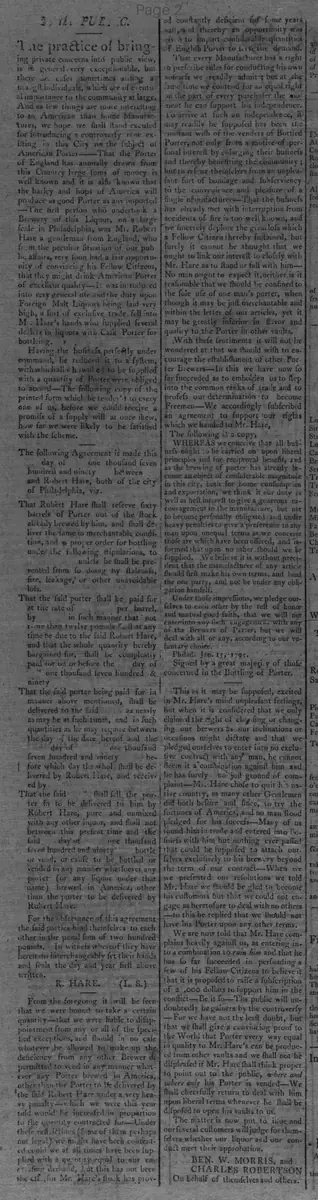
The practice of bringing private concerns into public view, is in general very exceptionable, but there are cases sometimes arising among individuals, which are of eventual importance to the community at large. And as few things are more interesting to an American than home Manufactures, we hope we shall stand excused for introducing a controversy now existing in this City on the subject of American Porter—That the Porter of England has annually drawn from this Country large sums of money is well known and it is also known that the barley and hops of America will produce as good Porter as any imported.—The first person who undertook a Brewery of this Liquor, on a large Scale in Philadelphia, was Mr. Robert Hare a gentleman from England, who from the peculiar situation of our public affairs, very soon had a fair opportunity of convincing his Fellow Citizens, that they might drink American Porter of excellent quality-It was introduced into very general use and the duty upon Foreign Malt Liquors being laid very high, a sort of exclusive trade fell into Mr. Hare's hands who supplied several dealers in liquors with Cask Porter for bottling. Having the business perfectly under command, he reduced it to a system, with which all who, will be supplied with a quantity of Porter were obliged to accord—The following copy of the printed form which he tendered to every one of us, before we could receive a promise of a supply will at once show, how far we were likely to be satisfied with the scheme.
The following Agreement is made this day of one thousand seven hundred and ninety five between and Robert Hare, both of the city of Philadelphia, viz. That Robert Hare shall reserve sixty barrels of Porter out of the stock already brewed by him, and shall deliver the same in merchantable condition, and in proper order for bottling under the following stipulations, to unless he shall be prevented from so doing by sickness, fire, leakage, or other unavoidable loss. That the said porter shall be paid for at the rate of per barrel, by in such manner that not more than twelve pounds shall at any time be due to the said Robert Hare, and that the whole quantity hereby bargained for, shall be completely paid for on or before the day of one thousand seven hundred & ninety five. That the said porter being paid for in manner above mentioned, shall be delivered to the said as nearly as may be at such times, and in such quantities as he may require between the day of the date hereof and the day of one thousand seven hundred and ninety five before which day the whole shall be delivered by Robert Hare, and received by That the said shall sell the porter so to be delivered to him by Robert Hare, pure and unmixed with any other liquor, and shall not between this present time and the said day of one thousand seven hundred and ninety five bottle or vend, or cause to be bottled or vended in any manner whatsoever any porter (or any liquor under that name) brewed in America, other than the porter to be delivered by Robert Hare. For the observance of this agreement the said parties bind themselves to each other in the penal sum of two hundred pounds. In witness whereof they have hereunto interchangeably set their hands and seals the day and year first above written.
R. HARE. (L. S.)
From the foregoing it will be seen that we were bound to take a certain quantity—that we were liable to disappointment from any or all of the specified exceptions, and should in no case whatever be allowed to make up the deficiency from any other Brewer or permitted to vend in any manner whatever any Porter brewed in America, other than the Porter to be delivered by the said Robert Hare under a very heavy penalty—which we were this year told would be increased in proportion to the quantity contracted for—Under these restrictions (some of them perhaps not legal) we might have been contented could we at all times have been supplied with a quantity equal to our increasing demand, But this has not been the case for Mr. Hare's stock has proved constantly deficient for some years past, and thereby an opportunity was given to import considerable quantities of English Porter to serve the demand. That every Manufacturer has a right to prescribe rules for conducting his own business we readily admit; but at the same time we contend for an equal right on the part of every purchaser the moment he can support his independence. To arrive at such an independence, it may readily be supposed has been the constant wish of the venders of Bottled Porter, not only from a motive of personal interest by enlarging their business and thereby benefiting the community; but to rescue themselves from an unpleasant sort of bondage and subserviency to the convenience and pleasure of a single manufacturer—That the business has already met with interruption from accidents of fire is too well known, and we sincerely deplore the great loss which a Fellow Citizen thereby sustained, but surely it cannot be thought that we ought to link our interest so closely with Mr. Hare as to stand or fall with him—No man ought to expect it, neither is it reasonable that we should be confined to the sole use of one man's porter, when though it may be just merchantable and within the letter of our articles, yet it may be greatly inferior in flavor and quality to the Porter in other vaults. With these sentiments it will not be wondered at that we should wish to encourage the establishment of other Porter Brewers—In this we have now so far succeeded as to embolden us to step into the common ranks of trade and to profess our determination to become Freemen—We accordingly subscribed an agreement to support our rights which we handed to Mr. Hare,
The following is a copy,
WHEREAS we conceive that all business ought to be carried on upon liberal principles and for reciprocal benefit, and as the brewing of porter has already become an object of considerable magnitude in this city, both for home consumption and exportation, we think it our duty as well as best interest to give a generous encouragement to the manufacture, but not to become personally obligated and under heavy penalties to give a preference to any man upon unequal terms as we conceive those are which have been offered, and informed that upon no other should we be supplied. We believe it is without precedent that the manufacturer of any article should first make his own terms, and bind the one party, and not be under any obligation himself. Under those impressions, we pledge ourselves to each other by the test of honor and mutual good faith, that we will not enter into any such engagement with any of the Brewers of Porter, but we will deal with all or any, according to our voluntary choice.
Philad. Jan. 15, 1795.
Signed by a great majority of those concerned in the Bottling of Porter.
This as it may be supposed, excited in Mr. Hare's mind unpleasant feelings. but when it is considered that we only claimed the right of choosing or changing our brewers as our inclinations or occasions might dictate and that we pledged ourselves to enter into no exclusive contract with any man, he cannot deem it a combination against him and he has surely no just ground of complaint—Mr. Hare chose to quit his native country, as many other Gentlemen did both before and since, to try the fortunes of America, and no man stood pledged for his success—Many of us found him in trade and entered into business with him but nothing ever passed that could be supposed to attach ourselves exclusively to his brewery beyond the term of our contract—When we presented our resolutions we told Mr. Hare we should be glad to become his customers but that we could not engage as heretofore to deal with no others —to this he replied that we should not have his Porter upon any other terms. We are now told that Mr. Hare complains heavily against us, as entering into a combination to ruin him and that he has so far succeeded in persuading a few of his Fellow Citizens to believe it that it is proposed to raise a subscription of 2000 dollars to support him in the conflict—Be it so—The public will undoubtedly be gainers by the controversy _For we have not the least doubt, but that we shall give a convincing proof to the World that Porter every way equal in quality to Mr. Hare's can be produced from other vaults and we shall not be displeased if Mr. Hare shall think proper to point out to the public, where and where only his Porter is vended We shall cheerfully return to deal with him upon liberal terms whenever he shall be disposed to open his vaults to us. The matter is now put to issue and our several customers will judge for themselves whether our liquor and our conduct meet their approbation.
BEN. W. MORRIS, and
CHARLES ROBERTSON
On behalf of themselves and others.
The following Agreement is made this day of one thousand seven hundred and ninety five between and Robert Hare, both of the city of Philadelphia, viz. That Robert Hare shall reserve sixty barrels of Porter out of the stock already brewed by him, and shall deliver the same in merchantable condition, and in proper order for bottling under the following stipulations, to unless he shall be prevented from so doing by sickness, fire, leakage, or other unavoidable loss. That the said porter shall be paid for at the rate of per barrel, by in such manner that not more than twelve pounds shall at any time be due to the said Robert Hare, and that the whole quantity hereby bargained for, shall be completely paid for on or before the day of one thousand seven hundred & ninety five. That the said porter being paid for in manner above mentioned, shall be delivered to the said as nearly as may be at such times, and in such quantities as he may require between the day of the date hereof and the day of one thousand seven hundred and ninety five before which day the whole shall be delivered by Robert Hare, and received by That the said shall sell the porter so to be delivered to him by Robert Hare, pure and unmixed with any other liquor, and shall not between this present time and the said day of one thousand seven hundred and ninety five bottle or vend, or cause to be bottled or vended in any manner whatsoever any porter (or any liquor under that name) brewed in America, other than the porter to be delivered by Robert Hare. For the observance of this agreement the said parties bind themselves to each other in the penal sum of two hundred pounds. In witness whereof they have hereunto interchangeably set their hands and seals the day and year first above written.
R. HARE. (L. S.)
From the foregoing it will be seen that we were bound to take a certain quantity—that we were liable to disappointment from any or all of the specified exceptions, and should in no case whatever be allowed to make up the deficiency from any other Brewer or permitted to vend in any manner whatever any Porter brewed in America, other than the Porter to be delivered by the said Robert Hare under a very heavy penalty—which we were this year told would be increased in proportion to the quantity contracted for—Under these restrictions (some of them perhaps not legal) we might have been contented could we at all times have been supplied with a quantity equal to our increasing demand, But this has not been the case for Mr. Hare's stock has proved constantly deficient for some years past, and thereby an opportunity was given to import considerable quantities of English Porter to serve the demand. That every Manufacturer has a right to prescribe rules for conducting his own business we readily admit; but at the same time we contend for an equal right on the part of every purchaser the moment he can support his independence. To arrive at such an independence, it may readily be supposed has been the constant wish of the venders of Bottled Porter, not only from a motive of personal interest by enlarging their business and thereby benefiting the community; but to rescue themselves from an unpleasant sort of bondage and subserviency to the convenience and pleasure of a single manufacturer—That the business has already met with interruption from accidents of fire is too well known, and we sincerely deplore the great loss which a Fellow Citizen thereby sustained, but surely it cannot be thought that we ought to link our interest so closely with Mr. Hare as to stand or fall with him—No man ought to expect it, neither is it reasonable that we should be confined to the sole use of one man's porter, when though it may be just merchantable and within the letter of our articles, yet it may be greatly inferior in flavor and quality to the Porter in other vaults. With these sentiments it will not be wondered at that we should wish to encourage the establishment of other Porter Brewers—In this we have now so far succeeded as to embolden us to step into the common ranks of trade and to profess our determination to become Freemen—We accordingly subscribed an agreement to support our rights which we handed to Mr. Hare,
The following is a copy,
WHEREAS we conceive that all business ought to be carried on upon liberal principles and for reciprocal benefit, and as the brewing of porter has already become an object of considerable magnitude in this city, both for home consumption and exportation, we think it our duty as well as best interest to give a generous encouragement to the manufacture, but not to become personally obligated and under heavy penalties to give a preference to any man upon unequal terms as we conceive those are which have been offered, and informed that upon no other should we be supplied. We believe it is without precedent that the manufacturer of any article should first make his own terms, and bind the one party, and not be under any obligation himself. Under those impressions, we pledge ourselves to each other by the test of honor and mutual good faith, that we will not enter into any such engagement with any of the Brewers of Porter, but we will deal with all or any, according to our voluntary choice.
Philad. Jan. 15, 1795.
Signed by a great majority of those concerned in the Bottling of Porter.
This as it may be supposed, excited in Mr. Hare's mind unpleasant feelings. but when it is considered that we only claimed the right of choosing or changing our brewers as our inclinations or occasions might dictate and that we pledged ourselves to enter into no exclusive contract with any man, he cannot deem it a combination against him and he has surely no just ground of complaint—Mr. Hare chose to quit his native country, as many other Gentlemen did both before and since, to try the fortunes of America, and no man stood pledged for his success—Many of us found him in trade and entered into business with him but nothing ever passed that could be supposed to attach ourselves exclusively to his brewery beyond the term of our contract—When we presented our resolutions we told Mr. Hare we should be glad to become his customers but that we could not engage as heretofore to deal with no others —to this he replied that we should not have his Porter upon any other terms. We are now told that Mr. Hare complains heavily against us, as entering into a combination to ruin him and that he has so far succeeded in persuading a few of his Fellow Citizens to believe it that it is proposed to raise a subscription of 2000 dollars to support him in the conflict—Be it so—The public will undoubtedly be gainers by the controversy _For we have not the least doubt, but that we shall give a convincing proof to the World that Porter every way equal in quality to Mr. Hare's can be produced from other vaults and we shall not be displeased if Mr. Hare shall think proper to point out to the public, where and where only his Porter is vended We shall cheerfully return to deal with him upon liberal terms whenever he shall be disposed to open his vaults to us. The matter is now put to issue and our several customers will judge for themselves whether our liquor and our conduct meet their approbation.
BEN. W. MORRIS, and
CHARLES ROBERTSON
On behalf of themselves and others.
What sub-type of article is it?
Trade Or Commerce
Economic Policy
What keywords are associated?
American Porter
Phila Brewing
Robert Hare
Exclusive Contracts
Home Manufactures
Porter Vendors
Business Independence
What entities or persons were involved?
Robert Hare
Ben. W. Morris
Charles Robertson
Philadelphia Porter Bottlers
Editorial Details
Primary Topic
Dispute Over Exclusive Contracts In Philadelphia Porter Brewing
Stance / Tone
Defense Of Vendors' Independence Against Monopolistic Supplier Practices
Key Figures
Robert Hare
Ben. W. Morris
Charles Robertson
Philadelphia Porter Bottlers
Key Arguments
English Porter Drains American Money; Local Ingredients Can Produce Equal Quality.
Hare's Exclusive Contracts Bind Vendors Under Penalties, Limiting Choice.
Vendors Faced Supply Shortages, Leading To Imports.
Vendors Have Right To Choose Brewers For Independence And Community Benefit.
Encouraging Multiple Brewers Promotes Competition And Home Manufacturing.
No Precedent For One Sided Manufacturer Obligations.
Public Will Benefit From Competition Proving Equal Quality Alternatives.