Thank you for visiting SNEWPapers!
Sign up free
Editorial
June 20, 1836
Alexandria Gazette
Alexandria, Alexandria County, District Of Columbia
What is this article about?
This editorial critiques the incumbent party's efforts to retain power in the presidential election, portraying it as a contest between 'Ins' and 'Outs.' It calculates electoral vote prospects, favoring Gen. Harrison over Van Buren, and urges opposition to perpetuations in office.
Clipping
OCR Quality
85%
Good
Full Text
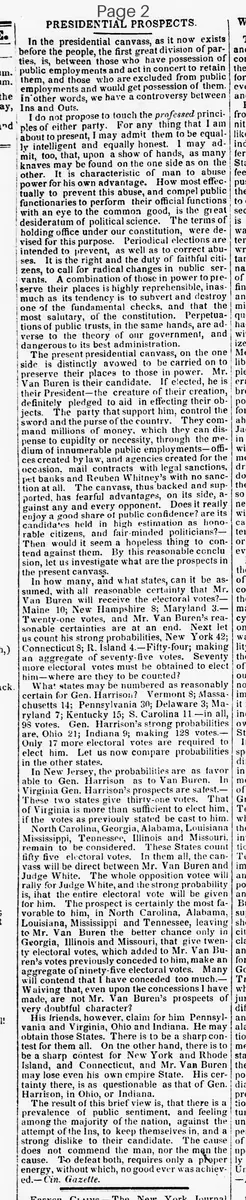
PRESIDENTIAL PROSPECTS.
In the presidential canvass, as it now exists before the people, the first great division of parties is, between those who have possession of public employments and act in concert to retain them, and those who are excluded from public employments and would get possession of them. In other words, we have a controversy between Ins and Outs.
I do not propose to touch the professed principles of either party. For any thing that I am about to present, I may admit them to be equally right. I may admit, too, that, upon a show of hands, as many knaves may be found on the one side as on the other. It is characteristic of man to abuse power for his own advantage. How most effectually to prevent this abuse, and compel public functionaries to perform their official functions with an eye to the common good, is the great desideratum of political science. The terms of holding office under our constitution, were devised for this purpose. Periodical elections are intended to prevent, as well as to correct abuses. It is the right and the duty of faithful citizens, to call for radical changes in public servants. A combination of those in power to preserve their places is highly reprehensible, inasmuch as its tendency is to subvert and destroy one of the fundamental checks, and that the most salutary, of the constitution. Perpetuations of public trusts, in the same hands, are adverse to the theory of our government, and dangerous to its best administration.
The present presidential canvass, on the one side is distinctly avowed to be carried on to preserve their places to those in power. Mr. Van Buren is their candidate. If elected, he is their President - the creature of their creation, definitely pledged to aid in effecting their objects. The party that support him, control the sword and the purse of the country. They command millions of money, which they can dispense to cupidity or necessity, through the medium of innumerable public employments - offices created by law, and agencies created for the occasion, mail contracts with legal sanctions, pet banks and Reuben Whitney's with no sanction at all. The canvass, thus backed and supported, has fearful advantages, on its side, against any and every opponent. Does it really enjoy a good share of public confidence? are its candidates held in high estimation as honorable citizens, and fair-minded politicians? - Then would it seem a hopeless thing to contend against them. By this reasonable conclusion, let us investigate what are the prospects in the present canvass.
In how many, and what states, can it be assumed, with all reasonable certainty that Mr. Van Buren will receive the electoral votes? - Maine 10; New Hampshire 5; Maryland 3. - Twenty-one votes, and Mr. Van Buren's reasonable certainties are at an end. Next let us count his strong probabilities, New York 42 Connecticut 8; R. Island 4. - Fifty-four; making an aggregate of seventy-five votes. Seventy more electoral votes must be obtained to elect him - where are they to be courted?
What states may be numbered as reasonably certain for Gen. Harrison? Vermont 5; Massachusetts 14; Pennsylvania 30; Delaware 3; Maryland 7; Kentucky 15; S. Carolina 11 - in all, 93 votes. Gen. Harrison's strong probabilities are, Ohio 21; Indiana 9; making 128 votes. - Only 17 more electoral votes are required to elect him. Let us now compare probabilities in the other states.
In New Jersey, the probabilities are as favorable to Gen. Harrison as to Van Buren. In Virginia Gen. Harrison's prospects are safest. - These two states give thirty-one votes. That of Virginia is more than sufficient to elect him, if the votes as previously stated be cast to him.
North Carolina, Georgia, Alabama, Louisiana Mississippi, Tennessee, Illinois and Missouri remain to be considered. These States count fifty five electoral votes. In them all, the canvass will be direct between Mr. Van Buren and Judge White. The whole opposition votes will rally for Judge White, and the strong probability is, that the entire electoral vote will be given for him. The prospect is certainly the most favorable to him, in North Carolina, Alabama, Louisiana, Mississippi and Tennessee, leaving to Mr. Van Buren the better chance only in Georgia, Illinois and Missouri, that give twenty electoral votes, which added to Mr. Van Buren's votes previously conceded to him, make an aggregate of ninety-five electoral votes. Many will contend that I have conceded too much. - Waiving that, even upon the concessions I have made, are not Mr. Van Buren's prospects of very doubtful character?
His friends, however, claim for him Pennsylvania and Virginia, Ohio and Indiana. He may obtain those States. There is to be a sharp contest for them all. On the other hand, there is to be a sharp contest for New York and Rhode Island, and Connecticut, and Mr. Van Buren may lose even his own empire State. His certainty there, is as questionable as that of Gen. Harrison, in Ohio, or Indiana.
The result of this brief view is, that there is a prevalence of public sentiment and feeling among the majority of the nation, against the attempt of the Ins, to keep themselves in, and a strong dislike to their candidate. The cause does not commend the man, nor the man the cause. To defeat both, requires only a proper energy, without which, no good ever was achieved. - Cin. Gazette.
In the presidential canvass, as it now exists before the people, the first great division of parties is, between those who have possession of public employments and act in concert to retain them, and those who are excluded from public employments and would get possession of them. In other words, we have a controversy between Ins and Outs.
I do not propose to touch the professed principles of either party. For any thing that I am about to present, I may admit them to be equally right. I may admit, too, that, upon a show of hands, as many knaves may be found on the one side as on the other. It is characteristic of man to abuse power for his own advantage. How most effectually to prevent this abuse, and compel public functionaries to perform their official functions with an eye to the common good, is the great desideratum of political science. The terms of holding office under our constitution, were devised for this purpose. Periodical elections are intended to prevent, as well as to correct abuses. It is the right and the duty of faithful citizens, to call for radical changes in public servants. A combination of those in power to preserve their places is highly reprehensible, inasmuch as its tendency is to subvert and destroy one of the fundamental checks, and that the most salutary, of the constitution. Perpetuations of public trusts, in the same hands, are adverse to the theory of our government, and dangerous to its best administration.
The present presidential canvass, on the one side is distinctly avowed to be carried on to preserve their places to those in power. Mr. Van Buren is their candidate. If elected, he is their President - the creature of their creation, definitely pledged to aid in effecting their objects. The party that support him, control the sword and the purse of the country. They command millions of money, which they can dispense to cupidity or necessity, through the medium of innumerable public employments - offices created by law, and agencies created for the occasion, mail contracts with legal sanctions, pet banks and Reuben Whitney's with no sanction at all. The canvass, thus backed and supported, has fearful advantages, on its side, against any and every opponent. Does it really enjoy a good share of public confidence? are its candidates held in high estimation as honorable citizens, and fair-minded politicians? - Then would it seem a hopeless thing to contend against them. By this reasonable conclusion, let us investigate what are the prospects in the present canvass.
In how many, and what states, can it be assumed, with all reasonable certainty that Mr. Van Buren will receive the electoral votes? - Maine 10; New Hampshire 5; Maryland 3. - Twenty-one votes, and Mr. Van Buren's reasonable certainties are at an end. Next let us count his strong probabilities, New York 42 Connecticut 8; R. Island 4. - Fifty-four; making an aggregate of seventy-five votes. Seventy more electoral votes must be obtained to elect him - where are they to be courted?
What states may be numbered as reasonably certain for Gen. Harrison? Vermont 5; Massachusetts 14; Pennsylvania 30; Delaware 3; Maryland 7; Kentucky 15; S. Carolina 11 - in all, 93 votes. Gen. Harrison's strong probabilities are, Ohio 21; Indiana 9; making 128 votes. - Only 17 more electoral votes are required to elect him. Let us now compare probabilities in the other states.
In New Jersey, the probabilities are as favorable to Gen. Harrison as to Van Buren. In Virginia Gen. Harrison's prospects are safest. - These two states give thirty-one votes. That of Virginia is more than sufficient to elect him, if the votes as previously stated be cast to him.
North Carolina, Georgia, Alabama, Louisiana Mississippi, Tennessee, Illinois and Missouri remain to be considered. These States count fifty five electoral votes. In them all, the canvass will be direct between Mr. Van Buren and Judge White. The whole opposition votes will rally for Judge White, and the strong probability is, that the entire electoral vote will be given for him. The prospect is certainly the most favorable to him, in North Carolina, Alabama, Louisiana, Mississippi and Tennessee, leaving to Mr. Van Buren the better chance only in Georgia, Illinois and Missouri, that give twenty electoral votes, which added to Mr. Van Buren's votes previously conceded to him, make an aggregate of ninety-five electoral votes. Many will contend that I have conceded too much. - Waiving that, even upon the concessions I have made, are not Mr. Van Buren's prospects of very doubtful character?
His friends, however, claim for him Pennsylvania and Virginia, Ohio and Indiana. He may obtain those States. There is to be a sharp contest for them all. On the other hand, there is to be a sharp contest for New York and Rhode Island, and Connecticut, and Mr. Van Buren may lose even his own empire State. His certainty there, is as questionable as that of Gen. Harrison, in Ohio, or Indiana.
The result of this brief view is, that there is a prevalence of public sentiment and feeling among the majority of the nation, against the attempt of the Ins, to keep themselves in, and a strong dislike to their candidate. The cause does not commend the man, nor the man the cause. To defeat both, requires only a proper energy, without which, no good ever was achieved. - Cin. Gazette.
What sub-type of article is it?
Partisan Politics
What keywords are associated?
Presidential Election
Van Buren
Harrison
Electoral Votes
Ins And Outs
Party Canvass
Political Abuse
What entities or persons were involved?
Mr. Van Buren
Gen. Harrison
Judge White
Reuben Whitney
Ins Party
Editorial Details
Primary Topic
Electoral Prospects In The Presidential Canvass Between Van Buren And Harrison
Stance / Tone
Critical Of Incumbent Party And Van Buren, Supportive Of Harrison And Opposition
Key Figures
Mr. Van Buren
Gen. Harrison
Judge White
Reuben Whitney
Ins Party
Key Arguments
The Presidential Contest Is Primarily Between Those In Power (Ins) Seeking To Retain Offices And Those Out (Outs) Seeking To Gain Them.
Periodical Elections Prevent Abuses Of Power And Perpetuations In Office Are Dangerous To Government.
Van Buren's Campaign Is Backed By Control Of Government Resources, Giving Unfair Advantages.
Electoral Vote Calculations Show Van Buren With 75 Probable Votes, Needing 70 More, While Harrison Has 128 Probable Votes, Needing Only 17 More.
In Doubtful States, Harrison's Prospects Are Stronger, Especially Virginia And New Jersey.
Opposition Will Rally Behind Judge White In Several Southern And Western States, Limiting Van Buren's Gains.
Public Sentiment Favors Defeating The Ins And Their Candidate Van Buren.