Thank you for visiting SNEWPapers!
Sign up free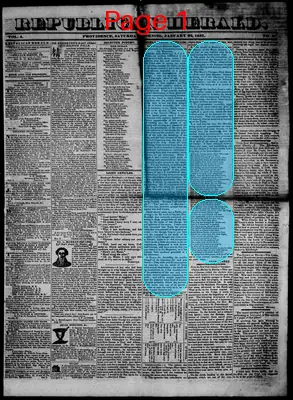
Literary
January 22, 1831
Republican Herald
Providence, Providence County, Rhode Island
What is this article about?
Rev. Adam Clarke shares childhood experiences learning weather prognostication on a farm, praises a table by Dr. Herschel for predicting weather based on moon phases, provides observations on its use, and includes an expanded poem on signs of approaching foul weather.
Clipping
OCR Quality
95%
Excellent
Full Text
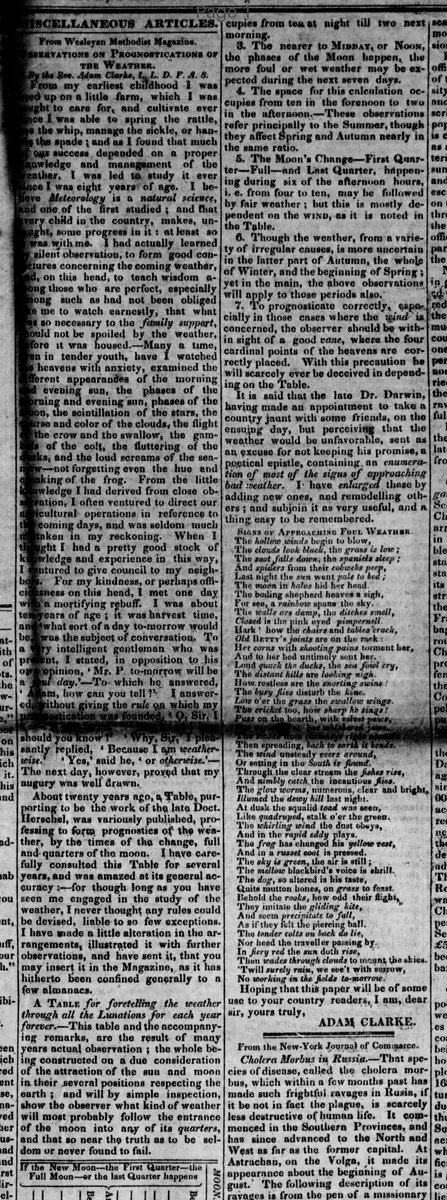
MISCELLANEOUS ARTICLES
From Wesleyan Methodist Magazine.
Observations on Prognostications of
THE WEATHER.
By the Rev. Adam Clarke, L. L. D. F. A. S.
From my earliest childhood I was
reared up on a little farm, which I was
taught to care for, and cultivate ever
since I was able to spring the rattle,
snap the whip, manage the sickle, or han-
dle the spade ; and as I found that much
of our success depended on a proper
knowledge and management of the
weather, I was led to study it ever
since I was eight years of age. I be-
lieve Meteorology is a natural science,
and one of the first studied ; and that
every child in the country, makes, un-
taught, some progress in it : at least so
was with me. I had actually learned
silent observation, to form good con-
jectures concerning the coming weather,
and, on this head, to teach wisdom a-
mong those who are ignorant, especially
among such as had not been obliged
to watch earnestly, that what
was so necessary to the family support,
would not be spoiled by the weather,
before it was housed.--Many a time,
when in tender youth, have I watched
the heavens with anxiety, examined the
different appearances of the morning
and evening sun, the phases of the
moon, the scintillation of the stars, the
course and color of the clouds, the flight
of the crow and the swallow. the gambols
of the colt, the fluttering of the
larks, and the loud screams of the sea-
gull--not forgetting even the croaking
of the frog. From the little
knowledge I had derived from close ob-
servation, I often ventured to direct our
agricultural operations in reference to
coming days, and was seldom much
mistaken in my reckoning. When I
thought I had a pretty good stock of
knowledge and experience in this way,
I ventured to give counsel to my neigh-
bors. For my kindness, or perhaps of-
ficiousness on this head, I met one day
with a mortifying rebuff. I was about
ten years of age; it was harvest time,
and what sort of a day to-morrow would
be was the subject of conversation. To
a very intelligent gentleman who was
present, I stated, in opposition to his
own opinion, ' Mr. P. to-morrow will be
a foul day.' To which he answered,
'I am, how can you tell?-- I answer-
ed without giving the rule on which my
prognostication was founded, O, Sir, I
should you know ? : Why, Sir I plea-
santly replied, ' Because I am weather-
wise.'
Yes,' said he, 'or otherwise.'--
The next day, however, proved that my
augury was well drawn.
About twenty years ago, a Table, pur-
porting to be the work of the late Doct.
Herschel, was variously published, pro-
fessing to form prognostics of the wea-
ther, by the times of the change, full
and-quarters of the moon. I have care-
fully consulted this Table for several
years, and was amazed at its general ac-
curacy :--for though long as you have
seen me engaged in the study of the
weather, I never thought any rules could
be devised, liable to so few exceptions.
I have made a little alteration in the ar-
rangements, illustrated it with further
observations, and have sent it, that you
may insert it in the Magazine, as it has
hitherto been confined generally to a
few almanacs.
A TABLE for foretelling the weather
through all the Lunations for each year
forever.--This table and the accompany-
ing remarks, are the result of many
years actual observation ; the whole be-
ing constructed on a due consideration
of the attraction of the sun and moon
in their several positions respecting the
earth; and will by simple inspection,
show the observer what kind of weather
will most probably follow the entrance
of the moon into any of its quarters,
and that so near the truth as to be sel-
dom or never found to fail.
If the New Moon--the First Quarter-the
Full Moon--or the Last Quarter happens
OBSERVATIONS.--1. The nearer the
Moon's Change--First Quarter--Full--and
Last Quarter, is to Midnight, the fairer
will be the weather during the next seven
days.
2. The space for this calculation oc-
cupies from ten at night till two next
morning.
3. The nearer to Midday, or Noon,
the phases of the Moon happen, the
more foul or wet weather may be ex-
pected during the next seven days.
4. The space for this calculation oc-
cupies from ten in the forenoon to two
in the afternoon.--These observations
refer principally to the Summer, though
they affect Spring and Autumn nearly in
the same ratio.
5. The Moon's Change--First Quar-
ter--Full--and Last Quarter, happen-
ing during six of the afternoon hours,
i. e. from four to ten, may be followed
by fair weather ; but this is mostly de-
pendent on the wind, as it is noted in
the Table.
6. Though the weather, from a varie-
ty of irregular causes, is more uncertain
in the latter part of Autumn, the whole
of Winter, and the beginning of Spring ;
yet in the main, the above observations
will apply to those periods also.
7. To prognosticate correctly, espe-
cially in those cases where the wind is
concerned, the observer should be with-
in sight of a good vane, where the four
cardinal points of the heavens are cor-
rectly placed. With this precaution he
will scarcely ever be deceived in depend-
ing on the Table.
It is said that the late Dr. Darwin,
having made an appointment to take a
country jaunt with some friends, on the
ensuing day, but perceiving that the
weather would be unfavorable, sent as
an excuse for not keeping his promise, a
poetical epistle, containing an enumera-
tion of most of the signs of approaching
bad weather. I have enlarged those by
adding new ones, and remodelling oth-
ers ; and subjoin it as very useful, and a
thing easy to be remembered.
Signs of Approaching Foul Weather.
The hollow winds begin to blow,
The clouds look black, the glass is low;
The soot falls down, the spaniels sleep;
And spiders from their cobwebs peep.
Last night the sun went pale to bed ;
The moon in halos hid her head.
The boding shepherd heaves a sigh,
For see, a rainbow spans the sky.
The walls are damp, the ditches smell,
Closed is the pink eyed pimpernell.
Hark ! how the chairs and tables crack,
Old Betty's joints are on the rack:
Her corns with shooting pains torment her,
And to her bed untimely sent her.
Loud quack the ducks, the sea fowl cry,
The distant hills are looking nigh.
How restless are the snorting swine!
The busy flies disturb the kine.
Low o'er the grass the swallow wings.
The cricket too, how sharp he sings!
Puss on the hearth, with velvet paws,
Then spreading back to earth it bends.
The wind unsteady veers around,
Or settling in the South is found.
Through the clear stream the fishes rise,
And nimbly catch, the incautious flies.
The glow worms, numerous, clear and bright,
Illumed the dewy hill last night.
At dusk the squalid toad was seen,
Like quadruped, stalk o'er the green.
The whirling wind the dust obeys,
And in the rapid eddy plays.
The frog has changed his yellow vest,
And in a russet coat is dressed.
The sky is green, the air is still;
The mellow blackbird's voice is shrill.
The dog, so altered is his taste,
Quits mutton bones, on grass to feast.
Behold the rooks, how odd their flight,
They imitate the gliding kite,
And seem precipitate to fall,
As if they felt the piercing ball.
The tender colts on back do lie,
Nor heed the traveller passing by.
In fiery red the sun doth rise,
Then fades through clouds to mount the skies.
"Twill surely rain, we see't with sorrow,
No working in the fields to-morrow.
Hoping that this paper will be of some
use to your country readers, I am, dear
sir, yours truly,
ADAM CLARKE.
From Wesleyan Methodist Magazine.
Observations on Prognostications of
THE WEATHER.
By the Rev. Adam Clarke, L. L. D. F. A. S.
From my earliest childhood I was
reared up on a little farm, which I was
taught to care for, and cultivate ever
since I was able to spring the rattle,
snap the whip, manage the sickle, or han-
dle the spade ; and as I found that much
of our success depended on a proper
knowledge and management of the
weather, I was led to study it ever
since I was eight years of age. I be-
lieve Meteorology is a natural science,
and one of the first studied ; and that
every child in the country, makes, un-
taught, some progress in it : at least so
was with me. I had actually learned
silent observation, to form good con-
jectures concerning the coming weather,
and, on this head, to teach wisdom a-
mong those who are ignorant, especially
among such as had not been obliged
to watch earnestly, that what
was so necessary to the family support,
would not be spoiled by the weather,
before it was housed.--Many a time,
when in tender youth, have I watched
the heavens with anxiety, examined the
different appearances of the morning
and evening sun, the phases of the
moon, the scintillation of the stars, the
course and color of the clouds, the flight
of the crow and the swallow. the gambols
of the colt, the fluttering of the
larks, and the loud screams of the sea-
gull--not forgetting even the croaking
of the frog. From the little
knowledge I had derived from close ob-
servation, I often ventured to direct our
agricultural operations in reference to
coming days, and was seldom much
mistaken in my reckoning. When I
thought I had a pretty good stock of
knowledge and experience in this way,
I ventured to give counsel to my neigh-
bors. For my kindness, or perhaps of-
ficiousness on this head, I met one day
with a mortifying rebuff. I was about
ten years of age; it was harvest time,
and what sort of a day to-morrow would
be was the subject of conversation. To
a very intelligent gentleman who was
present, I stated, in opposition to his
own opinion, ' Mr. P. to-morrow will be
a foul day.' To which he answered,
'I am, how can you tell?-- I answer-
ed without giving the rule on which my
prognostication was founded, O, Sir, I
should you know ? : Why, Sir I plea-
santly replied, ' Because I am weather-
wise.'
Yes,' said he, 'or otherwise.'--
The next day, however, proved that my
augury was well drawn.
About twenty years ago, a Table, pur-
porting to be the work of the late Doct.
Herschel, was variously published, pro-
fessing to form prognostics of the wea-
ther, by the times of the change, full
and-quarters of the moon. I have care-
fully consulted this Table for several
years, and was amazed at its general ac-
curacy :--for though long as you have
seen me engaged in the study of the
weather, I never thought any rules could
be devised, liable to so few exceptions.
I have made a little alteration in the ar-
rangements, illustrated it with further
observations, and have sent it, that you
may insert it in the Magazine, as it has
hitherto been confined generally to a
few almanacs.
A TABLE for foretelling the weather
through all the Lunations for each year
forever.--This table and the accompany-
ing remarks, are the result of many
years actual observation ; the whole be-
ing constructed on a due consideration
of the attraction of the sun and moon
in their several positions respecting the
earth; and will by simple inspection,
show the observer what kind of weather
will most probably follow the entrance
of the moon into any of its quarters,
and that so near the truth as to be sel-
dom or never found to fail.
If the New Moon--the First Quarter-the
Full Moon--or the Last Quarter happens
OBSERVATIONS.--1. The nearer the
Moon's Change--First Quarter--Full--and
Last Quarter, is to Midnight, the fairer
will be the weather during the next seven
days.
2. The space for this calculation oc-
cupies from ten at night till two next
morning.
3. The nearer to Midday, or Noon,
the phases of the Moon happen, the
more foul or wet weather may be ex-
pected during the next seven days.
4. The space for this calculation oc-
cupies from ten in the forenoon to two
in the afternoon.--These observations
refer principally to the Summer, though
they affect Spring and Autumn nearly in
the same ratio.
5. The Moon's Change--First Quar-
ter--Full--and Last Quarter, happen-
ing during six of the afternoon hours,
i. e. from four to ten, may be followed
by fair weather ; but this is mostly de-
pendent on the wind, as it is noted in
the Table.
6. Though the weather, from a varie-
ty of irregular causes, is more uncertain
in the latter part of Autumn, the whole
of Winter, and the beginning of Spring ;
yet in the main, the above observations
will apply to those periods also.
7. To prognosticate correctly, espe-
cially in those cases where the wind is
concerned, the observer should be with-
in sight of a good vane, where the four
cardinal points of the heavens are cor-
rectly placed. With this precaution he
will scarcely ever be deceived in depend-
ing on the Table.
It is said that the late Dr. Darwin,
having made an appointment to take a
country jaunt with some friends, on the
ensuing day, but perceiving that the
weather would be unfavorable, sent as
an excuse for not keeping his promise, a
poetical epistle, containing an enumera-
tion of most of the signs of approaching
bad weather. I have enlarged those by
adding new ones, and remodelling oth-
ers ; and subjoin it as very useful, and a
thing easy to be remembered.
Signs of Approaching Foul Weather.
The hollow winds begin to blow,
The clouds look black, the glass is low;
The soot falls down, the spaniels sleep;
And spiders from their cobwebs peep.
Last night the sun went pale to bed ;
The moon in halos hid her head.
The boding shepherd heaves a sigh,
For see, a rainbow spans the sky.
The walls are damp, the ditches smell,
Closed is the pink eyed pimpernell.
Hark ! how the chairs and tables crack,
Old Betty's joints are on the rack:
Her corns with shooting pains torment her,
And to her bed untimely sent her.
Loud quack the ducks, the sea fowl cry,
The distant hills are looking nigh.
How restless are the snorting swine!
The busy flies disturb the kine.
Low o'er the grass the swallow wings.
The cricket too, how sharp he sings!
Puss on the hearth, with velvet paws,
Then spreading back to earth it bends.
The wind unsteady veers around,
Or settling in the South is found.
Through the clear stream the fishes rise,
And nimbly catch, the incautious flies.
The glow worms, numerous, clear and bright,
Illumed the dewy hill last night.
At dusk the squalid toad was seen,
Like quadruped, stalk o'er the green.
The whirling wind the dust obeys,
And in the rapid eddy plays.
The frog has changed his yellow vest,
And in a russet coat is dressed.
The sky is green, the air is still;
The mellow blackbird's voice is shrill.
The dog, so altered is his taste,
Quits mutton bones, on grass to feast.
Behold the rooks, how odd their flight,
They imitate the gliding kite,
And seem precipitate to fall,
As if they felt the piercing ball.
The tender colts on back do lie,
Nor heed the traveller passing by.
In fiery red the sun doth rise,
Then fades through clouds to mount the skies.
"Twill surely rain, we see't with sorrow,
No working in the fields to-morrow.
Hoping that this paper will be of some
use to your country readers, I am, dear
sir, yours truly,
ADAM CLARKE.
What sub-type of article is it?
Essay
Poem
What themes does it cover?
Agriculture Rural
Nature
What keywords are associated?
Weather Prognostication
Meteorology
Farming
Moon Phases
Signs Of Rain
Rural Observation
Poem On Weather
What entities or persons were involved?
By The Rev. Adam Clarke, L. L. D. F. A. S.
Literary Details
Title
Observations On Prognostications Of The Weather
Author
By The Rev. Adam Clarke, L. L. D. F. A. S.
Subject
On Weather Prognostication And Signs
Key Lines
From My Earliest Childhood I Was Reared Up On A Little Farm, Which I Was Taught To Care For, And Cultivate Ever Since I Was Able To Spring The Rattle, Snap The Whip, Manage The Sickle, Or Handle The Spade ;
The Hollow Winds Begin To Blow, The Clouds Look Black, The Glass Is Low; The Soot Falls Down, The Spaniels Sleep; And Spiders From Their Cobwebs Peep.
Last Night The Sun Went Pale To Bed ; The Moon In Halos Hid Her Head. The Boding Shepherd Heaves A Sigh, For See, A Rainbow Spans The Sky.
The Nearer The Moon's Change First Quarter Full And Last Quarter, Is To Midnight, The Fairer Will Be The Weather During The Next Seven Days.
Twill Surely Rain, We See't With Sorrow, No Working In The Fields To Morrow.