Thank you for visiting SNEWPapers!
Sign up free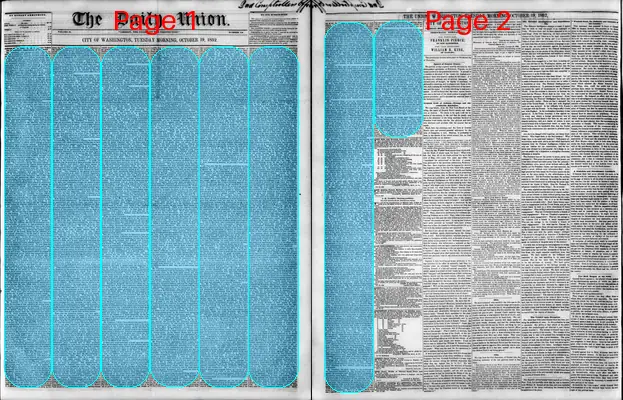
The Daily Union
Washington, District Of Columbia
What is this article about?
Hon. R. M. T. Hunter delivers a speech to the Democratic Association of Richmond, defending Virginia's political principles of states' rights, strict constitutional construction, free trade, and individual liberty. He reviews historical successes, critiques centralization, defends Southern slavery, supports Democratic candidates, and outlines U.S. foreign policy emphasizing neutrality and free competition.
Merged-components note: These components form a single continuous political speech by Hon. R. M. T. Hunter, split across columns and pages during initial parsing; merged based on sequential reading order and textual continuity.
Clippings

1 of 2
OCR Quality
Full Text
MR. PRESIDENT And FELLOW-CITIZENS: I appear before you in compliance with an invitation with which you have honored me, to address you upon public affairs. But upon those great principles of public action which I stand here to speak, not upon mere personal issues, I borrow nothing from men, but which give to them whatever of political importance they possess. With your leave, sirs, I shall speak as one at home, as a Virginian communing with Virginians, and throw off some of the restraints which, upon another occasion, and before another audience, might proper observe. I shall speak thus frankly and freely because it is my purpose to address myself the position which Virginia ought to hold in the present juncture of public affairs. To understand her present position it will be necessary briefly to review the past, to see how it is that she stands where she now does; and to ascertain what lights should guide her for the future, we must examine how far those which have heretofore directed her have been steady and If making this review should assign higher office to the principles of the old Virginia school of politics than has been heretofore ascribed to them, it will certainly not designed as an offering of flattery but as tribute to truth. It is not my purpose, Mr. President, to cherish the illusions of State pride, nor do I see how I should serve that end magnifying the deeds those who have gone before us, the contrast should only shame the more the poverty of our own performances. To understand the offices which the doctrines of the Virginia school have performed in past times, it will be necessary to revert briefly to the circumstances out of which it sprung. Mr. Webster, in his celebrated argument in the case of Gibbons vs. Ogden, ascribes it mainly to a desire to extend the power of the federal government over the subject of commerce, and cites as the first act of a public body which led to the convention that formed our present constitution a resolution of Virginia in 1786, appointing commissioners to meet those of other States upon this subject. This, again, was founded upon certain resolutions of Mr. Madison upon the same subject, which passed the general assembly of that State. These resolutions define the object of such a grant to be to enable the general government, through the power of laying restrictions, to obtain fair, equal, and reciprocal privileges in regard to trade from foreign nations, and also to secure equality and reciprocity amongst the States of the confederacy in regard to the right of participating in the advantages of external and internal commerce. Connected with all this was a desire, in my opinion, to make the federal government independent of the State governments within its sphere, and to enlarge its powers generally in regard to foreign nations. Accordingly the constitution, when formed, seems to have had for its main ends the endowment of the federal government with the powers of a complete government, so far as foreign nations were concerned, and the securing not only a perfect freedom of trade and intercourse amongst the States and their citizens, but also an entire equality amongst them in regard to commercial privileges, and in relation to the general action of the new government. But there was a large party at that time whose views extended much further. They believed in the old European scheme of civilization; they regarded the highest duties of government to be those of a paternal character, and were for arming the general government with the "patria potestas" accordingly. All the concerns of the great interests of agriculture, commerce, and manufactures, and, in short, the whole machinery of society, ought, in their opinion, to be placed under its control; and to effect these objects able and persevering efforts were made. The anti-federalists, who were opposed to an exclusion of the powers of the federal government, in their debates in State conventions, extended these powers by construction to extravagant lengths for the purpose of making the new constitution odious. The consequence was that, after the adoption of the constitution, they were embarrassed by their previous course in their opposition to its broad construction. Such we know to have been the case with Mr. Henry, and doubtless the same difficulty felt more or less by them all. Under these circumstances, it is perhaps not surprising that the early tendencies of the general government should have been towards a rapid consolidation of power in their own hands. It was probably fortunate for the country that Mr. Jefferson was abroad during the disputes preliminary to the adoption of that instrument. He was thus unembarrassed by previous committals, free to observe impartially, and to act independently upon his own judgment when it was formed. He was not long in perceiving whither the system was tending. The claim was openly made and powerfully sustained, of a right in the general government to provide for whatever concerns the general interests of learning, of agriculture, of manufactures, and of commerce, as far as regards an application of money. In short, sirs, Mr. Jefferson saw that the tendencies were to a centralization of power in that government, and he knew, as was afterwards declared in one of the celebrated resolutions of Virginia in 1798, that the inevitable effect of this must be "to transform the present republican system of the United States into an absolute, or at best a mixed monarchy;" for the seed of the old European scheme of civilization, if sowed here, must produce the like fruit again. It was the old European notion to make a sort of second-hand providence out of human government, and to require it to predestinate the whole course of action and events, whether social or individual, within the society for which it acted. To meet these dangers, he determined to found his own school, and to base it not only upon different but upon opposite principles. He founded it upon the right of individual judgment and upon the free will of man. He proposed to allow the largest liberty of individual action which was compatible with the peace and order of the whole, and to throw open the prizes of life, whether of honor or of profit, to the free and equal competition of all well knowing the strongest, the ablest and best, would be the most apt to take them. Ascending another step to a still higher generalization he proposed to leave to each State the right to develop its own scheme of culture, its own system of civilization, and of internal improvements, and here again to throw open all the prizes for which communities contend in social enterprise and intercourse, to free and equal competition amongst the States. But these grants, both to the States and to individuals, were to be so exercised by each as not to infringe upon the equal right of another. He was fortunately enabled to show that the true construction of the constitution in regard to the powers of the State and general governments, established relations between the two, which were in precise accordance with his political school—a school founded upon the principle of voluntary action, in both individuals and societies. Human imagination has never conceived a system which could give so powerful a spur to human progress, and so great an impulse to human energy. It calls into play all the active elements of human character, and affords an opportunity for the peaceful exercise of each. To what else is it that we owe the scene of universal energy which our country exhibits? Mr. President, I do not mean to say that I have laid down the doctrines of that school in the precise terms in which they were announced by its fathers. I have given my own analysis of them, as taken from the tendencies of the system, which have been manifested by experience, and as derived from the resolutions and report of 1798-'99, which constitute the first authentic text and commentary of the doctrines. But it so happens that the ends and results of the system have been defined very much as I define them by cotemporaneous commentators. When Mr. Jefferson's first message appeared, it was "examined" by Alexander Hamilton in a series of essays marked with the usual evidences of ardent temper and great ability, and signed Lucius Crassus. In one of them (No. 3, written in 1801,) he speaks of what he conceives to be the duties of the country in reference to the protection of the industrial interests of the country, and then he says, "To suggestions of that kind, the adepts of the new school have a ready answer: Industry will succeed and prosper in proportion as it is left to the exertion of individual enterprise." Again, in No. 18 of the same series of essays, he says: "To make a display of concern for their prosperity agriculture manufactures commerce and navigation are introduced among the pageants of the piece but except as to protection from casual embarrassments Grear pILLArs of our prosperity ought to be left to take care of themselves doctrines of the "new school," as he well calls it. So too, Cabot, in a letter to Hamilton in 1800, says of Jefferson, that he "must see the roots of our society pulled up, and a new course of cultivation substituted." But, Mr. President, I have said that this "new school" was founded in Virginia, and with your leave I will proceed to make good the assertion. I say it because, in the first place, the resolutions and the report upon them of the Virginia legislature, in 1798-'99, form the first authentic text and commentary in regard to the doctrines of the school; and because, secondly, there is the high authority of cotemporary history to sustain the assertion. Alexander Hamilton, in a letter to Dayton, written in 1799, says, in regard to the resolutions of which I have been speaking, "The late attempt of Virginia and Kentucky to unite the State legislatures in a direct resistance to certain laws of the Union are to be considered in no other light than as an attempt to change the government. It is stated in addition that the opposition party in Virginia, the headquarters of the faction, have followed up the hostile declarations of their general assembly by an actual preparation of the means of supporting them by force; that they have taken measures to put their militia upon a more efficient footing—are preparing considerable arsenals and magazines, and (which is an unequivocal proof how much they are in earnest) have gone so far as to lay new taxes upon their citizens." Again he says, in a letter to King, in 1800, "The spirit of faction is abated nowhere. In Virginia it is more violent than ever. It seems demonstrated that the leaders there, who possess completely all the powers of the local government, are resolved to possess those of the national by the most dangerous combinations, and, cannot effect this, to resort to physical force." Bayard, in a letter to Hamilton in 1801, says, "I consider the State ambition of Virginia as the source of the present party. The faction who govern that State aim to govern the United States Virginia will never be satisfied but when this state of things exists." Rutledge, in a letter to Hamilton in 1801, says: "Viewing Mr. J. and Mr. B. separately, each appears improper for the presidency; but looking at them comparatively, the federalists think their preferring Mr. Burr will be the least mischief they can do. His promotion will be prodigiously afflicting to the Virginia faction, and must disjoint the party." Again: Bayard, in a letter to Hamilton in 1802, speaking of the hopes of the federal party, says: "An occasion is only wanting for Virginia to find herself abandoned by all her auxiliaries; and she would be abandoned only upon the ground of her inimical principles to an efficient government." The whole correspondence between Hamilton and his federal friends, during the contest between Jefferson and Burr, and, indeed, after the election of the former, shows the bitterness with which they regarded her action at that time, and the importance which they attached to it. Hamilton, in a letter to Morris, speaks of the "bloated and senseless junto of Virginia;" and Bayard, in a letter to Hamilton of the same year, talks of "the proud and aspiring lords of the ancient Dominion." Mr. President, I mention these things, not as a matter of feeling and resentment, but as a part of the history of the times. I have always believed that the federal leaders of that day were both patriotic and able; and, wide as has been the difference of opinion between us upon principles, still I have not doubted their motives. I refer to these things to show the importance they attached to the action of the Virginians of that day, and their opinion as to the origin of the "new school." I wished, too, to give their picture of the times, not merely in outline, but in coloring. It is amusing, Mr. President, to compare the ill-omened predictions with which the federalists of that day, in their correspondence as it appears in the Hamilton papers, regarded the advent of Mr. Jefferson to power. They seemed to expect the destruction of the necessary establishments of the government an era of radicalism, a sort of wild democratic saturnalia, and the most hopeful amongst them regarded it as certain that Mr. Jefferson and his party must break down. Without any exertion on our part, "says Bayard to Hamilton in 1802, "in the course of two or three years they will render every honest man in the country our proselyte." So much did Hamilton fear the progress of these principles, that in his letter to Dayton, from which I have before quoted, he declares the necessity of counteracting them, and proposed means for that purpose, which show what his system would have been could he have directed the American people. The influence of the general government was to be extended as an object of primary importance; federal justices of the peace were to be appointed in each county, to be compensated by fees for their services; the roads of the country were to be improved; a society instituted to encourage agriculture and the arts. Roads were to be made, but, remarkably enough, the power to make canals he thought ought to be added by a new article to the constitution. A law was to be enacted to protect public officers against libels; and if possible the large States were to be divided; and this he seemed to think, was an object of the very first magnitude. Such then, Mr. President, were the fears of the federalists in relation to the republican party, and such the expedients by which that party was to be defeated and counteracted. How signally did the course of events disappoint these predictions and expectations! Mr. Jefferson administered the government not only for these four years, but for four others, and he was succeeded by Madison and Monroe, who were of the same school of politics, and administered the government for eight years each! The future historian of this country will hereafter refer to these ministrations as the halcyon period of the republic. He will say of them that, although not free from errors, some of which were of a grave character, yet they saved the federal government from the vortex of centralization and its manifest mischiefs, and gave it a right direction. He will say of the men themselves that, notwithstanding their occasional errors, they conducted the ship of State, under trying and difficult circumstances, with rare moderation, wisdom, and ability. He will say of the great democratic party of the country, not that it has ever, up to this year, at least, planted itself fully and squarely upon the doctrines of the Virginia school, but that for a long period its chosen leaders were from that school, and not only have its tendencies been in the direction of those principles, but its ends can only be fully accomplished by a faithful adherence to them, as it is upon those principles alone that democracy can be made compatible with individual liberty and a free representative form of government. When he demonstrates from past history that the tendencies of the democratic party have always been towards the principles of that great school, he will say of it that it has always been most successful and prosperous when it adhered most closely to those doctrines, and has experienced most reverses, and suffered most from differences and collisions, when it departed the widest from them. When pursuing that road, the democratic column never falters or stops—its progress is onwards. It is when it departs from that track that its course becomes devious and uncertain. Take the first of those great political issues which was prominent enough to have survived those who originated it. Take the United States Bank—an institution devised by Hamilton for the purpose of controlling the credit and exchanges of the country, and which thus drew the whole of that vast subject within the sphere of federal power. I admit that in the earlier history of the issue there were individuals and portions of the democratic party which favored the measure; there were times, too, when the great democratic column wavered and bent before the obstacle. But after more than the third of a century the party united, as far as any party ever unites, to destroy the institution. Not only did they overthrow the bank, but they substituted for it a measure in precise accordance with the principles of the Virginia school. I mean, sire, the independent treasury, which leaves the whole subject of credit and exchange to State management and individual competition. What has been the result? We have not only rid ourselves of the bank, with its disturbing and corrupting influences upon trade and politics, but we have substituted a scheme by which society manages this vast business for itself, under the operation of the natural laws of trade, without trouble to the government or disturbance to itself. So well has the system worked that no one talks of repealing it; its bitterest opponents are silenced by practical experience, and we no longer hear of it as an issue between parties. Take next the protective system; and here again I must make an admission in regard to the democratic party, similar to the one just made in relation to the bank. Still, the free-trade element in that party constantly grew, from the nature of the objects of the party, until in 1846 the entire, or almost the entire, party, united to carry that great measure of free trade—a measure which established the revenue-tariff system as the settled policy of the country, so far at least as the democratic party could establish a policy. Under what ill-omened vaticinations, what prophecies of future mischiefs, what groans and complaints, was that great measure consummated! The revenue was to fall off—to fall far below the wants of the government; the great productive interests were to suffer atrophy and decline; and especially was that of manufactures to perish and disappear. But the democratic party, reposing faith in their principles, marched gallantly up to the work; and what has been the result? Not only has the revenue arising from it exceeded the most sanguine expectations of its friends, but never, at any period of our history, have all the great industrial interests been so prosperous and contented. Never, I believe I may say, have the manufacturing interests themselves, when taken as a whole, been so prosperous and contented. This is a subject upon which I have made earnest inquiry. The conclusion to which I have come is, that they never had less cause to complain. The manufacturers of New England, I believe, have never been more contented or in a more prosperous condition. Some small additions to the free list, such as that of dye-stuffs, and some other articles, which would occasion no material departure from the revenue-tariff policy, and cost but little to the revenue, would satisfy, I believe, nearly the whole manufacturing interest of New England. I speak of the practical manufacturers, not of politicians, who desire more to protect themselves in their positions than to assist the manufacturer. There are some branches of the iron manufacture, I know, which have suffered depression, and have made complaints. But the depression seems to be passing away with the temporary causes which occasioned it, and the prices of iron already have an upward tendency. The great prosperity of the productive interests of the country, and the number of new railroads which is increasing with the general prosperity, are enlarging so much the demand for iron that this upward tendency of price will probably be sustained. And thus it is that trade, by the silent and beneficent operation of the laws of Nature, will invariably right itself, if man, with his artificial regulations, will step aside and give those laws fair play. But if you will take the manufacture of iron in its entirety—if you will take not only those who make the raw material, but those who manufacture articles out of that material—I doubt whether the iron interest has ever been more prosperous. Mr. Robert J. Walker made this assertion in a public speech in Pittsburg since the act of 1846, and he told me himself that it had not been contradicted, so far as he knew, even in that great centre of the coal and iron interest. Here, then, sirs, is another glorious result achieved by the democratic party, and achieved by following the principles of that great school of which I have been speaking. I come next to the internal improvement issue; and I claim here as great a triumph for the principles of the Virginia school as upon either of the questions which I have just touched. I do not mean to say that the democratic party, as a party, have ever adopted our doctrines upon this subject in their fullest extent, or that there are not eminent men of the party who still hold a different creed in that regard. Nor do I mean to say that the federal government has designedly acted upon those principles in relation to internal improvements. But I do say that either by accident or design the subject has been substantially left where our system would have left it—to the States, and to individual or social enterprise, under their direction. The system of internal communication, such as we now have it, is substantially the creation of the State governments. What a system it is! The world cannot exhibit one to be compared with it in extent, and in point of human achievement, when you consider the resources and the sparseness of the population that made it. Before its development it was supposed that the States were incapable of conducting by agreement anything so complicated as a system of roads and canals embracing many States. Alexander Hamilton supposed that it could be best managed by the general government, wherever two or more States were concerned. And yet we see an entire line of railroad in rapid process of completion from Maine to Louisiana. State after State supplies its particular link, as the laws of trade require it, until soon not a gap will be left to disturb the continuity of the series. From East to West, across the entire inhabited belt of the States upon this side of the Rocky mountains, line after line of railroad is either completed or in process of completion. Their arches span our broadest streams, their sinuous lines ascend our mountain steeps, or, burying themselves in the earth, they rend their way, and pursue their direct course to whatever centre of trade they may be tending, and from which it would seem that no physical obstacle can divert or intercept them. When, may I ask, should we have seen such a system of internal communication if the general government had taken charge of the subject? To such a system there cannot be two heads; the one or the other government must retire from the field, or otherwise the one would neutralize what the other did. Suppose the general government had taken the matter in hand, should we have had any system at all? or if one, would it not have represented rather the political influence of those who voted for the bill than the wants of trade? But should we have had any system at all? Why, sirs, even the States found it difficult to reconcile the differences between rival towns within their own borders. How would it have been with the general government, encumbered with so many other duties, if it had undertaken a system which required them to reconcile not only the rival interests of towns, but of States, and of sections composed of States? Look to the few attempts of this character which they have already made. They contributed money to the Chesapeake and Ohio canal; it would have been almost as well to have thrown it into the Potomac river. Take, too, the history of the efforts of the general government to improve the rivers and harbors of the West, as given by a distinguished northwestern senator, (Mr. Douglas, of Illinois.) What is it but an account of plans badly conceived and as illy executed? Consider the Cumberland road—that great national work of its day, upon which it was supposed at one time that the continuance of the Union almost depended. Who hears of it now? In what class of improvements does it stand? Is it of even fifth-rate importance? It is indeed a finished road, finished not by completion, but by abortion. When we come to compare these feeble and ineffectual efforts with the grand system which is the creation of State authority and of individual enterprise, am I not right in claiming a triumph upon this subject for the doctrines of the Virginia school? It matters not whether, by accident or design, the system has been left precisely where those principles would have left it, and has not been executed by the federal government, whose agency was supposed to be indispensable by those who favored the opposite political school. But, sirs, I said not only that the democratic party had prospered most when it adhered most nearly to the principles of which I have been speaking, but also that it had experienced most reverses, and suffered most from divisions, when the government in its policy departed most widely from them. The latter branch of the proposition is as susceptible of demonstration as the former. The federal government at one time assumed the management of the systems of credit and exchange of the country by the establishment of a national bank. It proved to be a disturbing influence, not only upon the politics, but the trade of the country. Serious oscillations in the currency of the country were, not without cause, attributed to it, and the excitement in relation to it became at last so intense as to disturb almost the good fellowship of neighborhoods. The democratic party were forced in the end to rally to its overthrow, and with it passed away the disturbing influences of which I have been speaking. What, too, was the result of the attempt on the part of the general government to foster one great productive interest by taxing the others for its support? Year after year, as the protective system developed its fruits, the opposition to it became more bitter and intense, until at last one of the States threatened to secede from the Union, and the crisis became so serious and imminent that the whole country drew the long breath of expectation in anxiety for the result. Palliatives mitigated the evil for a while, but the democratic party at last, with a resolution worthy of itself and of the great ends which it pursues, planted itself here, too, upon the great principles of free competition and of individual right. The result has been prosperity, peace, and fraternal feeling, so far at least as that great and once disturbing question is concerned. But, sirs, how did the negro question become the source of so much disturbance and bitter feeling in the Union, except by a departure from these principles? It was not so until the era of the Missouri question, and it arose then when the general government undertook to discriminate between the systems of civilization and the social organizations of the States; and when, too, it attempted to deny to them equal rights in relation to the settlement and colonization of the vacant territory of the Union. It was not so until the debates and action of Congress were sought to be perverted to the creation of a moral machinery for the destruction of the institutions of some of the States, without regard to their feelings of self-respect, or even to their peace and safety. Mr. President, I think I have shown that, next to Providence, this country owes its prosperity most to the great principles of the Virginia school. I have shown their application to the great questions which disturbed the country most, and have not paused to show the thousand minor points in which their propriety were acknowledged and their influence felt in the great spur which fair and equal competition give to human enterprises. If, then, they have been so salutary in the past, are they not equally or even more necessary in the future administration of the affairs of the country? If there ever could have been a doubt upon this point, when we numbered some three or four millions, and occupied but a portion of the Atlantic slope, it seems to me there can be none now when we extend from sea to sea, and from the northern lakes to the Gulf of Mexico—when we number so many millions of people, and have to deal with interests so vast and complicated. Suppose the work of consolidation should go on until this general government should assume all, or even nearly all, the important powers of a complete government, within as well as without: could it execute the duties thus assumed? Would not Congress become an impracticable and inefficient body? How is it now? If you wish to know, look to the table of the Speaker of the House of Representatives, piled up with bills at the close of each session, many of them acted upon by the Senate, all of them examined by committees, some of them indispensable to the discharge of the proper duties of Congress. One of the chief causes which lead to this state of things is that Congress undertakes to meddle with matters which do not properly belong to it. Weeks, months, may be expended in debates upon Collins lines—upon schemes for getting up a mercantile steam marine by direct aid from the federal treasury—schemes which ought always to be left to private enterprise; or it may be that weeks or months may be wasted in attacks upon the institutions of the South, and in attempts from that position to make them odious and unsafe, until the body itself becomes demoralized for all the legitimate purposes of public business. When, at last, attention is turned to the proper business of Congress, there is no longer time for its due consideration. Measures that deserve days or weeks of grave consideration are passed in minutes or hours—passed in a spirit of generous confidence in some member or committee which matured them, or sometimes from a sheer sense of the necessity of doing something; and, when passed, they may often be found attached to the tail of some appropriation bill, with which they have neither congruity nor consistency. Take up the naval appropriation bill, and you will find perhaps a provision for executing the printing of the two houses of Congress. Take the military appropriation bill, and you will perhaps find some scheme for organizing an executive department or some plan, it may be, for naturalizing the camel upon our continent. Upon the civil and diplomatic bill you find all sorts of laws upon all sorts of subjects, and upon all of them private claims. In this state of things, would it be prudent or proper, even in the view of mere expediency, for Congress to break down further limitations upon its powers imposed by the constitution itself, according to the construction of the Virginia school? Suppose the general government were to assume the general subject of internal improvement, within the sphere of jurisdiction, as there is now a great talk of doing: could it find time to take charge of the system and give it a proper consideration? Embarrassed as it would be with all the jealousies of which I have before spoken, of rival towns, States, and sections—jealousies which this class of questions produce more freely than any other—it would become perfectly impracticable. It would do nothing upon this subject or perhaps upon any other. If it attempted a system of internal improvement, that system would represent not the wants of trade, but the political influence of those who had a beneficial interest in it. And whilst Congress becomes more and more inefficient and impracticable, are we to suppose that the wheels of government will be stopped, and the business of society brought to a close? By no means. Experience shows that as Congress becomes more inefficient and impracticable, the executive shows itself to be more active and energetic in supplying the omissions of the legislative department. What has been our experience already upon this subject? We all recollect the case of California: session after session Congress failed to provide a government for it, owing to the intense sectional excitement upon the question. Perceiving this, the executive intervened; without the authority of law, a Convention of the people there was called; without law money was raised by the executive; without the authority of law that convention was paid out of this fund, and after that convention had adopted a constitution excluding the slaveholding States not only from territory which the people in California occupied, or might reasonably expect to occupy, but from the whole Pacific coast, the authority of the United States was abdicated into the hands of the government thus constituted by the United States governor; and this, again, was done without law. And these monstrous assumptions of authority by the executive were acquiesced in by the legislative department. They were acquiesced in by the legislative department because the executive had done precisely what a sectional majority of Congress desired to do, and had been unable to do without exposing the Union itself, as they thought, to too great a shock. Their ends could thus be attained more easily through executive action, and thus they acquiesced in such a precedent as had never appeared before upon our statute-book, and I trust will never be seen there again. But if we continue our examination, we shall find these cases of executive legislation multiply upon us. Congress fails to pass some necessary law or appropriation, the machinery of commerce begins to jar, and the business of society suffers inconvenience. Forthwith some ingenious construction of an old law enables the executive to supply the place of the new one which is missing; or, if it be a question of money, he finds some balance of an old appropriation, which ought long ago to have gone to the surplus fund, and he uses that; or, if there be no appropriation directly to the point, a balance of some appropriation for another purpose is, by a legal fiction, transferred to one for which it was never intended. Many roads are open to the executive for obtaining legislative power; and if the legislature is itself inefficient and inactive, he may pursue them almost unnoticed and uncensured. There is the treasury circular, sirs, which stands to the revenue laws as the opinions of judges do to your statute laws. Now, these constructions of law by the Secretaries, like your judge-made law, are necessary things, and are good enough in their places, provided always that the legislatures are in an efficient state to supervise the law thus made, and to correct it when wrong. But if Congress should be unable to attend to its proper duties from the number of subjects of which it has taken charge, then a very wide door is open to executive legislation. Why, sirs, the practice in relation to receiving bank notes in payment of public duties originated not in any law, but in a treasury circular of Alexander Hamilton. That question, which afterwards divided parties and agitated the country so deeply, had been thus originally settled, not by a reference to Congress, but by the executive alone. Now, Mr. President, I do not mean to say that these practices and malpractices originated in any design on the part of our Presidents to create a central despotism; they held their places for four, or at most eight years, and none of them probably desired to leave behind them a master over themselves, or their children and fellow-citizens. But these things grow out of centralization, and exhibit the natural workings of our system when Congress departs from those limitations so wisely imposed upon them in the constitution. Nor let it be said that any fear of the growth of executive power is idle and chimerical. As far back as 1798 one of the Virginia resolutions of that date declared that a consolidation of powers in the federal government must lead to a monarchy. There is assuredly more reason now to fear such a result from centralization than in their day, and it was a wise fear even then. Mr. President, experience shows that Congress cannot depart with impunity from the limitations of the constitution as laid down by the State rights school, and that often unexpected mischiefs flow from the aberration. Some years ago Congress undertook to distribute the public property of the Union amongst the States, and to provide them with revenue. It was said then by some of us that the result of this precedent must be to bring individual demands upon the public treasury, and thus we might come to behold the dangerous spectacle of citizens looking, not to their honest industry, but to the ballot-box for their livelihood. The apprehension was regarded as chimerical, and yet at the last session of Congress we have seen a bill making a gratuitous distribution of farms to individuals passing the House, and not yet acted upon by the Senate. This bill was passed by a union of those who wanted the farms and of States who wished to get rid of the United States as a landlord within their borders. It seems to me, sirs, that we ought to withdraw all pretence for such a coalition by passing a fair graduation law, which may open up these lands for settlement as fast as there is a fair and real demand for them for that purpose. For the rest the remedy for all these evils is a return to the old republican system. Restrict Congress to the powers given by the constitution according to the doctrines of the strict-construction school. They will then have enough for all federative purposes—enough, too, but not more than enough to do. The business of a complete government, so far as foreign nations are concerned, the necessary establishments, and the taxation for that purpose, and even their limited powers over the vast subject of internal commerce, will afford them employment enough for their time and energies. If they attempt more, before long they must abdicate all to make way for an intenser form of centralization. As the Roman Senate had to give way to the Roman Emperor when their possessions became too large for one legislature, so must it end here if we disturb the just distribution of power under our system, and consolidate it all in the federal government. Mr. President, in the application which I have thus far made of the State-rights and free trade principles to the subjects under consideration, according to my views, all the States of this confederacy are concerned. The political and industrial interests of all of them are best to be subserved, in my opinion, by a close adherence to those principles. But I shall address myself now to a question and a class of States, in regard to which these doctrines assume a special importance. I refer to that issue which hangs like a dark cloud in the northeastern quarter of our horizon—a pillar of cloud by day, and it may be a pillar of fire by night, not to guide us to peace and safety, but perhaps to visit us with ruin and destruction. I mean, sir, that question which, more than any other, disturbs the harmony of the Union, and of those States which, being most threatened with assault, are most in need of the defences of the constitution. It is not to be denied that the slaveholding interest of the South is in a most critical condition, and that dangers from more than one quarter daily menace it. Nearly all Christendom is combined against us. Upon this subject, for years past, England has been, and to some extent still is, the great national agitator. A large, and I fear, a growing party in our non-slaveholding States, professing to have discovered some law of higher obligation than the constitution, organize themselves in reference to the single object of abolishing slavery, and are determined to destroy the institution, even if it be necessary to destroy us to effect their purpose. Much of the influence of the press, the school, and the church has been devoted to the creation of a moral machinery to be used against us, such as the world has never witnessed upon any political question before. To meet all this we stand not only isolated and alone, but divided amongst ourselves. Our means of defence, too, have been diminished. The slaveholding States came out of the recent contest in relation to the settlement of the territory obtained from Mexico not only relatively weaker in point of political power, but to some extent absolutely weaker; for a portion of Texas, which was absolutely under the jurisdiction of pro-slavery laws, is now doubtful, to say the least of it. The precedent, too, established by the legislation which settled that question, if we should allow it the moral force of precedent—which, by the way, I deny, for reasons hereafter to be given—are against us. When we acquired territory by the cession of Louisiana, it was under the jurisdiction of pro-slavery law. A contest was raised with us in regard to its settlement, and the slaveholding States were excluded from more than half of it, so far as the political and national advantages of settling and colonizing new territory were concerned. When, years afterwards, territory was acquired from Mexico under the dominion of anti-slavery law, as the North asserted, and which, by the way, I never believed, it would have been fair and reciprocal, upon their own principles, to have divided this country with us, and to have recognised the right to settle with slaves south of the given line. To us this would have been of inestimable importance. It would have recognised our right to grow in political and national strength with the residue of the confederacy, and to settle with our slaves a share at least of the common territory of the Union. It would also have secured to the South the right of going into that territory with their slaves, if any should hereafter be acquired south of that line—that is to say, in the quarter where such acquisitions are likely to be made. To have denied us this, and to have failed to recognise our right to settle with our slaves anywhere within this territory, could only have been justified by the North itself upon the ground that slavery could be no subject of reciprocal compromise or equal arrangement, and that the institution was under the ban of federal authority in regard to its future growth. But there was yet another law in the series by which the slave trade, as it is called, was abolished in the District of Columbia—a law whose main purpose seemed to be sentimental, and to place the act of selling a slave under the ban of federal authority, whose purpose it was, in other words, to direct the moral force of federal legislation against the propriety of such sales. And yet it would be difficult to say who would be most injured, the master or the slave, if this right were abolished in the southern States. It would take from the slave the right of exchanging his position in a poor country for one of abundance, and deprive him of all facilities for emigration, which is essential to the improvement of all races, and to the black as much as any other. In short, it would rob southern slavery of one of its most ameliorating features, as you and I must both know. I say then, sirs, that the precedents established by this legislation, if it could have the force of precedent, would be against us. But I deny that it has any such force. The opponents of the Compromise, as it was called, although beaten and worsted, succeeded in one thing at least. They separated the measures, and forced a vote upon each singly. The result of this was to show that the admission of California, the main question in issue, was passed against the almost unanimous vote of the South; thus proving that it was a sectional measure carried by the sectional majority to be benefited by it, and against the almost united vote of the section to be injured by it. Thus, too, it was shown that it wanted that element of mutual agreement, express or implied, which alone can give the moral force of precedent to legislation of a sectional character—unless, indeed, it may be said that the acquiescence of the southern States was to be considered as giving that assent. But I do not understand those States as having acquiesced in those measures because they believed them just and fair to themselves. They acquiesced because they believed the wrong to be irremediable, and that it was better to submit to what had been done than to resort to extreme measures; because, too, they believed that they had defences enough under the constitution for self-protection, if the South would be true to that constitution and itself; and because they thought it best for all concerned to quiet agitation, and bury differences under the hope that no further assaults would be made upon them, or, if they were, that by a conciliatory course at present, a more united front could be shown upon any future occasion which might require it. It was in this sense that I understood their acquiescence, and in these views I concurred. I know, however, and I grieve to see it, that some of our best men despair in regard to the future destiny of the South; that they consider the institution of slavery as doomed, and the fate of the States connected with it as being sealed, and behold in gloomy silence the course of public affairs. Like the picture I have somewhere seen of the Indian, who, feeling himself within the sweep of the cataract, and knowing resistance to be vain, takes the paddle within the boat, and folding his arms, drifts on in stern and silent resignation to the fate which awaits him, so they, too, prefer to make no resistance which may be idle. Mr. President, I, for one, believe that there is no just cause for despair. I believe that there is hope for the South, not only for peace and safety, but for a brilliant future, if it will be true to itself and the constitution. Let the South stand upon the great principles of the school of which I have been speaking; let her sons sustain with jealous care the defences of the constitution, and the limitations which it imposes upon Congress. Here, sir, is the brazen wall of our defence, and if we can introduce those principles into the administration of the affairs of the general government, shall we not secure safely and achieve progress and prosperity? And why despair of carrying this great end? Do they not interest others besides ourselves? Are they not necessary to make democracy compatible with individual liberty and free representative government? The defences which they establish in regard to our property, are they not essential for all property and for American liberty itself? Take the platforms of these schemers, and is ours the only property at which they direct their efforts? Are not all their ends and purposes of a socialist tendency? But, Mr. President, the southern States have within themselves the physical means for self-defence without the Union, and the political means within it. They extend westward from Mason and Dixon's line to the Rio Grande, and southwardly from the Ohio river and the southern boundary of Iowa to the Gulf of Mexico. They embrace territory enough for an empire, and already there are several millions of people upon it. United together they must have weight enough with any party to afford them the means of self-defence. Not only must their future development be great, but the future course of commerce and of trade must add to the number of their friends who will have an interest in their peace and prosperity. Already are great lines of railroads from East to West bringing the southwestern and southeastern States into closer proximity, and binding them together by a more fraternal feeling. Nor is this all. The great railroad streams of this country, if I may use the figure, divide themselves into two great systems—the one flowing down the valley of the St. Lawrence, with its mouths at New York and Boston, with its delta between; the other, starting westwardly from Memphis, or perhaps some point west of that again, sweeps through the valleys of the Tennessee and Ohio, and must empty through Charleston and Norfolk. By these two systems must flow most of the railroad commerce of the Union east of the Rocky mountains, and the southern will draw its supplies not only from the slave States, but from much of the southern portions of the northwestern States themselves. Commercial bonds beget political ties, and those States whose trade is connected by a common system must have a deep interest in the prosperity of each other. As these works spring into existence, and develop the resources of the southern States, they will increase in population and power. The larger States will have a local patronage to sustain the local public opinion which may be necessary for their safety, and thus may be counteracted some of those federal influences which divide and weaken us upon questions where it is mortifying to behold any division at all. So sensible was Hamilton of this ability of large States to protect themselves and their institutions, and to extend the influence of their local opinion, that in his letter to Dayton, amongst the means of extending the influence of the federal government and diminishing that of the States, he suggests, as especially important, the division, if possible, of the large States of the confederacy. Mr. President, with these means of defence and progress before us I choose not to despair. I will rather trust to the defences which our fathers erected out of good constitutional stone and mortar, and which I believe will be sufficient for the purpose, if their descendants have virtue and manhood enough to maintain them. But, sir, domestic questions are not the only ones which press themselves upon us for grave consideration. Our foreign relations grow daily in importance, and questions of magnitude arise out of them so often that it becomes us to see if they may not be reduced to something like a system. We have suddenly grown into a great people and we take our position now amongst the first powers of the earth—the boy has sprung into manhood, and with the feelings natural to that condition, is disposed to try his strength with his neighbors. So strong is this disposition that, upon several recent occasions, the shrewd common sense of our people was barely sufficient to restrain it from mischievous excesses. Why is all this, sirs? It must proceed from something deeper than the surface—from some cause of steady and permanent action. Our people feel their strength and power, and know that in whatever scale their weight may be thrown it must have an immense influence. They begin to ask themselves if they do not owe it to the great interests of humanity, and to Him who gave them this strength, to wield it for other than selfish purposes. They ask themselves what part are they to play in public affairs, which may be worthy of their aspirations, and commensurate with their strength. When we look to the stirring scenes around us of change, of movement and progress it is not surprising that they too should feel its influences The improvement in the arts, the discovery of vast auriferous deposites, and the comparatively long peace in Europe, have infused a spirit of movement into the whole civilized portion of the human race. Civilized man himself, compared with what he was fifty years ago, may be almost said to be a new and recreated being. In point of physical capacity he is ten times, perhaps twenty times, the man that he once was. The Emperor Charles said to have affirmed that a man was as many times a man as he knew a different language. With more truth, perhaps, it might be said that he was many times a man as he understood a useful art. Measured by this test, the civilized man of to-day is many times the being that he was half a century ago. He communicates with his fellow in hours and days, when formerly it required weeks and months; he exchanges ideas in seconds and minutes, where twenty years ago even weeks and months would scarcely have sufficed He spins and weaves, he digs and piles, he fetches and carries, with ten or twenty times the facility that he once did, and his power over material Nature seems to have commenced an increase in almost a compound ratio. His moral progress has been nearly as great as his physical The men who lead society now are perhaps not the equals of those who led it fifty years ago but immeasurably is the mass superior since the great store human knowledge has become so much more accessible! Social development has kept pace with the individual, and in no country has its progress been more rapid than our own. Within three or four years, the Anglo-American system of civilization has traversed this continent as by a bound, and planted itself upon the shores of the Pacific. Within that period, the American pioneer, emerging from the forest, cleared the mountains, and descending to the sea, posted himself upon the utmost western verge of human footsteps. While he yet stood leaning upon his rifle, and meditating upon the secrets of an destiny, which still remained to be unfolded beyond that mighty deep, his ear is startled with the familiar sounds of the axe and the hammer, the steam-whistle and the forge, which come reverberating across the sea, to give him notice that another branch of the great Anglo-Saxon stem is taking root in that other new world, to dispute, perhaps at some future day, the supremacy of the seas, and the empire of commerce, with both mother and daughter. It is said that Charlemagne wept when he saw the Norman corsairs off the coast of France, I know not whether the Asiatic has most cause to laugh or cry but certain it is that the Anglo-Saxon, and the most restless member of that family, the Anglo-American, is upon him. He comes now upon no temporary foray—for no passing purpose of tribute or plunder, but brings Lares and Penates, his household gods and his household troops, to occupy, upon the shores of the Pacific and within the islands of that ocean, the most eligible positions for commanding the commerce of Asia. That old land, which so long ago seemed to have been sealed up and stamped, and laid by for some great and indefinite future use, begins to stir beneath the finger of change and start from its immobility. The spirit of European and American adventure is everywhere trying the approaches to it, throughout all its borders, and the intense gaze, not only of commercial, but of scientific curiosity, is upon it. Another Daniel has arisen, to read the handwriting on the walls of Persepolis; the buried sculptures of Nineveh, and the secret symbol of the Hierophant, must now tell forth their tale and reveal their mysteries. Things which it would almost seem Heaven and Earth had united to conceal are now laid bare to the eager gaze of scientific curiosity; and the land of old, upon which Time had cast the darkly-woven mantle of oblivion, must unloosen itself of traditions and mysteries coeval perhaps with the cradling of the human race itself. Amidst this change in the old and the new—amidst this scene of universal movement, of progress and expectation, when great events precipitate themselves upon us with a rapidity that startles—is it surprising that the American people should ask what part are they to play which may be worthy of their mission and suitable to their strength. The question which the American heart has asked the American head must answer. The desire for glory is as native to the national as to the individual heart; and if no proper place is made for it in your scheme of politics, it will find its way to an improper place. I believe that there is an appropriate part for it in the affairs of the world, which is not only worthy of their aspirations, but consistent with their domestic system and traditions. The old neutrality policy of Washington in regard to European affairs was not only wise in his day, but it is so now. With the tangled thread of European politics we can have but little to do, and the talk which we have heard of intervention to enforce non-intervention in, as it seems to me, scarcely respectable; for it argues a want either of knowledge or else of a proper attention to the subjects with which it deals. To call upon European nations to give up intervention in the affairs of Europe is to demand them to give up their system of the balance of power, which rests upon intervention for its support, and to maintain which so much blood has been shed and so much money expended. They must give up, too, their system of public law, which is enforced by intervention under the solemn guarantee of treaties. Since the treaty of Westphalia, European nations have been bound together in a sort of loose federative system founded upon treaty or compact, as the succeeding general wars of Europe were closed by treaties. Those bonds were drawn closer and closer, until the treaty of Vienna, which included all the European nations, and settled the questions of disputed boundary and dynasty which were then pending. These treaties constitute the most natural portion of the law of Europe, and it so happened that in all of them are stipulations of guarantee which look to the intervention of the large powers to enforce certain provisions of the treaty, should force become necessary. The whole European system rests, therefore, upon intervention, in some shape or other, for the force to maintain it. Now, sirs, I think, and you think, it would be better if their system of public law provided that each nation should have the right of self-government and self-development; but what if those nations determine differently? What concern is it of ours? How can we claim a right to meddle with their federal system and deny them a similar right in relation to ours? But when we come nearer home, to those nations which may belong to our own system, the case is different. They have the deepest possible interest in maintaining the right of self-government and self-development without hindrance from others. Upon this right must depend their most valuable means of progress and happiness, and to secure this capacity to nations, especially to those which are young and whose systems are new, is a matter of great importance to the general interests of humanity. Where, then, an international public law is in progress of formation, or remains to be formed, it is an object of the first magnitude so to mold and frame that law as to preserve and guard this capacity. Those nations which belong to the new system, who are strong enough to act as conservators of the public peace, owe it to their own glory, to the interests of the weaker members of the family, and to their own interests, which consist in the general welfare of all, to throw the safeguards of public law around this right of self-government in nations. Such was the intention of the celebrated declaration of Monroe. He did not say, as has been so often affirmed, that no European nation should plant colonies on this continent; he said that those nations should not introduce the system of the balance of power and intervention here; and we know from history that the cabinet of Great Britain promised to back him in this declaration. The declaration performed a great office in its day, and, at least so far as European nations are concerned, we should make it good for the future. For the rest, to what higher purposes and ends could we bend our diplomacy than to throw open the markets of the world, not for ourselves alone, but to the free, equal, and universal competition of mankind? From such a state of things we should have everything to hope, and nothing to fear. Claiming nothing from others but the justice and equality which we accord to them, we should be entitled to the first place morally and commercially amongst the nations of the world, if we could win it in fair competition. In what seas, in what climate, and with what race, need we fear competition upon such terms? Holding as we do so large a portion of the shores of both oceans, ours must be the half-way house for the most valuable part of the commerce between them. Trained, too, as our people are, surely we need fear no encounter into which our destiny may lead us. Suppose, then, that we should thus secure to the weaker members of our own system of nations the right of self-development, by the establishment of public law amongst them, in accordance with our own principles, and suppose that the influence of this example should spread, as it must, not by force, but by conviction and persuasion of other nations of the world; and suppose, further, that in pursuance of the same enlightened system, we should open market after market of the world to the equal competition of all: I say, suppose all these things, and then tell me if the people have ever existed who have established such claims to the gratitude of mankind as we might then fairly prefer? Nothing in the annals of human conquest, or of national achievement, has ever equalled it; for such a system would send forth the whole human race, as by a bound, in the path of progress and improvement. And what would it be but an extension of our domestic system, or the voluntary principle in government? At home we then open the prizes of life to universal competition and leave the largest liberty of individual action. Ascending a step to a higher generalization, we leave to each State the right of developing its own scheme of culture and civilization, and we throw open the prizes of social exertion and enterprise to the equal competition of those communities, and, under the limitation that each should so use its own rights as not to injure the equal rights of another, we make this the law of the confederacy. If, then, taking another step to a still higher generalization, we should secure under the same limitations the right of independent action and self government to the nations of the world, and then open the rewards and honors of international commerce and intercourse to a fair and universal competition, should we not thus conform the public law of the world to the domestic system of our confederacy, and introduce abroad the same principles of progress which have worked such wonders at home? Mr. President, these are not my speculations alone. Political writers abroad are taking somewhat similar views. It was but the other day that I cast my eye upon an article in a leading French Review, in which the great issue of the world was pronounced to be as between the Anglo-Saxon scheme of civilization and that of continental Europe-the Anglo-Saxon being defined to consist in individualism and competition, the continental in centralization and protection. That the former is better for the material interests of man was admitted, but the question of moral superiority between the systems was considered as yet to be settled. So far as one of them can speak I am willing to risk the destinies of my race upon those great principles which are of Anglo-Saxon origin, only in the sense that they are Anglo-American. I believe that its superiority will prove itself to be far greater in a moral than in a material point of view; because it makes democracy compatible with individual liberty and free representative institutions, whilst the other seeks equality through the dead level of Oriental despotism, and knows no other democracy save that of socialism. Mr. President, if I have succeeded in maintaining and enforcing the great principles of the Virginia school; if in truth they are as important as I deem them, I need not enter into any comparison between parties for the purpose of showing to which we should look as the nearest exponent of those views. The whigs would not thank me for imputing any such opinions to them; for to do so would be to identify them with those abstractions which they love to ridicule and condemn. But they will say, perhaps, that we have no right to form any such expectations from the democratic party. I think I have shown that the tendencies of that party since the institution of the government have been towards these doctrines, and that the great ends of the party itself can only be attained by an adherence to these principles. I may add, and I rejoice to be able to say it, that the democratic party has nationalized the principles of the Virginia school by adopting them as an element in their creed at their last convention. A great day it was for the party and the country when they did so. I shall be told, and I admit it, that there are eminent men in the party who hold opinions upon some subjects in opposition to that creed. Still, sirs, we have the great fact that the party have adopted those principles as a rule of action. Why, sirs, Christian sects adopt creeds, and their members being fallible men, do not come up entirely to their requirements. Shall we, therefore, say that the creeds are useless, and the members hypocrites? No, sirs; they adopt the creeds as rules of conduct; and if they are good rules, the members improve themselves and others in the effort to live up to them. And so, sirs, of the democratic party and their creed: It is now their rule of conduct; its members will study it; young men will look to it for their guidance; and if, as we believe, its principles are true, their influence must extend daily. But, in speaking of the principles which should guide the administration of public affairs, I must not omit one which stands to the political as charity does to the Christian virtues a virtue without which all others are vain. I mean, sirs, economy, by which bad governments sometimes become tolerable, and without which the best may at last fall into odium. In regard to this, it must be remembered that the democratic party is cut off by principle from some kinds of expenditure, which the whigs are bound to practice from principle. This may certainly be said of the democratic party if it means to stand upon the principles of the resolutions and report of the Virginia general assembly in 1798-'99. But, sirs, we are not left to theory upon this point; experience has demonstrated in a very recent case, that the democratic party is the more economical in its practice. A whig Secretary, Mr. Corwin, has estimated the annual expenditures of Mr. Polk's administration for the years 1846, '47 and '49, during the Mexican war. Exclusive of payments for public debt and trust funds, they were $45,729,888: but the estimate of the same Secretary for the expenditures of the last fiscal year in time of peace, was at the commencement of the session $43,333,000: and to these estimates others were afterwards added. It is true that they included the expenses of collecting the revenue, which was excluded in the average for the yearly expenditure of the Mexican war, but the additional estimates probably more than made up that difference. We thus have the estimated expenditure for a year of peace within about ten per cent of that of a year of war. And yet according to the statement of Mr. Pearce of Maryland, they had seventy thousand volunteers, say ten additional regiments not only in service. In addition to this, we all know that there was a much larger naval force in commission: and that we occupied not only the territory which we now have, but much of Mexico besides. Mr. President, I said, in the commencement of my remarks, that I should not speak upon mere personal politics. If I have at all approached the height of the great argument which I undertook, it cannot be necessary to do so. I select amongst the candidates for an exponent of the principles which I entertain, and upon that point there can surely be no doubt. I might say of General Scott as I said of the whig party, that he would scarcely thank me to impute to him the principles which I have this evening advocated. His whole course of previous opinion places him in opposition to them. On the other hand, the votes given by General Pierce whilst in Congress place him in close proximity to the Virginia school of politicians. I rejoiced when I heard of his nomination, that just at this time we were to have a candidate whose course was likely to bring those doctrines into favorable notice, and who had proved himself to be sound upon the subject of internal improvements. Upon the negro question, I had known nothing of him from personal observation. I was a member of the House of Representatives whilst he was in the Senate, and I had always regarded him as one of the New Hampshire republicans who at that day were reckoned amongst the soundest members of the school. His votes show him, whilst in Congress, to have voted in the main with the defenders of southern rights, and to have thrown the weight of his influence against any improper agitation of the subject. When the whole course of a man's public life has tended consistently in one direction, when his acts and professions have proved consistency of character, and when, too, experience has shown him to be a man of probity and honor, it would take a great deal to make me believe that he had changed when he himself denied the fact. Upon this question, Mr. President, I am willing to trust him. But, sirs, with regard to his opponent the case is different. I cannot forget the agency which Governor Seward and party had in his nomination. It seems to me that if elected he would find it almost impossible to resist their unwholesome influences. I cannot forget that nearly the whole southern delegation in the Whig Convention voted, for ballot after ballot, against him, exhibiting to the very last an appearance of extreme reluctance to his nomination. I cannot forget either that such men as Gentry and Williams, of Tennessee, Toombs and Stephens, of Georgia, Faulkner of our own State, Cabell of Florida, Brooke of Mississippi, and Outlaw of North Carolina, manifested the utmost repugnance to him, even after his nomination, and expressed publicly their fears of Seward's influence over him. These gentlemen had means of knowing the secret workings and influences upon the party which I could not have, nor do I profess now to have them. But their testimony would cause me to pause long, even if I had no other objection to him, before I could vote for such a nomination. Mr. President, the great reason for my preference of the democratic candidate is, that through him I wish to sustain the principles upon which at last the prosperity of the country must depend. No matter how sound a man's sentiments may be upon the subject of slavery-no matter how favorable in the abstract-if his opinions are such upon constitutional questions as to throw down my defenses under that instrument, he could not have my vote; for he destroys what is of far more importance to my protection than any aid which he can personally render me. With these views, I cannot sustain Gen. Scott's pretensions to the presidency. But it is in that capacity only that I oppose him. As a man of honor and probity, he has my entire respect; as a military man, my high admiration. I have no purpose to be served by a warfare upon the just reputation of any man, nor shall I ever engage in it. Of all human possessions, the most sacred in my eyes is a man's title to a good name when it is fairly won. It would often be better to kill him than to sully the name upon whose spotless purity depend in his character the charm and the grace of life itself. What days of toil and sleepless nights may it not have cost him, what sacrifices and difficulties may he not have encountered, how much of pain that wrings the brow, and of care that aches the heart, may he not have endured to earn that reputation! It sometimes costs a human life to pluck the immortal flower that springs from out the monumental stem. Reckless indeed must be the hand which would deflower that stem, and cast its leaves away upon the winds of heaven. My hand at least shall never be raised for such a purpose. My object, sirs, is truth. My purpose this evening was to maintain and enforce the principles of that great school which was founded in my native State. I desired, too, to do justice to the achievements of Jefferson, Madison and Monroe, of Giles, Taylor of Caroline, Nicholas, Roane, and other fathers of the political faith to which I belong. Every stone that I could lay upon their monument would be to me a labor of love. But, above all, the Virginia fathers, in my opinion, pointed out the true line of our constitutional defence, the line not only of safety for the South, but of progress and prosperity for the whole Union; and I, sirs, wished, as far as one voice could do it, to rally their sons to the rescue. I see, sire, around me, youths just about to take upon themselves the responsibilities of manhood, and to fix perhaps their party relations. I say to them that their lot is probably to be cast in the midst of eventful times, and that if our government should take the right direction, in a few years, perhaps in a quarter of a century, the field of American politics will offer one of the most magnificent theatres ever presented to human ambition. With the prospects of such a career, their training cannot be too careful, nor the labor of preparation be too arduous. In the order of nature it cannot be long before the sacred trust and responsibility of defending the honor and interests of their native State must descend upon them. Let them study well her true interests and glory. Above all, let them pursue the path of their fathers, blazed through the wilderness when a way was yet to be opened, and proved by experience not only to be safe, but to lead to a magnificent prosperity. Let them take it, and my word for it, they will find no cause hereafter to look backward with regret, or forward with fear. But, Mr. President, all things must come to a close. I must not further protract my remarks. I have executed my task; and in doing so, I know I have been long; I fear I have been tedious; but then I am told that I address a Spartan Band, and although I should have been more to their taste, had I been more laconic, still I supposed that their Spartan firmness and patience would bear them through even the trial to which I have exposed them. I will not tax those estimable qualities further than to thank them and this audience for the kind attention they have given me.
What sub-type of article is it?
What themes does it cover?
What keywords are associated?
What entities or persons were involved?
Where did it happen?
Story Details
Key Persons
Location
Richmond, Virginia
Event Date
Circa 1852
Story Details
Hunter reviews the origins and successes of Virginia's political school emphasizing states' rights, strict construction, free trade, and limited federal power; critiques centralization and executive overreach; defends Southern slavery against abolitionism; endorses Democratic principles and candidate Pierce over Scott; advocates U.S. foreign policy of neutrality, Monroe Doctrine, and global free competition.