Thank you for visiting SNEWPapers!
Sign up free
Daily National Intelligencer
Washington, District Of Columbia
What is this article about?
A promotional letter to the National Intelligencer advocating for the George Town Commercial Company, explaining its $50,000 capital structure, benefits to farmers, merchants, and property owners through dividends and insurance, and urging subscriptions amid Baltimore banks' refusal of district paper. Books open Monday at Mr. Semmes's Tavern.
Merged-components note: This is a continuation of a single letter to the editor discussing the George Town Commercial Company, split across pages due to page boundaries; relabeled from 'commercial' to 'letter_to_editor' as it fits the format of reader correspondence.
Clippings
1 of 2
OCR Quality
Full Text
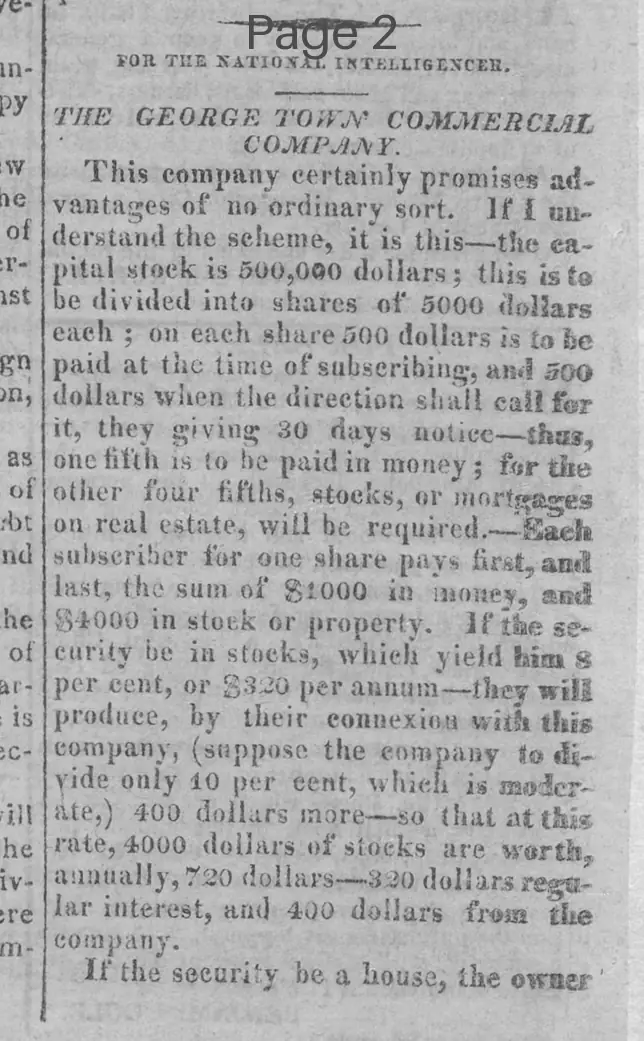
THE GEORGE TOWN COMMERCIAL COMPANY.
This company certainly promises advantages of no ordinary sort. If I understand the scheme, it is this—the capital stock is $50,000 dollars; this is to be divided into shares of $5000 dollars each; on each share $500 dollars is to be paid at the time of subscribing, and $500 dollars when the direction shall call for it, they giving 30 days notice—thus, one fifth is to be paid in money; for the other four fifths, stocks, or mortgages on real estate, will be required. Each subscriber for one share pays first, and last, the sum of $1000 in money, and $4000 in stock or property. If the security be in stocks, which yield him 6 per cent, or $240 per annum—they will produce, by their connexion with this company, (suppose the company to divide only 10 per cent, which is moderate,) $400 dollars more—so that at this rate, $4000 dollars of stocks are worth, annually, $720 dollars—$320 dollars regular interest, and $400 dollars from the company.
If the security be a house, the owner
gets his rent, or the use of it, as tho it were not connected with the company—and the dividend from the company, also: If it be land, the result is the same.
How is it with a farmer? He owns, for instance, land worth 8000 dollars—this, with 2000 dollars in money, will entitle him to 2 shares. He tills this land, enjoys its proceeds, as before: and, if the company divide only 10 per cent, it brings him 800 dollars annually, in addition; or, if the company divide 20 per cent, which may be sometimes expected, and reasonably, it adds to his income 1600 dollars. This serves necessarily to increase the value of property—for, if a house rent only for 500 dollars, and brings, after its connexion with this company, 500 dollars more, the owner would put a price on it which should bear a relation to its annual value. So with land—so with stocks.
The security which this scheme holds out, is ample. It proposes to receive no destructible property, unaccompanied by a policy of insurance. This perfects, and renders permanent, the system of security.
Stockholders are made perfectly safe; for even should they make nothing, they cannot lose, on the score of risque, inasmuch as the operations of the company, which involve risque, will be all covered by insurance.
But there is one feature in this scheme which has particularly challenged my attention. It is the restriction which the company proposes to itself, in its issues of promissory notes. It confines itself to an amount which shall not exceed the half of its capital. This feature, alone, is calculated to give a most unexampled credit to the company.—What could not that individual command, whose debts could never exceed the half of his estate? It seems to me, that the notes of such a company, founded in such substantial and overflowing security, will be sought after, and find a ready circulation every where.
The citizens of George Town and Washington, and the neighboring country, are particularly interested in the success of this company. The Farmer, the Planter, the Miller, the Merchant, the Mechanic, the Bankers, are all interested. We already begin to feel the good effects of the "Importing & Exporting Company," now in operation. A company known to every body to be well and substantially founded, and ably managed. Importations by this company, will, ere long, enliven our wharves.
And the day is at hand, when much labor, expense, and risque will be saved to our section of the country, by the foreign merchandize which will be emptied at our doors.
The completion of this period, is proposed to be facilitated by "The George-Town Commercial Company." The introduction into commercial operations, of three hundred thousand dollars, backed by two hundred thousand dollars extra security, cannot but swell the veins, and add to the blood of our commercial body—the most distant members of which will come in for their share of nourishment. The market will be increased for the produce of our soil—our store-houses will be laden with foreign merchandise—the bustle on our wharves, and in our streets, may be soon made to resemble that of our older cities. Spirit and enterprise will do much. This town need not progress with the dead-march step of individual exertion—the whole may be put into brisker motion, by a concentrated momentum. No disparagement is meant to individual exertion. Far from it. We have men amongst us whose individual exertions merit applause; men who have gone far towards giving to our town its present flourishing appearance. But their movements have been nevertheless slow, compared with those, which are always created by immense capital.
Never was there a period in the history of this place more friendly to commercial enterprise. Baltimore, it seems, has resolved (or the Banks in it rather) to receive no district bank paper, either in payment of bills, or on deposit. This new measure was adopted, if I am rightly informed, last Saturday. For one I am much obliged to those gentlemen.—I am so, because I dont live in Baltimore. If I were a citizen of that flourishing city, and a merchant, I should arraign the justness of that policy. But I am not and I am glad of it. If however they begin to wince at our growth, (for it cannot be that they doubt our Banking credit) and attempt to trammel us, in our youth, by a policy so illiberal, it is timely admonition to the citizens of our district to set up for themselves. I hope the citizens of Georgetown will take advantage of this hint. If it is well improved, it will work their independence. Let the citizens of Georgetown out with their turnpike roads—throw wide open the sluices of commerce—let individual exertion back the efforts of associations, in exporting and importing—and the day may be soon hastened, when to go to Baltimore for merchandise, from Georgetown, will be just cause of wonder—as much so, as it would be, to import stone from England.
As a citizen of Georgetown, I am obliged to our neighbors for this policy, which however illiberal it must be considered, cannot fail to do us good.
On Monday next the books will be opened at Mr. Semmes's Tavern for subscribers to "The Georgetown Commercial Company."—I sincerely trust that
What sub-type of article is it?
What themes does it cover?
What keywords are associated?
What entities or persons were involved?
Letter to Editor Details
Recipient
National Intelligencer
Main Argument
the george town commercial company offers substantial benefits to investors through its secure structure, low-risk operations backed by insurance, and potential high dividends, promoting local commerce and independence from baltimore; citizens should subscribe to capitalize on this opportunity.
Notable Details