Thank you for visiting SNEWPapers!
Sign up free
The Caledonian
Saint Johnsbury, Caledonia County, Vermont
What is this article about?
Congressman Daniel P. King writes to Robert S. Daniels defending his support for Whig presidential nominee Gen. Zachary Taylor in 1848, arguing it provides the best prospect for peace, reform, and curbing slavery extension over Democrat Lewis Cass or Free Soil Martin Van Buren. He cites John Quincy Adams' preference for Taylor.
Clipping
OCR Quality
Full Text
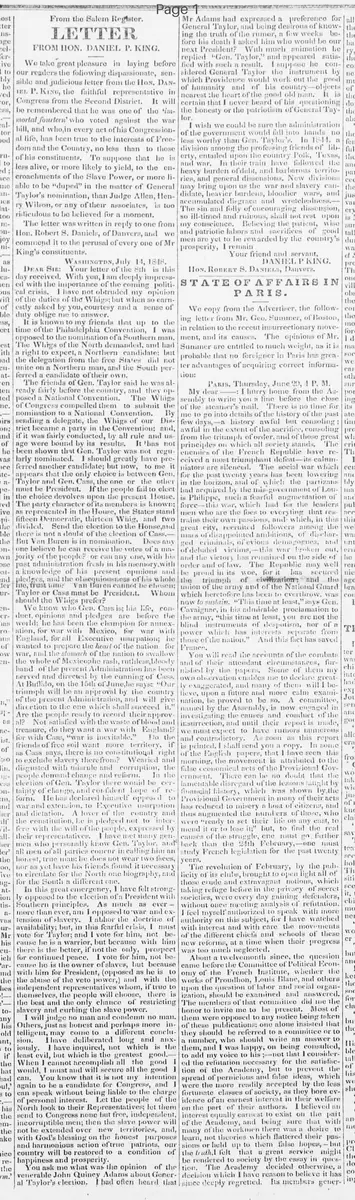
LETTER
FROM HON. DANIEL P. KING,
We take great pleasure in laying before our readers the following dispassionate, sensible and judicious letter from the Hon. Daniel P. King, the faithful representative in Congress from the Second District. It will be remembered that he was one of the immortal fourteen who voted against the war bill, and who, in every act of his Congressional life, has been true to the interests of freedom and the Country, no less than to those of his constituents. To suppose that he is less alive, or more likely to yield, to the encroachments of the Slave Power, or more liable to be "duped" in the matter of General Taylor's nomination, than Judge Allen, Henry Wilson, or any of their associates, is too ridiculous to be believed for a moment.
The letter was written in reply to one from Hon. Robert S. Daniels, of Danvers, and we commend it to the perusal of every one of Mr. King's constituents.
WASHINGTON, July 14, 1848.
DEAR SIR: Your letter of the 8th is this day received. With you, I am deeply impressed with the importance of the coming political crisis. I have not obtruded my opinion of the duties of the Whigs: but when so earnestly asked by you, courtesy and a sense of duty oblige me to answer.
It is known to my friends that up to the time of the Philadelphia Convention, I was opposed to the nomination of a Southern man. The Whigs of the North demanded, and had a right to expect, a Northern candidate; but the delegation from the free States did not unite on a Northern man, and the South preferred a candidate of their own.
The friends of Gen. Taylor said he was already fairly before the country, and they opposed a National Convention. The Whigs of Congress compelled them to submit the nomination to a National Convention. By sending a delegate, the Whigs of our District became a party in the Convention: and, if it was fairly conducted, by all rule and usage we were bound by its results. It has not been shown that Gen. Taylor was not regularly nominated. I should greatly have preferred another candidate: but now, to me it appears that the only choice is between Gen. Taylor and Gen. Cass, the one or the other must be President. If the people fail to elect, the choice devolves upon the present House. The party character of its members is known: as represented in the House, the States stand fifteen Democratic, thirteen Whig, and two divided. Send the election to the House, and there is not a doubt of the election of Cass.
But Van Buren is in nomination. Does any one believe he can receive the votes of a majority of the people? or can any one, with his past administration fresh in his memory, with a knowledge of his present opinions and pledges, and the obsequiousness of his whole party, trust him? Van Buren cannot be chosen: Taylor or Cass must be President.
Whom should the Whigs prefer?
We know who Gen. Cass is; his life, conduct, opinions and pledges are before the world: he has been the champion for annexation, for war with Mexico, for war with England, for all Executive usurpation; he wanted to prepare the heart of the nation for war, and the stomach of the nation to swallow the whole of Mexico; the rash, ruthless, bloody hand of the present Administration has been nerved and directed by the cunning of Cass. At Buffalo, on the 15th of June, he says: "Our triumph will be an approval by the country of the present Administration, and will give direction to the one which shall succeed it."
Are the people ready to record their approbation? Not satisfied with the waste of blood and treasure, do they want a war with England? for with Cass, "war is inevitable." Do the friends of free soil want more territory, if, as Cass says, there is no constitutional right to exclude slavery therefrom? Weary and disgusted with misrule and corruption, the people demand change and reform. In the election of Gen. Taylor there would be certainty of change, and confident hope of reform. He has declared himself opposed to war and extension, to Executive usurpation and dictation. A lover of the country and the constitution, he is pledged not to interfere with the will of the people, expressed by their representatives. I have met many gentlemen who personally know Gen. Taylor, and all men of all parties concur in calling him an honest, true man: he does not wear two faces, nor as yet have his friends found it necessary to circulate for the North one biography, and for the South a different one.
In this great emergency, I have felt strongly opposed to the election of a President with Southern principles. As much as ever—more than ever, am I opposed to war and extension of slavery. I abhor the doctrine of availability; but, in this fearful crisis, I must vote for Taylor; and I vote for him, not because he is a warrior, but because with him there is the better, if not the only, prospect for continued peace. I vote for him, not because he is the owner of slaves, but because with him for President, (opposed as he is to the abuse of the veto power,) and with the independent representatives whom, if true to themselves, the people will choose, there is the best and the only chance of restricting slavery and curbing the slave power.
I will judge no man and condemn no man. Others, just as honest and perhaps more intelligent, may come to a different conclusion.
I have deliberated long and anxiously. I have inquired, not which is the least evil, but which is the greatest good. When I cannot accomplish all the good I would, I must and will secure all the good I can. You know that it is not my intention again to be a candidate for Congress, and I can speak without being liable to the charge of personal interest. Let the people of the North look to their Representatives; let them send to Congress none but free, independent, incorruptible men; then the slave power will not be extended over new territories, and, with God's blessing on the honest purposes and harmonious action of true patriots, our country will be restored to a condition of happiness and prosperity.
You ask me what was the opinion of the venerable John Quincy Adams about General Taylor's election. I had often heard that Mr. Adams had expressed a preference for General Taylor, and being desirous of knowing the truth of the rumor, a few weeks before his death I asked him who would be our next President? With much animation he replied "Gen. Taylor," and appeared satisfied with such a result. I suppose he considered General Taylor the instrument by which Providence would work out the good of humanity and of his country—objects nearest the heart of the good old man. It is certain that I never heard of his questioning the honesty or the patriotism of General Taylor.
I wish we could be sure the administration of the government would fall into hands no less worthy than Gen. Taylor's. In 1844, a division among the professing friends of liberty, entailed upon the country Polk, Texas, and war. In their train have followed the heavy burden of debt, and barbarous territories, and general dissensions. New divisions may bring upon us the war and slavery candidate, heavier burdens, bloodier wars, and accumulated disgrace and wretchedness.
The sin and folly of encouraging dissension so ill-timed and ruinous, shall not rest upon my conscience. Believing the patient, wise and patriotic labors and sacrifices of good men are yet to be rewarded by the country's prosperity, I remain
Your friend and servant,
DANIEL P. KING,
Hon. ROBERT S. DANIELS, Danvers.
What sub-type of article is it?
What themes does it cover?
What keywords are associated?
What entities or persons were involved?
Letter to Editor Details
Author
Daniel P. King
Recipient
Hon. Robert S. Daniels, Danvers
Main Argument
in the 1848 presidential election, whigs should support gen. zachary taylor over gen. lewis cass or martin van buren, as taylor offers the best chance for peace, reform, and restricting the extension of slavery, despite his southern background.
Notable Details