Thank you for visiting SNEWPapers!
Sign up free
Story
May 15, 1859
Nashville Union And American
Nashville, Davidson County, Tennessee
What is this article about?
Historical anecdote of George Washington's rejected courtship of heiress Mary Cary due to his modest means, followed by a poignant reunion after his Yorktown victory in 1781.
Clipping
OCR Quality
95%
Excellent
Full Text
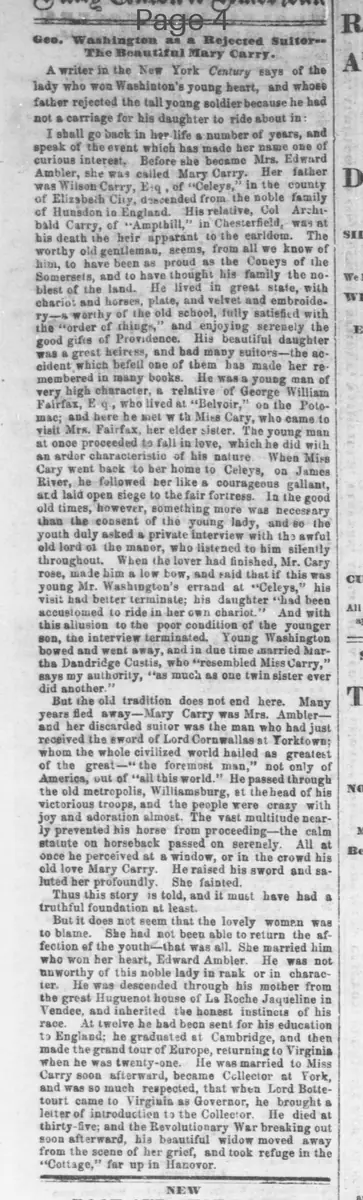
Geo. Washington as a Rejected Suitor—The Beautiful Mary Cary.
A writer in the New York Century says of the lady who won Washington's young heart, and whose father rejected the tall young soldier because he had not a carriage for his daughter to ride about in:
I shall go back in her life a number of years, and speak of the event which has made her name one of curious interest. Before she became Mrs. Edward Ambler, she was called Mary Cary. Her father was Wilson Cary, Esq., of "Celeys," in the county of Elizabeth City, descended from the noble family of Hunsdon in England. His relative, Col. Archibald Cary, of "Ampthill," in Chesterfield, was at his death the heir apparent to the earldom. The worthy old gentleman, seems, from all we know of him, to have been as proud as the Carys of the Somersets, and to have thought his family the noblest of the land. He lived in great state, with chariot and horses, plate, and velvet and embroidery—a worthy of the old school, fully satisfied with the "order of things," and enjoying serenely the good gifts of Providence.
She was a great heiress, and had many suitors—the accident which befell one of them has made her remembered in many books. He was a young man of very high character, a relative of George William Fairfax, Esq., who lived at "Belvoir," on the Potomac; and here he met with Miss Cary, who came to visit Mrs. Fairfax, her elder sister. The young man at once proceeded to fall in love, which he did with an ardor characteristic of his nature. When Miss Cary went back to her home to Celeys, on James River, he followed her like a courageous gallant, and laid open siege to the fair fortress. In the good old times, however, something more was necessary than the consent of the young lady, and so the youth duly asked a private interview with the awful lord of the manor, who listened to him silently throughout. When the lover had finished, Mr. Cary rose, made him a low bow, and said that if this was young Mr. Washington's errand at "Celeys," his visit had better terminate; his daughter "had been accustomed to ride in her own chariot." And with this allusion to the poor condition of the younger son, the interview terminated. Young Washington bowed and went away, and in due time married Martha Dandridge Custis, who "resembled Miss Cary," says my authority, "as much as one twin sister ever did another."
But the old tradition does not end here. Many years fled away—Mary Cary was Mrs. Ambler—and her discarded suitor was the man who had just received the sword of Lord Cornwallis at Yorktown; whom the whole civilized world hailed as greatest of the great—“the foremost man," not only of America, but of "all this world." He passed through the old metropolis, Williamsburg, at the head of his victorious troops, and the people were crazy with joy and adoration almost. The vast multitude nearly prevented his horse from proceeding—the calm statue on horseback passed on serenely. All at once he perceived at a window, or in the crowd his old love Mary Cary. He raised his sword and saluted her profoundly. She fainted.
Thus this story is told, and it must have had a truthful foundation at least.
But it does not seem that the lovely woman was to blame. She had not been able to return the affection of the youth—that was all. She married him who won her heart, Edward Ambler. He was not unworthy of this noble lady in rank or in character. He was descended through his mother from the great Huguenot house of La Roche Jaqueline in Vendee, and inherited the honest instincts of his race. At twelve he had been sent for his education to England; he graduated at Cambridge, and then made the grand tour of Europe, returning to Virginia when he was twenty-one. He was married to Miss Cary soon afterward, became Collector at York, and was so much respected, that when Lord Botetourt came to Virginia as Governor, he brought a letter of introduction to the Collector. He died at thirty-five; and the Revolutionary War breaking out soon afterward, his beautiful widow moved away from the scene of her grief, and took refuge in the "Cottage," far up in Hanover.
A writer in the New York Century says of the lady who won Washington's young heart, and whose father rejected the tall young soldier because he had not a carriage for his daughter to ride about in:
I shall go back in her life a number of years, and speak of the event which has made her name one of curious interest. Before she became Mrs. Edward Ambler, she was called Mary Cary. Her father was Wilson Cary, Esq., of "Celeys," in the county of Elizabeth City, descended from the noble family of Hunsdon in England. His relative, Col. Archibald Cary, of "Ampthill," in Chesterfield, was at his death the heir apparent to the earldom. The worthy old gentleman, seems, from all we know of him, to have been as proud as the Carys of the Somersets, and to have thought his family the noblest of the land. He lived in great state, with chariot and horses, plate, and velvet and embroidery—a worthy of the old school, fully satisfied with the "order of things," and enjoying serenely the good gifts of Providence.
She was a great heiress, and had many suitors—the accident which befell one of them has made her remembered in many books. He was a young man of very high character, a relative of George William Fairfax, Esq., who lived at "Belvoir," on the Potomac; and here he met with Miss Cary, who came to visit Mrs. Fairfax, her elder sister. The young man at once proceeded to fall in love, which he did with an ardor characteristic of his nature. When Miss Cary went back to her home to Celeys, on James River, he followed her like a courageous gallant, and laid open siege to the fair fortress. In the good old times, however, something more was necessary than the consent of the young lady, and so the youth duly asked a private interview with the awful lord of the manor, who listened to him silently throughout. When the lover had finished, Mr. Cary rose, made him a low bow, and said that if this was young Mr. Washington's errand at "Celeys," his visit had better terminate; his daughter "had been accustomed to ride in her own chariot." And with this allusion to the poor condition of the younger son, the interview terminated. Young Washington bowed and went away, and in due time married Martha Dandridge Custis, who "resembled Miss Cary," says my authority, "as much as one twin sister ever did another."
But the old tradition does not end here. Many years fled away—Mary Cary was Mrs. Ambler—and her discarded suitor was the man who had just received the sword of Lord Cornwallis at Yorktown; whom the whole civilized world hailed as greatest of the great—“the foremost man," not only of America, but of "all this world." He passed through the old metropolis, Williamsburg, at the head of his victorious troops, and the people were crazy with joy and adoration almost. The vast multitude nearly prevented his horse from proceeding—the calm statue on horseback passed on serenely. All at once he perceived at a window, or in the crowd his old love Mary Cary. He raised his sword and saluted her profoundly. She fainted.
Thus this story is told, and it must have had a truthful foundation at least.
But it does not seem that the lovely woman was to blame. She had not been able to return the affection of the youth—that was all. She married him who won her heart, Edward Ambler. He was not unworthy of this noble lady in rank or in character. He was descended through his mother from the great Huguenot house of La Roche Jaqueline in Vendee, and inherited the honest instincts of his race. At twelve he had been sent for his education to England; he graduated at Cambridge, and then made the grand tour of Europe, returning to Virginia when he was twenty-one. He was married to Miss Cary soon afterward, became Collector at York, and was so much respected, that when Lord Botetourt came to Virginia as Governor, he brought a letter of introduction to the Collector. He died at thirty-five; and the Revolutionary War breaking out soon afterward, his beautiful widow moved away from the scene of her grief, and took refuge in the "Cottage," far up in Hanover.
What sub-type of article is it?
Biography
Romance
Historical Event
What themes does it cover?
Love
Fortune Reversal
Social Manners
What keywords are associated?
Washington Suitor
Mary Cary
Courtship Rejection
Yorktown Salute
Historical Romance
What entities or persons were involved?
Geo. Washington
Mary Cary
Wilson Cary
Edward Ambler
George William Fairfax
Where did it happen?
Celeys, Elizabeth City, Virginia; Belvoir, Potomac; James River; Williamsburg; Yorktown; Hanover
Story Details
Key Persons
Geo. Washington
Mary Cary
Wilson Cary
Edward Ambler
George William Fairfax
Location
Celeys, Elizabeth City, Virginia; Belvoir, Potomac; James River; Williamsburg; Yorktown; Hanover
Event Date
Pre Revolutionary War Period, Culminating In 1781 At Yorktown
Story Details
Young George Washington courts Mary Cary but is rejected by her father for lacking a carriage. Years later, after his victory at Yorktown, he salutes her in Williamsburg, causing her to faint. Mary marries Edward Ambler instead.