Thank you for visiting SNEWPapers!
Sign up free
Literary
July 22, 1843
The North Carolinian
Fayetteville, Cumberland County, North Carolina
What is this article about?
In a German tradition, the Baron of Atterkeim arranges his daughter Hildegarde's marriage to knight Hermann, despite her feelings for poor Count Frauburg. Hermann's jealous brother Edward disguises as the Bronze Soldier to disrupt the wedding with a supernatural omen, leading to fatal violence between the brothers and the curse on Stolberg.
Clipping
OCR Quality
98%
Excellent
Full Text
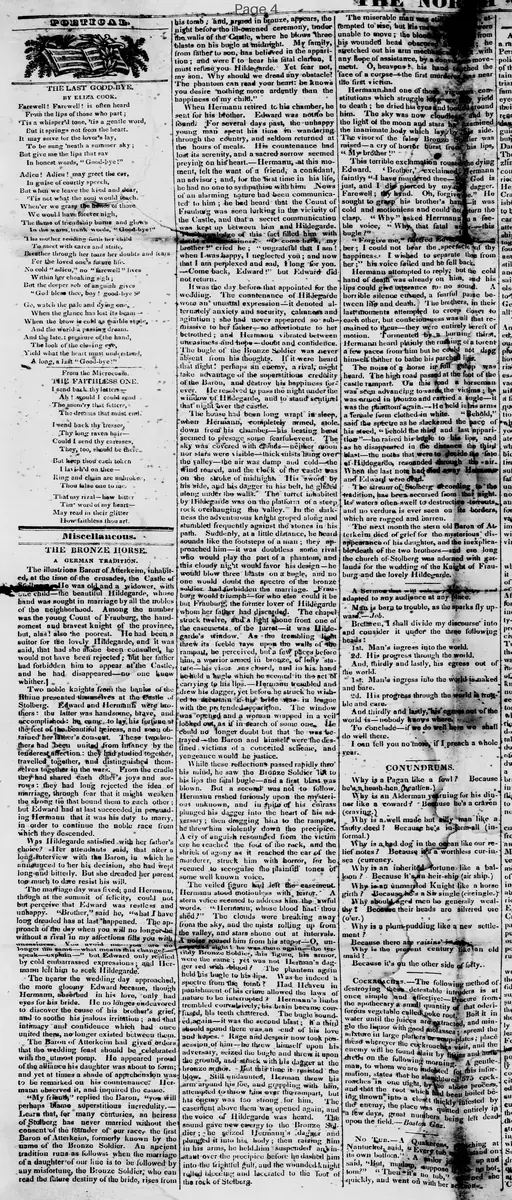
THE BRONZE HORSE:
A German Tradition.
The illustrious Baron of Atterkeim, inhabited, at the time of the crusades, the Castle of Stolberg. He was old and a widower, with one child—the beautiful Hildegarde, whose hand was sought in marriage by all the nobles of the neighborhood. Among the number was the young Count of Frauburg, the handsomest and bravest knight of the province, but, alas! also the poorest. He had been a suitor for the lovely Hildegarde, and it was said, that had she alone been consulted, he would not have been rejected; but her father had forbidden him to appear at the Castle, and he had disappeared—no one knew whither.
Two noble knights from the banks of the Rhine presented themselves at the Castle of Stolberg. Edward and Hermann were brothers: the latter was handsome, brave, and accomplished: he came to lay his fortune at the feet of the beautiful heiress, and soon obtained her father's consent. These two brothers had been united from infancy by the tenderest affection: they had studied together, travelled together, and distinguished themselves together in the wars. From the cradle they had shared each other's joys and sorrows: they had long rejected the idea of marriage, through fear that it might weaken the strong tie that bound them to each other; but Edward had at last succeeded in persuading Hermann that it was his duty to marry, in order to continue the noble race from which they descended.
Was Hildegarde satisfied with her father's choice? Her attendants said, that after a long interview with the Baron, in which he announced to her his decision, she had wept long and bitterly. But she dreaded her parent too much to dare resist his will. The marriage day was fixed; and Hermann, though at the summit of felicity, could not but perceive that Edward was restless and unhappy. "Brother," said he, "what have long dreaded has at last happened. The approach of the day when you will no longer be without a rival in my affections fills you with uneasiness. You avoid me—you are no longer the same—what means this change?" Speak—explain—" but Edward only replied by cold embarrassed expressions; and Hermann left him to seek Hildegarde.
The nearer the wedding day approached, the more gloomy Edward became, though Hermann, absorbed in his love, only had eyes for his bride. He no longer endeavored to discover the cause of his brother's grief, and to soothe his jealous irritation; and that intimacy and confidence which had once united them, no longer existed between them. The Baron of Atterkeim had given orders that the wedding feast should be celebrated with the utmost pomp. He appeared proud of the alliance his daughter was about to form; and yet at times a shade of apprehension was to be remarked on his countenance. Hermann observed it, and inquired the cause. "My friend," replied the Baron, "you will perhaps blame a superstitious incredulity. Learn that, for many centuries, an heiress of Stolberg has never married without the consent of the founder of our race, the first Baron of Atterkeim, formerly known by the name of the Bronze Soldier. An ancient tradition runs as follows: when the marriage of a daughter of our line is to be followed by any misfortune, the Bronze Soldier, who can read the future destiny of the bride, rises from his tomb; and, armed in bronze, appears, the night before the ill-omened ceremony, to do the walls of the Castle, where he blows three blasts on his bugle at midnight. My family, from father to son, has believed in the apparition; and were I to hear his fatal clarion, I must refuse you Hildegarde. Yet fear not, my son. Why should we dread any obstacle? The phantom can read your heart: he knows you desire nothing more ardently than the happiness of my child."
When Hermann retired to his chamber, he sent for his brother. Edward was not to be found. For several days past, the unhappy young man spent his time in wandering through the country, and seldom returned at the hours of meals. His countenance had lost its serenity, and a sacred sorrow seemed preying on his heart. Hermann, at this moment, felt the want of a friend; a confidant, an adviser; and, for the first time in his life, he had no one to sympathise with him: News of an alarming nature had been communicated to him; he had heard that the Count of Frauburg was seen lurking in the vicinity of the Castle, and that a secret communication was kept up between him and Hildegarde. Knowledge of this fact filled him with doubts and unhappiness. "O come back, my brother!" cried he; "ungrateful that I am! when I was happy, I neglected you; and now that I am perplexed and sad, I long for you. Come back, Edward!" but Edward did not return.
It was the day before that appointed for the wedding. The countenance of Hildegarde wore an unusual expression—it denoted alternately anxiety and security, calmness and agitation; she had never appeared so submissive to her father—so affectionate to her betrothed; and Hermann vibrated between uneasiness and hope—doubt and confidence. The bugle of the Bronze Soldier was never absent from his thoughts. If it were heard that night: perhaps an enemy, a rival, might take advantage of the superstitious credulity of the Baron, and destroy his happiness forever. He resolved to pass the night under the window of Hildegarde, and to stand sentinel that night over the castle.
The house had been long wrapt in sleep, when Hermann, completely armed, stole down from his chamber—his beating heart seemed to presage some fearful event. The sky was covered with clouds—neither moon nor stars were visible—thick mists hung over the valley—the air was damp and cold—the wind roared, and the clock of the castle was on the stroke of midnight. His sword by his side, and his dagger in his belt, he glided along under the walls. The turret inhabited by Hildegarde was on the platform of a steep rock overhanging the valley. In the darkness the adventurous knight groped along and stumbled frequently against the stones in his path. Suddenly, at a little distance, he heard sounds like the footsteps of a man; they approached him—it was doubtless some rival who would play the part of a phantom, and this cloudy night would favor his design—he would blow three blasts on a bugle, and no one would doubt the spectre of the bronze soldier had forbidden the marriage. Frauburg would triumph—for who else could it be but Frauburg, the former lover of Hildegarde whom her father had discarded. The chapel struck twelve, and a light shone from one of the casements of the turret—it was Hildegarde's window. As the trembling light threw its feeble rays upon the walls of the rampart, he perceived, but a few paces before him, a warrior armed in bronze, of lofty stature—his visor was closed, and in his hand he held a bugle which he seemed in the act of carrying to his lips. Hermann trembled and drew his dagger, yet before he struck he wished to ascertain if his bride was in league with the pretended apparition. The window was opened and a woman wrapped in a veil looked out, as if in search of some one. He could no longer doubt but that he was betrayed—the Baron and himself were the destined victims of a concerted scheme, and vengeance would be justice.
While these reflections passed rapidly thro' his mind, he saw the Bronze Soldier fit to his lips the fatal bugle—and a first blast was blown. But a second was not to follow. Hermann rushed furiously upon the mysterious unknown, and in spite of his cuirass plunged his dagger into the heart of his adversary; then dragging him to the rampart, he threw him violently down the precipice. A cry of anguish resounded from the victim ere he reached the foot of the rock, and the shriek of agony as it reached the ear of the murderer, struck him with horror, for he seemed to recognise the plaintive tones of some well known voice.
The veiled figure had let the casement. Hermann stood motionless with terror. A stern voice seemed to address him—the awful words. Hermann, whose blood hast thou shed? The clouds were breaking away from the sky, and the mists rolling up from the valley, and stars shone out at intervals. A noise roused him from his stupor—O, uncovered sight! he was there again the terribly Bronze Soldier, his figure, his armor were the same; yet was not Hermann's dagger red with blood? The phantom again held his bugle to his lips. Was he indeed a spectre from the tomb? Had Heaven in punishment of his crime allowed the laws of nature to be interrupted? Hermann's limbs trembled convulsively; his brain became confused, his teeth chattered. The bugle sounded again—it was the second blast; if a third should sound there was an end of his love and hopes. Rage and despair now took possession of him—he threw himself upon his adversary, seized the bugle and threw it upon the ground, and struck with his dagger at the bronze armor. But this time it resisted the blow. Still undaunted, Hermann threw his arm around his foe, and grappling with him, attempted to throw him over the rampart, but his enemy was too strong for him. The casement above them was opened again, and the voice of Hildegarde was heard. The sound gave new energy to the Bronze Soldier; he seized Hermann's dagger and plunged it into his body; then raising him in his arms, he held him suspended an instant over the precipice before he dashed him into the frightful gulf, and the wounded knight rolled bleeding and lacerated to the foot of the rock of Stolberg.
The miserable man attempted to rise; but his members were unable to move; the blood from his wounded head obscured his sight; he stretched out his arm mechanically with any hope of assistance, by a convulsive movement. O, heavens! his hand touched the face of a corpse—the first murderer as near the first victim. Hermann had one of those constitutions which struggle long to yield to death; he dried his eyes and looked around him. The sky was now clouded and by the light of the moon and stars he examined the inanimate body which lay by his side. The visor of the false Bronze Soldier was raised—a cry of horror burst from his lips, "My brother!"
This terrible exclamation roused the dying Edward. "Brother," exclaimed Hermann faintly, "I have murdered thee! God is just, and I die pierced by my own dagger. Farewell, my brother. Oh, forgive me." He sought to grasp his brother's hand—it was cold and motionless and could not return the clasp. "Why," asked Hermann in a feeble voice; "Why that fatal at this bugle?" "Forgive me," faltered Edward; "I could not bear the spectacle of thy happiness. I wished to separate thee from her;" his voice failed and he fell back. Hermann attempted to reply; but the cold hand of death was already on him, and his lips could give utterance to no sound. A horrible silence ensued, a fearful pause between life and death. The brothers, in their last moments attempted to creep closer to each other, but consciousness was all that remained to them—they were entirely bereft of motion.
Tormented by a burning thirst, Hermann heard plainly the rushing of a torrent a few paces from him but he could not drag himself thither to bathe his parched lips. The noise of a horse in full gallop was heard. The high road passed at the foot of the castle rampart. On this road a horseman was seen advancing towards the victims; he was clad in bronze and carried a bugle—it was the phantom again. He held in his arms a female form clothed in white. "Behold," said the spectre as he slackened the pace of his steed, "behold the third and last apparition"—he raised his bugle to his lips, and as he disappeared in the distance the third blast—the notes that were to decide the fate of Hildegarde, resounded through the air. When the last note had died away Hermann and Edward were dead.
The stream of Stolberg according to the tradition, has been accursed from that night. Its waters often swell to destructive torrents, and no verdure is ever seen on its borders, which are rugged and barren. The next month the stern old Baron of Atterkeim died of grief for the mysterious disappearance of his daughter, and the inexplicable death of the two brothers—and ere long the church of Stolberg was adorned with garlands for the wedding of the Knight of Frauburg and the lovely Hildegarde.
A German Tradition.
The illustrious Baron of Atterkeim, inhabited, at the time of the crusades, the Castle of Stolberg. He was old and a widower, with one child—the beautiful Hildegarde, whose hand was sought in marriage by all the nobles of the neighborhood. Among the number was the young Count of Frauburg, the handsomest and bravest knight of the province, but, alas! also the poorest. He had been a suitor for the lovely Hildegarde, and it was said, that had she alone been consulted, he would not have been rejected; but her father had forbidden him to appear at the Castle, and he had disappeared—no one knew whither.
Two noble knights from the banks of the Rhine presented themselves at the Castle of Stolberg. Edward and Hermann were brothers: the latter was handsome, brave, and accomplished: he came to lay his fortune at the feet of the beautiful heiress, and soon obtained her father's consent. These two brothers had been united from infancy by the tenderest affection: they had studied together, travelled together, and distinguished themselves together in the wars. From the cradle they had shared each other's joys and sorrows: they had long rejected the idea of marriage, through fear that it might weaken the strong tie that bound them to each other; but Edward had at last succeeded in persuading Hermann that it was his duty to marry, in order to continue the noble race from which they descended.
Was Hildegarde satisfied with her father's choice? Her attendants said, that after a long interview with the Baron, in which he announced to her his decision, she had wept long and bitterly. But she dreaded her parent too much to dare resist his will. The marriage day was fixed; and Hermann, though at the summit of felicity, could not but perceive that Edward was restless and unhappy. "Brother," said he, "what have long dreaded has at last happened. The approach of the day when you will no longer be without a rival in my affections fills you with uneasiness. You avoid me—you are no longer the same—what means this change?" Speak—explain—" but Edward only replied by cold embarrassed expressions; and Hermann left him to seek Hildegarde.
The nearer the wedding day approached, the more gloomy Edward became, though Hermann, absorbed in his love, only had eyes for his bride. He no longer endeavored to discover the cause of his brother's grief, and to soothe his jealous irritation; and that intimacy and confidence which had once united them, no longer existed between them. The Baron of Atterkeim had given orders that the wedding feast should be celebrated with the utmost pomp. He appeared proud of the alliance his daughter was about to form; and yet at times a shade of apprehension was to be remarked on his countenance. Hermann observed it, and inquired the cause. "My friend," replied the Baron, "you will perhaps blame a superstitious incredulity. Learn that, for many centuries, an heiress of Stolberg has never married without the consent of the founder of our race, the first Baron of Atterkeim, formerly known by the name of the Bronze Soldier. An ancient tradition runs as follows: when the marriage of a daughter of our line is to be followed by any misfortune, the Bronze Soldier, who can read the future destiny of the bride, rises from his tomb; and, armed in bronze, appears, the night before the ill-omened ceremony, to do the walls of the Castle, where he blows three blasts on his bugle at midnight. My family, from father to son, has believed in the apparition; and were I to hear his fatal clarion, I must refuse you Hildegarde. Yet fear not, my son. Why should we dread any obstacle? The phantom can read your heart: he knows you desire nothing more ardently than the happiness of my child."
When Hermann retired to his chamber, he sent for his brother. Edward was not to be found. For several days past, the unhappy young man spent his time in wandering through the country, and seldom returned at the hours of meals. His countenance had lost its serenity, and a sacred sorrow seemed preying on his heart. Hermann, at this moment, felt the want of a friend; a confidant, an adviser; and, for the first time in his life, he had no one to sympathise with him: News of an alarming nature had been communicated to him; he had heard that the Count of Frauburg was seen lurking in the vicinity of the Castle, and that a secret communication was kept up between him and Hildegarde. Knowledge of this fact filled him with doubts and unhappiness. "O come back, my brother!" cried he; "ungrateful that I am! when I was happy, I neglected you; and now that I am perplexed and sad, I long for you. Come back, Edward!" but Edward did not return.
It was the day before that appointed for the wedding. The countenance of Hildegarde wore an unusual expression—it denoted alternately anxiety and security, calmness and agitation; she had never appeared so submissive to her father—so affectionate to her betrothed; and Hermann vibrated between uneasiness and hope—doubt and confidence. The bugle of the Bronze Soldier was never absent from his thoughts. If it were heard that night: perhaps an enemy, a rival, might take advantage of the superstitious credulity of the Baron, and destroy his happiness forever. He resolved to pass the night under the window of Hildegarde, and to stand sentinel that night over the castle.
The house had been long wrapt in sleep, when Hermann, completely armed, stole down from his chamber—his beating heart seemed to presage some fearful event. The sky was covered with clouds—neither moon nor stars were visible—thick mists hung over the valley—the air was damp and cold—the wind roared, and the clock of the castle was on the stroke of midnight. His sword by his side, and his dagger in his belt, he glided along under the walls. The turret inhabited by Hildegarde was on the platform of a steep rock overhanging the valley. In the darkness the adventurous knight groped along and stumbled frequently against the stones in his path. Suddenly, at a little distance, he heard sounds like the footsteps of a man; they approached him—it was doubtless some rival who would play the part of a phantom, and this cloudy night would favor his design—he would blow three blasts on a bugle, and no one would doubt the spectre of the bronze soldier had forbidden the marriage. Frauburg would triumph—for who else could it be but Frauburg, the former lover of Hildegarde whom her father had discarded. The chapel struck twelve, and a light shone from one of the casements of the turret—it was Hildegarde's window. As the trembling light threw its feeble rays upon the walls of the rampart, he perceived, but a few paces before him, a warrior armed in bronze, of lofty stature—his visor was closed, and in his hand he held a bugle which he seemed in the act of carrying to his lips. Hermann trembled and drew his dagger, yet before he struck he wished to ascertain if his bride was in league with the pretended apparition. The window was opened and a woman wrapped in a veil looked out, as if in search of some one. He could no longer doubt but that he was betrayed—the Baron and himself were the destined victims of a concerted scheme, and vengeance would be justice.
While these reflections passed rapidly thro' his mind, he saw the Bronze Soldier fit to his lips the fatal bugle—and a first blast was blown. But a second was not to follow. Hermann rushed furiously upon the mysterious unknown, and in spite of his cuirass plunged his dagger into the heart of his adversary; then dragging him to the rampart, he threw him violently down the precipice. A cry of anguish resounded from the victim ere he reached the foot of the rock, and the shriek of agony as it reached the ear of the murderer, struck him with horror, for he seemed to recognise the plaintive tones of some well known voice.
The veiled figure had let the casement. Hermann stood motionless with terror. A stern voice seemed to address him—the awful words. Hermann, whose blood hast thou shed? The clouds were breaking away from the sky, and the mists rolling up from the valley, and stars shone out at intervals. A noise roused him from his stupor—O, uncovered sight! he was there again the terribly Bronze Soldier, his figure, his armor were the same; yet was not Hermann's dagger red with blood? The phantom again held his bugle to his lips. Was he indeed a spectre from the tomb? Had Heaven in punishment of his crime allowed the laws of nature to be interrupted? Hermann's limbs trembled convulsively; his brain became confused, his teeth chattered. The bugle sounded again—it was the second blast; if a third should sound there was an end of his love and hopes. Rage and despair now took possession of him—he threw himself upon his adversary, seized the bugle and threw it upon the ground, and struck with his dagger at the bronze armor. But this time it resisted the blow. Still undaunted, Hermann threw his arm around his foe, and grappling with him, attempted to throw him over the rampart, but his enemy was too strong for him. The casement above them was opened again, and the voice of Hildegarde was heard. The sound gave new energy to the Bronze Soldier; he seized Hermann's dagger and plunged it into his body; then raising him in his arms, he held him suspended an instant over the precipice before he dashed him into the frightful gulf, and the wounded knight rolled bleeding and lacerated to the foot of the rock of Stolberg.
The miserable man attempted to rise; but his members were unable to move; the blood from his wounded head obscured his sight; he stretched out his arm mechanically with any hope of assistance, by a convulsive movement. O, heavens! his hand touched the face of a corpse—the first murderer as near the first victim. Hermann had one of those constitutions which struggle long to yield to death; he dried his eyes and looked around him. The sky was now clouded and by the light of the moon and stars he examined the inanimate body which lay by his side. The visor of the false Bronze Soldier was raised—a cry of horror burst from his lips, "My brother!"
This terrible exclamation roused the dying Edward. "Brother," exclaimed Hermann faintly, "I have murdered thee! God is just, and I die pierced by my own dagger. Farewell, my brother. Oh, forgive me." He sought to grasp his brother's hand—it was cold and motionless and could not return the clasp. "Why," asked Hermann in a feeble voice; "Why that fatal at this bugle?" "Forgive me," faltered Edward; "I could not bear the spectacle of thy happiness. I wished to separate thee from her;" his voice failed and he fell back. Hermann attempted to reply; but the cold hand of death was already on him, and his lips could give utterance to no sound. A horrible silence ensued, a fearful pause between life and death. The brothers, in their last moments attempted to creep closer to each other, but consciousness was all that remained to them—they were entirely bereft of motion.
Tormented by a burning thirst, Hermann heard plainly the rushing of a torrent a few paces from him but he could not drag himself thither to bathe his parched lips. The noise of a horse in full gallop was heard. The high road passed at the foot of the castle rampart. On this road a horseman was seen advancing towards the victims; he was clad in bronze and carried a bugle—it was the phantom again. He held in his arms a female form clothed in white. "Behold," said the spectre as he slackened the pace of his steed, "behold the third and last apparition"—he raised his bugle to his lips, and as he disappeared in the distance the third blast—the notes that were to decide the fate of Hildegarde, resounded through the air. When the last note had died away Hermann and Edward were dead.
The stream of Stolberg according to the tradition, has been accursed from that night. Its waters often swell to destructive torrents, and no verdure is ever seen on its borders, which are rugged and barren. The next month the stern old Baron of Atterkeim died of grief for the mysterious disappearance of his daughter, and the inexplicable death of the two brothers—and ere long the church of Stolberg was adorned with garlands for the wedding of the Knight of Frauburg and the lovely Hildegarde.
What sub-type of article is it?
Prose Fiction
What themes does it cover?
Love Romance
Friendship
Death Mortality
What keywords are associated?
German Tradition
Bronze Soldier
Knights
Jealousy
Supernatural
Marriage
Castle Stolberg
Brothers
Phantom
Wedding Omen
Literary Details
Title
The Bronze Horse: A German Tradition.
Subject
A German Tradition