Thank you for visiting SNEWPapers!
Sign up free
Editorial
June 18, 1792
National Gazette
Philadelphia, Philadelphia County, Pennsylvania
What is this article about?
An editorial criticizing the U.S. excise law as imitating Britain's corrupt indirect taxation system, referencing 1776 Whigs' resistance in Germantown and warning against partial reforms that lull public vigilance. Dated June 14.
Clipping
OCR Quality
98%
Excellent
Full Text
For the NATIONAL GAZETTE.
EXCISE LAW.
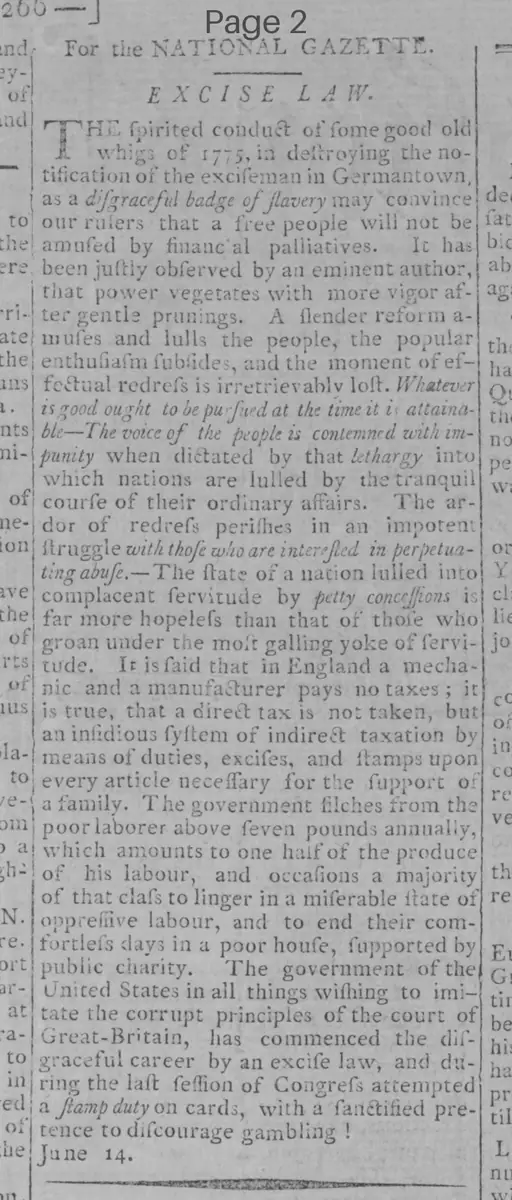
The spirited conduct of some good old whigs of 1775, in destroying the notification of the exciseman in Germantown, as a disgraceful badge of slavery may convince our rulers that a free people will not be amused by financial palliatives. It has been justly observed by an eminent author, that power vegetates with more vigor after gentle prunings. A slender reform amuses and lulls the people, the popular enthusiasm subsides, and the moment of effectual redress is irretrievably lost. Whatever is good ought to be pursued at the time it is attainable—The voice of the people is contemned with impunity when dictated by that lethargy into which nations are lulled by the tranquil course of their ordinary affairs. The ardor of redress perishes in an impotent struggle with those who are interested in perpetuating abuse.—The state of a nation lulled into complacent servitude by petty concessions is far more hopeless than that of those who groan under the most galling yoke of servitude. It is said that in England a mechanic and a manufacturer pays no taxes; it is true, that a direct tax is not taken, but an insidious system of indirect taxation by means of duties, excises, and stamps upon every article necessary for the support of a family. The government filches from the poor laborer above seven pounds annually, which amounts to one half of the produce of his labour, and occasions a majority of that class to linger in a miserable state of oppressive labour, and to end their comfortless days in a poor house, supported by public charity. The government of the United States in all things wishing to imitate the corrupt principles of the court of Great-Britain, has commenced the disgraceful career by an excise law, and during the last session of Congress attempted a stamp duty on cards, with a sanctified pretence to discourage gambling!
June 14.
EXCISE LAW.
The spirited conduct of some good old whigs of 1775, in destroying the notification of the exciseman in Germantown, as a disgraceful badge of slavery may convince our rulers that a free people will not be amused by financial palliatives. It has been justly observed by an eminent author, that power vegetates with more vigor after gentle prunings. A slender reform amuses and lulls the people, the popular enthusiasm subsides, and the moment of effectual redress is irretrievably lost. Whatever is good ought to be pursued at the time it is attainable—The voice of the people is contemned with impunity when dictated by that lethargy into which nations are lulled by the tranquil course of their ordinary affairs. The ardor of redress perishes in an impotent struggle with those who are interested in perpetuating abuse.—The state of a nation lulled into complacent servitude by petty concessions is far more hopeless than that of those who groan under the most galling yoke of servitude. It is said that in England a mechanic and a manufacturer pays no taxes; it is true, that a direct tax is not taken, but an insidious system of indirect taxation by means of duties, excises, and stamps upon every article necessary for the support of a family. The government filches from the poor laborer above seven pounds annually, which amounts to one half of the produce of his labour, and occasions a majority of that class to linger in a miserable state of oppressive labour, and to end their comfortless days in a poor house, supported by public charity. The government of the United States in all things wishing to imitate the corrupt principles of the court of Great-Britain, has commenced the disgraceful career by an excise law, and during the last session of Congress attempted a stamp duty on cards, with a sanctified pretence to discourage gambling!
June 14.
What sub-type of article is it?
Taxation
Economic Policy
What keywords are associated?
Excise Law
Indirect Taxation
Whigs 1775
Germantown
Stamp Duty
British Imitation
What entities or persons were involved?
Whigs Of 1775
Our Rulers
Congress
Government Of The United States
Court Of Great Britain
Editorial Details
Primary Topic
Opposition To The Excise Law And Indirect Taxation
Stance / Tone
Strongly Critical Of U.S. Imitation Of British Taxation Practices
Key Figures
Whigs Of 1775
Our Rulers
Congress
Government Of The United States
Court Of Great Britain
Key Arguments
Destruction Of Exciseman's Notification In Germantown Demonstrates Resistance To Excise As Slavery Badge
Partial Reforms Strengthen Power By Lulling Public Enthusiasm
Voice Of The People Ignored During Times Of Lethargy
Britain's Indirect Taxes Burden The Poor, Filching Half Their Labor
U.S. Excise Law And Proposed Stamp Duty Imitate Britain's Corrupt System