Thank you for visiting SNEWPapers!
Sign up free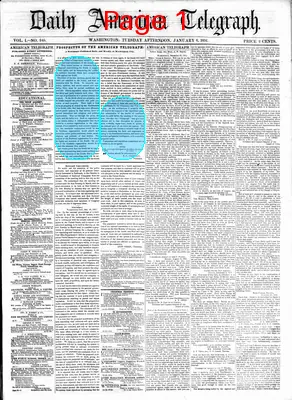
Editorial
January 6, 1852
Daily American Telegraph
Washington, District Of Columbia
What is this article about?
Editorial argues that the recent slavery compromise requires Southern unity and Northern cooperation to protect slave property rights against Northern abolitionists. Urges Southern Democrats to unite on 1798 principles, support the Baltimore Convention, and back candidates who safeguard Southern interests. Promotes the American Telegraph newspaper to aid in the 1852 presidential election discussion.
Clipping
OCR Quality
98%
Excellent
Full Text
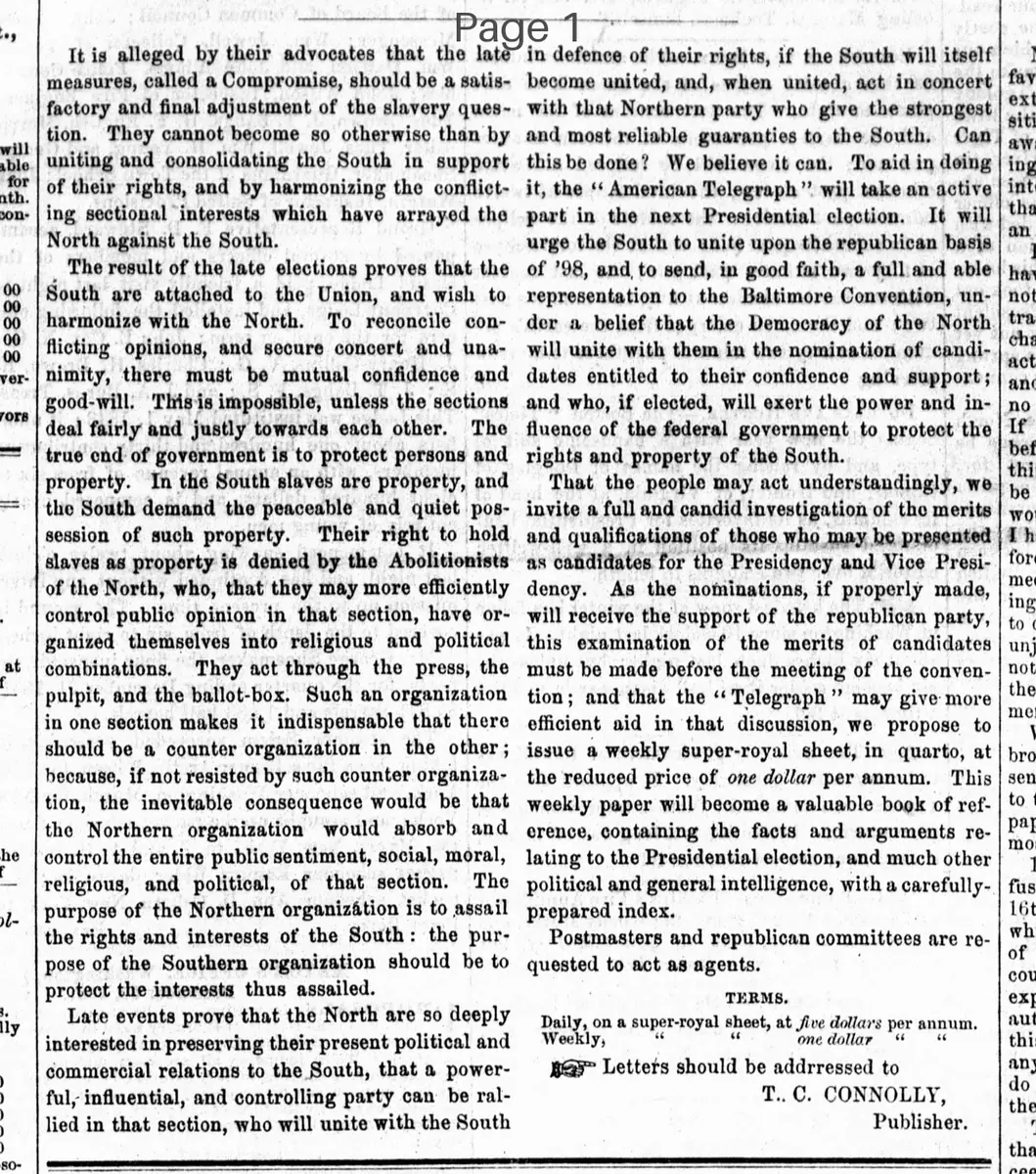
It is alleged by their advocates that the late measures, called a Compromise, should be a satisfactory and final adjustment of the slavery question. They cannot become so otherwise than by uniting and consolidating the South in support of their rights, and by harmonizing the conflicting sectional interests which have arrayed the North against the South.
The result of the late elections proves that the South are attached to the Union, and wish to harmonize with the North. To reconcile conflicting opinions, and secure concert and unanimity, there must be mutual confidence and good-will. This is impossible, unless the sections deal fairly and justly towards each other. The true end of government is to protect persons and property. In the South slaves are property, and the South demand the peaceable and quiet possession of such property. Their right to hold slaves as property is denied by the Abolitionists of the North, who, that they may more efficiently control public opinion in that section, have organized themselves into religious and political combinations. They act through the press, the pulpit, and the ballot-box. Such an organization in one section makes it indispensable that there should be a counter organization in the other: because, if not resisted by such counter organization, the inevitable consequence would be that the Northern organization would absorb and control the entire public sentiment, social, moral, religious, and political, of that section. The purpose of the Northern organization is to assail the rights and interests of the South: the purpose of the Southern organization should be to protect the interests thus assailed.
Late events prove that the North are so deeply interested in preserving their present political and commercial relations to the South, that a powerful, influential, and controlling party can be rallied in that section, who will unite with the South in defence of their rights, if the South will itself become united, and, when united, act in concert with that Northern party who give the strongest and most reliable guaranties to the South. Can this be done? We believe it can. To aid in doing it, the "American Telegraph" will take an active part in the next Presidential election. It will urge the South to unite upon the republican basis of '98, and to send, in good faith, a full and able representation to the Baltimore Convention, under a belief that the Democracy of the North will unite with them in the nomination of candidates entitled to their confidence and support; and who, if elected, will exert the power and influence of the federal government to protect the rights and property of the South.
That the people may act understandingly, we invite a full and candid investigation of the merits and qualifications of those who may be presented as candidates for the Presidency and Vice Presidency. As the nominations, if properly made, will receive the support of the republican party, this examination of the merits of candidates must be made before the meeting of the convention; and that the "Telegraph" may give more efficient aid in that discussion, we propose to issue a weekly super-royal sheet, in quarto, at the reduced price of one dollar per annum. This weekly paper will become a valuable book of reference, containing the facts and arguments relating to the Presidential election, and much other political and general intelligence, with a carefully-prepared index.
Postmasters and republican committees are requested to act as agents.
TERMS.
Daily, on a super-royal sheet, at five dollars per annum.
Weekly, one dollar
Letters should be addressed to
T. C. CONNOLLY,
Publisher.
The result of the late elections proves that the South are attached to the Union, and wish to harmonize with the North. To reconcile conflicting opinions, and secure concert and unanimity, there must be mutual confidence and good-will. This is impossible, unless the sections deal fairly and justly towards each other. The true end of government is to protect persons and property. In the South slaves are property, and the South demand the peaceable and quiet possession of such property. Their right to hold slaves as property is denied by the Abolitionists of the North, who, that they may more efficiently control public opinion in that section, have organized themselves into religious and political combinations. They act through the press, the pulpit, and the ballot-box. Such an organization in one section makes it indispensable that there should be a counter organization in the other: because, if not resisted by such counter organization, the inevitable consequence would be that the Northern organization would absorb and control the entire public sentiment, social, moral, religious, and political, of that section. The purpose of the Northern organization is to assail the rights and interests of the South: the purpose of the Southern organization should be to protect the interests thus assailed.
Late events prove that the North are so deeply interested in preserving their present political and commercial relations to the South, that a powerful, influential, and controlling party can be rallied in that section, who will unite with the South in defence of their rights, if the South will itself become united, and, when united, act in concert with that Northern party who give the strongest and most reliable guaranties to the South. Can this be done? We believe it can. To aid in doing it, the "American Telegraph" will take an active part in the next Presidential election. It will urge the South to unite upon the republican basis of '98, and to send, in good faith, a full and able representation to the Baltimore Convention, under a belief that the Democracy of the North will unite with them in the nomination of candidates entitled to their confidence and support; and who, if elected, will exert the power and influence of the federal government to protect the rights and property of the South.
That the people may act understandingly, we invite a full and candid investigation of the merits and qualifications of those who may be presented as candidates for the Presidency and Vice Presidency. As the nominations, if properly made, will receive the support of the republican party, this examination of the merits of candidates must be made before the meeting of the convention; and that the "Telegraph" may give more efficient aid in that discussion, we propose to issue a weekly super-royal sheet, in quarto, at the reduced price of one dollar per annum. This weekly paper will become a valuable book of reference, containing the facts and arguments relating to the Presidential election, and much other political and general intelligence, with a carefully-prepared index.
Postmasters and republican committees are requested to act as agents.
TERMS.
Daily, on a super-royal sheet, at five dollars per annum.
Weekly, one dollar
Letters should be addressed to
T. C. CONNOLLY,
Publisher.
What sub-type of article is it?
Slavery Abolition
Partisan Politics
What keywords are associated?
Slavery Compromise
Southern Rights
Abolitionists
Northern Organization
Presidential Election
Baltimore Convention
Democratic Unity
Slave Property
What entities or persons were involved?
Abolitionists Of The North
South
North
Democracy Of The North
Baltimore Convention
Republican Party
T. C. Connolly
Editorial Details
Primary Topic
Protection Of Southern Slave Property Rights Through Political Unity
Stance / Tone
Pro Southern Defense Against Northern Abolitionism And Call For Democratic Unity
Key Figures
Abolitionists Of The North
South
North
Democracy Of The North
Baltimore Convention
Republican Party
T. C. Connolly
Key Arguments
The Compromise On Slavery Requires Southern Consolidation And Northern Harmonization To Be Final.
Southern Attachment To The Union Shown In Elections, But Mutual Fairness Needed.
Slaves Are Property In The South, Denied By Northern Abolitionists Who Organize Religiously And Politically.
Counter Organization In South Essential To Resist Northern Control Of Public Sentiment.
Northern Party Can Ally With United South To Defend Rights.
American Telegraph Will Promote Unity On 1798 Republican Basis And Support Baltimore Convention Nominations.
Invite Investigation Of Presidential Candidates; Propose Weekly Edition For Discussion.