Thank you for visiting SNEWPapers!
Sign up free
National Gazette
Philadelphia, Philadelphia County, Pennsylvania
What is this article about?
This letter argues that the U.S. elective government is superior to hereditary monarchies, as short presidential terms and impeachment liability promote accountability and prevent abuses, contrasting with examples from Poland, Charles II, and George III.
Merged-components note: These components form a single continuous letter to the editor on elective government, spanning the page break; relabeled from editorial to letter_to_editor for coherence.
Clippings
1 of 2
OCR Quality
Full Text
Detached Thoughts on Elective GOVERNMENT.
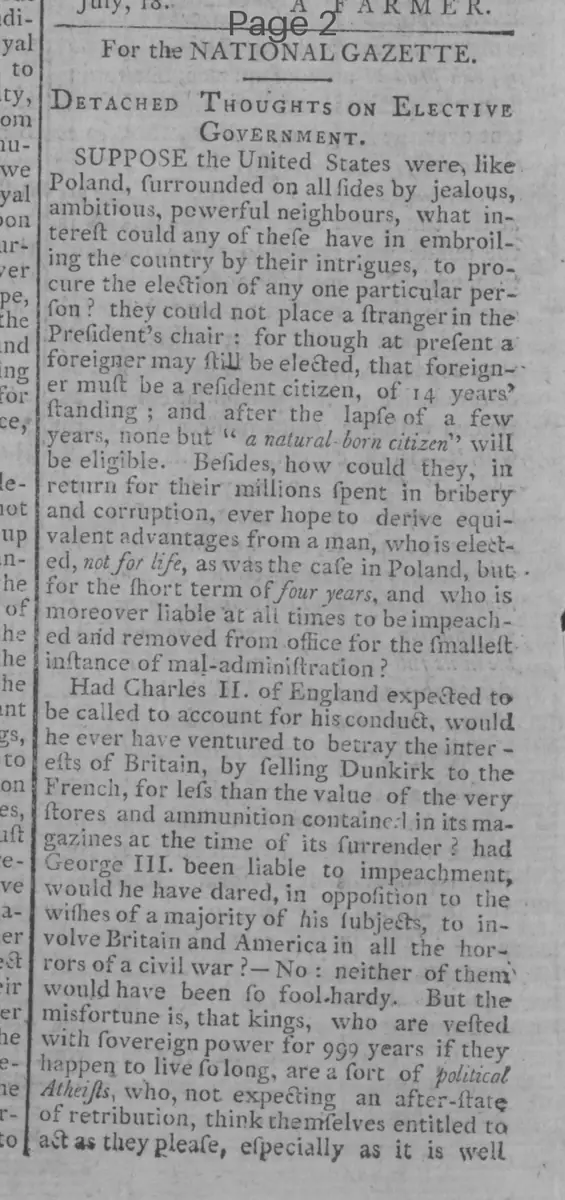
SUPPOSE the United States were, like Poland, surrounded on all sides by jealous, ambitious, powerful neighbours, what interest could any of these have in embroiling the country by their intrigues, to procure the election of any one particular person? they could not place a stranger in the President's chair: for though at present a foreigner may still be elected, that foreigner must be a resident citizen, of 14 years' standing; and after the lapse of a few years, none but "a natural born citizen" will be eligible. Besides, how could they, in return for their millions spent in bribery and corruption, ever hope to derive equivalent advantages from a man, who is elected, not for life, as was the case in Poland, but for the short term of four years, and who is moreover liable at all times to be impeached and removed from office for the smallest instance of mal-administration?
Had Charles II. of England expected to be called to account for his conduct, would he ever have ventured to betray the interests of Britain, by selling Dunkirk to the French, for less than the value of the very stores and ammunition contained in its magazines at the time of its surrender? had George III. been liable to impeachment, would he have dared, in opposition to the wishes of a majority of his subjects, to involve Britain and America in all the horrors of a civil war?—No: neither of them would have been so fool-hardy. But the misfortune is, that kings, who are vested with sovereign power for 999 years if they happen to live so long, are a sort of political atheists, who, not expecting an after-state of retribution, think themselves entitled to act as they please, especially as it is well
It is well known, that kings can do no wrong—
Whereas the man, who if entrusted with power only for a short time, and who knows that he is liable to do wrong, must firmly believe in a future state, where he will be rewarded with praise or impeachment, according to his deeds: and by such belief, he will regulate his conduct.
When the candid, honest American contemplates the enormous abuses, that have invariably attended hereditary power in every country of the world: when he reflects, that all the evils, attendant on the election of a chief magistrate, are obviated by our happy constitution, whilst all the benefits are secured to us; he cannot but acknowledge, that our form of government is infinitely superior to any that has ever yet been established in the known world.
It must therefore be his ardent wish to guard it against all encroachments or innovations; and he ought to be cautious how he gives ear to the doctrines of any man who recommends alterations in it, except for the sole purpose of erecting, if possible, still stronger bulwarks to secure the liberties of the people, not only from actual danger, but even from the very appearance or possibility of it.
What sub-type of article is it?
What themes does it cover?
What keywords are associated?
What entities or persons were involved?
Letter to Editor Details
Recipient
National Gazette
Main Argument
the u.s. elective government with short terms and impeachment is superior to hereditary monarchies, as it ensures accountability and prevents abuses seen in historical examples like poland and british kings.
Notable Details