Thank you for visiting SNEWPapers!
Sign up free
The New Hampshire Gazette
Portsmouth, Rockingham County, New Hampshire
What is this article about?
An anonymous letter under the pseudonym Benevolus criticizes the recently Senate-ratified Jay Treaty of Commerce with Britain, arguing it surrenders American trade to British control, allows undue influence in representation, and undermines sovereignty. It urges President Washington to withhold final ratification to protect national interests.
Clipping
OCR Quality
Full Text
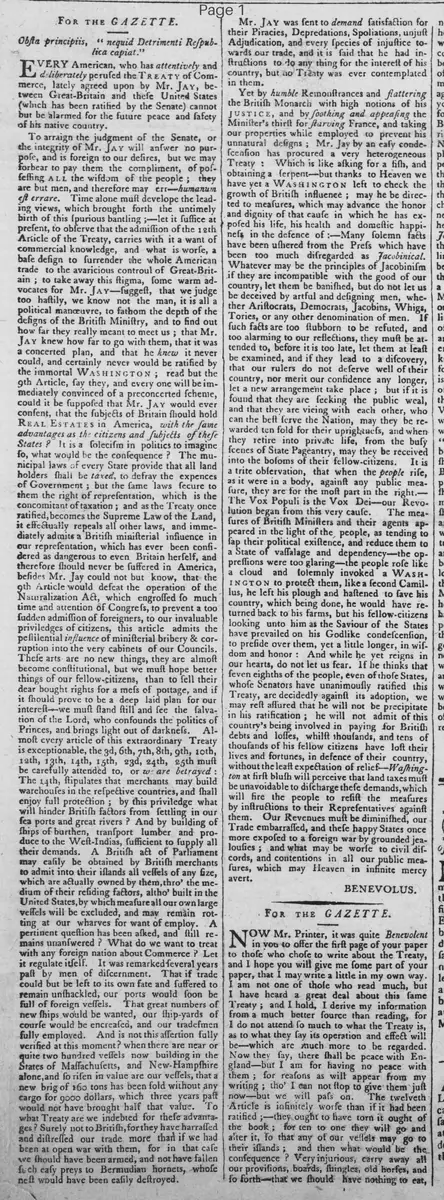
Obsta principiis, "nequid Detrimenti Republicae capiat."
Every American who has attentively and deliberately perused the TREATY of Commerce, lately agreed upon by Mr. JAY, between Great-Britain and the United States (which has been ratified by the Senate) cannot but be alarmed for the future peace and safety of his native country.
To arraign the judgment of the Senate, or the integrity of Mr. Jay will answer no purpose, and is foreign to our desires, but we may forbear to pay them the compliment, of professing ALL the wisdom of the people; they are but men, and therefore may err--humanum est errare. Time alone must develope the leading views, which brought forth the untimely birth of this spurious bantling; let it suffice at present, to observe that the admission of the 12th Article of the Treaty, carries with it a want of commercial knowledge, and what is worse, a base design to surrender the whole American trade to the avaricious controul of Great-Britain; to take away this stigma, some warm advocates for Mr. Jay'suggest, that we judge too hastily, we know not the man, it is all a political manœuvre, to fathom the depth of the designs of the British Ministry, and to find out how far they really meant to meet us; that Mr. Jay knew how far to go with them, that it was a concerted plan, and that he knew it never could, and certainly never would be ratified by the immortal WASHINGTON: read but the 9th Article, say they, and every one will be immediately convinced of a preconcerted scheme, could it be supposed that Mr. Jay would ever consent, that the subjects of Britain should hold REAL ESTATES in America, with the same advantages as the citizens and subjects of these States? It is a solecism in politics to imagine so, what would be the consequence? The municipal laws of every State provide that all land holders shall be taxed, to defray the expences of Government; but the same laws secure to them the right of representation, which is the concomitant of taxation; and as the Treaty once ratified, becomes the Supreme Law of the Land, it effectually repeals all other laws, and immediately admits a British ministerial influence in our representation, which has ever been considered as dangerous to even Britain herself, and therefore should never be suffered in America, besides Mr. Jay could not but know, that the 9th Article would defeat the operation of the Naturalization Act, which engrossed so much time and attention of Congress, to prevent a too sudden admission of foreigners, to our invaluable priviledges of citizens, this article admits the pestilential influence of ministerial bribery & corruption into the very cabinets of our Councils.
These arts are no new things, they are almost become constitutional, but we must hope better things of our fellow-citizens, than to sell their dear bought rights for a mess of pottage, and if it should prove to be a deep laid plan for 'our interest--we must stand still and see the salvation of the Lord, who confounds the politics of Princes, and brings light out of darkness. Almost every article of this extraordinary Treaty is exceptionable, the 3d, 6th, 7th, 8th, 9th, 10th, 12th, 13th, 14th, 15th, 23d, 24th, 25th must be carefully attended to, or we are betrayed: The 14th, stipulates that merchants may build warehoues in the respective countries, and shall enjoy full protection; by this priviledge what will hinder British factors from settling in our sea ports and great rivers? And by building of ships of burthen, transport lumber and produce to the West-Indias, sufficient to supply all their demands. A British Act of Parliament may easily be obtained by British merchants to admit into their islands all vessels of any size, which are actually owned by them, thro' the medium of their residing factors, altho' built in the United States, by which measure all our own large vessels will be excluded, and may remain rotting at our wharves for want of employ. A pertinent question has been asked, and still remains unanswered? What do we want to treat with any foreign nation about Commerce? Let it regulate itself. It was remarked several years past by men of discernment. That if trade could but be left to its own fate and suffered to remain unshackled, our ports would soon be full of foreign vessels. That great numbers of new ships would be wanted, our ship-yards of course would be encreased, and our tradesmen fully employed. And is not this assertion fully verified at this moment? when there are near or quite two hundred vessels now building in the States of Massachusetts, and New-Hampshire alone, and so risen in value are our vessels, that a new brig of 160 tons has been sold without any cargo for 5000 dollars, which three years past would not have brought half that value. To what Treaty are we indebted for these advantages? Surely not to British, for they have harrassed and distressed our trade more than if we had been at open war with them, for in that case we should have been armed, and not have fallen such easy preys to Bermudian hornets, whose nests would have been easily destroyed.
Mr. Jay was sent to demand satisfaction for their Piracies, Depredations, Spoliations, unjust Adjudication, and every species of injustice towards our trade, and it is said that he had instructions to do any thing for the interest of his country, but no Treaty was ever contemplated in them.
Yet by humble Remonstrances and flattering the British Monarch with high notions of his JUSTICE, and by soothing and appeasing the Minister's thirst for turning France, and taking our properties while employed to prevent his unnatural designs; Mr. Jay by an easy condescension has procured a very heterogeneous Treaty: Which is like asking for a fish, and obtaining a Serpent but thanks to Heaven we have yet a WASHINGTON left to check the growth of British influence; may he be directed to measures, which may advance the honor and dignity of that cause in which he has exposed his life, his health and domestic happiness in the defence of: Many solemn facts have been ushered from the Press which have been too much disregarded as Jacobinical.
Whatever may be the principles of Jacobinism if they are incompatible with the good of our country, let them be banished, but do not let us be deceived by artful and designing men, whether Aristocrats, Democrats, Jacobins, Whigs, Tories, or any other denomination of men. If such facts are too stubborn to be refuted, and too alarming to our reflections, they must be attended to, before it is too late, let them at least be examined, and if they lead to a discovery, that our rulers do not deserve well of their country, nor merit our confidence any longer, let a new arrangement take place; but if it is found that they are seeking the public weal, and that they are vying with each other, who can the best serve the Nation, may they be rewarded ten fold for their uprightness, and when they retire into private life, from the busy scenes of State Pageantry, may they be received into the bosoms of their fellow-citizens. It is a trite observation, that when the people rise, as it were in a body, against any public measure, they are for the most part in the right.- The Vox Populi is the Vox Dei--our Revolution began from this very cause. The measures of British Ministers and their agents appeared in the light of the people, as tending to sap their political existence, and reduce them to a State of vassalage and dependency the oppressions were too glaring-the people rose like a cloud and solemnly invoked a WASHINGTON to protect them, like a second Camillus, he left his plough and hastened to save his country, which being done, he would have returned back to his farms, but his fellow-citizens looking unto him as the Saviour of the States have prevailed on his Godlike condescension, to preside over them, yet a little longer, in wisdom and honor: And while he yet reigns in our hearts, do not let us fear. If he thinks that even eight-tenths of the people, even of those States, whose Senators have unanimously ratified this Treaty, are decidedly against its adoption, we may rest assured that he will not be precipitate in his ratification; he will not admit of this country's being involved in paying for British debts and losses, whilst thousands, and tens of thousands of his fellow citizens have lost their lives and fortunes, in defence of their country, without the least expectation of relief--Washington at first blush will perceive that land taxes must be unavoidable to discharge these demands, which will fire the people to resist the measures by instructions to their Representatives against them. Our Revenues must be diminished, our Trade embarrassed, and these happy States once more exposed to a foreign war by grounded jealousies; and what may be worse to civil discord, and contentions in all our public measures, which may Heaven in infinite mercy avert.
BENEVOLUS.
What sub-type of article is it?
What themes does it cover?
What keywords are associated?
What entities or persons were involved?
Letter to Editor Details
Author
Benevolus.
Recipient
The Gazette
Main Argument
the jay treaty surrenders american commerce and sovereignty to british control, allowing undue influence in representation and contradicting naturalization laws; president washington should reject ratification to prevent economic harm, taxation, and potential conflict.
Notable Details