Thank you for visiting SNEWPapers!
Sign up free
Alexandria Daily Gazette, Commercial & Political
Alexandria, Virginia
What is this article about?
In a House of Representatives debate on January 17, Mr. Quincy criticizes the administration's embargo policy, arguing it was intended as coercion against Great Britain rather than mere precaution, and questions the lack of serious war preparations despite rhetoric.
Clipping
OCR Quality
Full Text
HOUSE OF REPRESENTATIVES.
Tuesday, January 17.
DEBATE ON EXTRA SESSION
[CONTINUED.]
[Mr. Quincy's speech continued.]
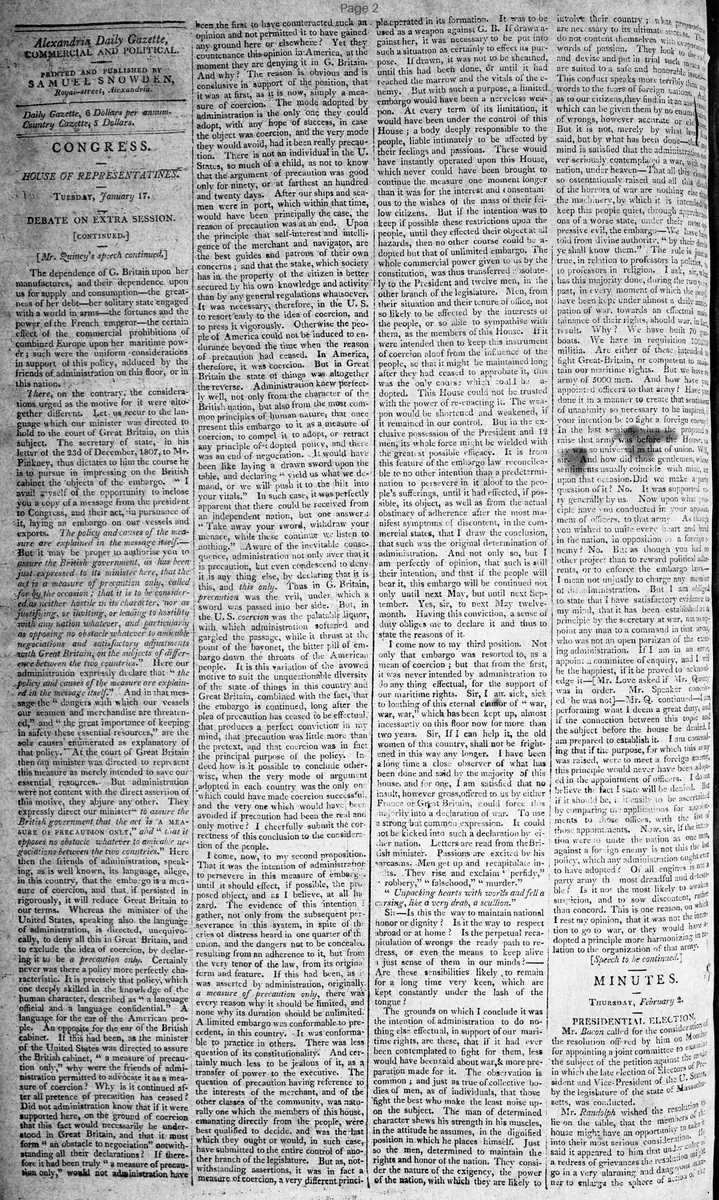
The dependence of G. Britain upon her manufactures, and their dependence upon us for supply and consumption--the greatness of her debt--her solitary state engaged with a world in arms--the fortunes and the power of the French emperor--the certain effect of the commercial prohibitions of combined Europe upon her maritime power; such were the uniform considerations in support of this policy, adduced by the friends of administration on this floor, or in this nation.
There, on the contrary, the considerations urged as the motive for it were altogether different. Let us recur to the language which our minister was directed to hold to the court of Great Britain, on this subject. The secretary of state, in his letter of the 23d of December, 1807, to Mr. Pinkney, thus dictates to him the course he is to pursue in impressing on the British cabinet the objects of the embargo. I avail myself of the opportunity to inclose you a copy of a message from the president to Congress, and their act, in pursuance of it, laying an embargo on our vessels and exports. The policy and causes of the measure are explained in the message itself. But it may be proper to authorise you to assure the British government, as has been just expressed to its minister here, that the act is a measure of precaution only, called for by the occasion; that it is to be considered as neither hostile in its character, nor as justifying, or inviting, or leading to hostility with any nation whatever, and particularly as opposing no obstacle whatever to amicable negociations and satisfactory adjustments with Great Britain, on the subjects of difference between the two countries. Here our administration expressly declare that the policy and causes of the measure are explained in the message itself. And in that message the dangers with which our vessels our seamen and merchandise are threatened, and the great importance of keeping in safety these essential resources, are the sole causes enumerated as explanatory of that policy. At the court of Great Britain then our minister was directed to represent this measure as merely intended to save our essential resources. But administration were not content with the direct assertion of this motive, they abjure any other. They expressly direct our minister to assure the British government that the act is A MEASURE OF PRECAUTION ONLY, and that it opposes no obstacle whatever to amicable negociations between the two countries. Here then the friends of administration, speaking, as is well known, its language, allege in this country, that the embargo is a measure of coercion, and that if persisted in rigorously, it will reduce Great Britain to our terms. Whereas the minister of the United States, speaking also the language of administration, is directed, unequivocally, to deny all this in Great Britain, and to exclude the idea of coercion, by declaring it to be a precaution only. Certainly never was there a policy more perfectly characteristic. It is precisely that policy, which one deeply skilled in the knowledge of the human character, described as a language official and a language confidential. A language for the ear of the American people. An opposite for the ear of the British cabinet. If this had been, as the minister of the United States was directed to assure the British cabinet, a measure of precaution only, why were the friends of administration permitted to advocate it as a measure of coercion? Why is it continued after all pretence of precaution has ceased? Did not administration know that if it were supported here, on the ground of coercion that this fact would necessarily be understood in Great Britain, and that it must form an obstacle to negociation notwithstanding all their declarations? If therefore it had been truly a measure of precaution only, would not administration have been the first to have counteracted such an opinion and not permitted it to have gained any ground here or elsewhere? Yet they countenance this opinion in America, at the moment they are denying it in G. Britain. And why? The reason is obvious and is conclusive in support of the position, that it was at first, as it is now, simply a measure of coercion. The mode adopted by administration is the only one they could adopt, with any hope of success, in case the object was coercion, and the very mode they would avoid, had it been really precaution. There is not an individual in the U. States, so much of a child, as not to know that the argument of precaution was good only for ninety, or at farthest an hundred and twenty days. After our ships and seamen were in port, which within that time, would have been principally the case, the reason of precaution was at an end. Upon the principle that self-interest and intelligence of the merchant and navigator, are the best guides and patrons of their own concerns; and that the stake, which society has in the property of the citizen is better secured by his own knowledge and activity than by any general regulations whatsoever. It was necessary, therefore, in the U. S. to resort early to the idea of coercion, and to press it vigorously. Otherwise the people of America could not be induced to endurance beyond the time when the reason of precaution had ceased. In America, therefore, it was coercion. But in Great Britain the state of things was altogether the reverse. Administration knew perfectly well, not only from the character of the British nation, but also from the most common principles of human nature; that once present this embargo to it as a measure of coercion, to compel it to adopt, or retract any principle of adopted policy, and there was an end of negociation. It would have been like laying a drawn sword upon the table, and declaring yield us what we demand, or we will push it to the hilt into your vitals. In such case, it was perfectly apparent that there could be received from an independent nation, but one answer: Take away your sword, withdraw your menace, while these continue we listen to nothing. Aware of the inevitable consequence, administration not only aver that it is precaution, but even condescend to deny it is any thing else, by declaring that it is this, and this only. Thus in G. Britain, precaution was the veil, under which a sword was passed into her side. But, in the U. S. coercion was the palatable liquor, with which administration softened and gargled the passage, while it thrust at the point of the bayonet, the bitter pill of embargo down the throats of the American people. It is this variation of the avowed motive to suit the unquestionable diversity of the state of things in this country and Great Britain, combined with the fact, that the embargo is continued, long after the plea of precaution has ceased to be effectual; that produces a perfect conviction in my mind, that precaution was little more than the pretext, and that coercion was in fact the principal purpose of the policy. Indeed how is it possible to conclude otherwise, when the very mode of argument adopted in each country was the only one which could have made coercion successful, and the very one which would have been avoided if precaution had been the real and only motive? I cheerfully submit the correctness of this conclusion to the consideration of the people.
I come, now, to my second proposition. That it was the intention of administration to persevere in this measure of embargo until it should effect, if possible, the proposed object; and as I believe, at all hazard. The evidence of this intention I gather, not only from the subsequent perseverance in this system, in spite of the cries of distress heard in one quarter of the union, and the dangers not to be concealed resulting from an adherence to it, but from the very tenor of the law. from its original form and feature. If this had been, as it was asserted by administration, originally a measure of precaution only, there was every reason why it should be limited, and none why its duration should be unlimited. A limited embargo was conformable to precedent, in this country. It was conformable to practice in others. There was less question of its constitutionality. And certainly much less to be jealous of it, as a transfer of power to the executive. The question of precaution having reference to the interests of the merchant, and of the other classes of the community, was naturally one which the members of this house, emanating directly from the people, were best qualified to decide. and was the last which they ought or would, in such case, have submitted to the entire control of another branch of the legislature. But as, notwithstanding assertions, it was in fact a measure of coercion, a very different principle operated in its formation. It was to be used as a weapon against G. B. If drawn against her, it was necessary to be put into such a situation as certainly to effect its purpose. If drawn, it was not to be sheathed until this had been done, or until it had reached the marrow and the vitals of the enemy. But with such a purpose, a limited embargo would have been a nerveless weapon. At every term of its limitation, it would have been under the control of this House; a body deeply responsible to the people, liable intimately to be affected by their feelings and passions. These would have instantly operated upon this House. which never could have been brought to continue the measure one moment longer than it was for the interest and consentaneous to the wishes of the mass of their fellow citizens. But if the intention was to keep if possible these restrictions upon the people, until they effected their object at all hazards, then no other course could be adopted but that of unlimited embargo. The whole commercial power given to us by the constitution, was thus transferred absolutely to the President and twelve men, in the other branch of the legislature. Men, from their situation and their tenure of office, not so likely to be affected by the interests of the people, or so able to sympathise with them, as the members of this House. If it were intended then to keep this instrument of coercion aloof from the influence of the people, so that it might be maintained long after they had ceased to approbate it, this was the only course which could be adopted. This House could not be trusted with the power of re-enacting it. The weapon would be shortened and weakened, if it remained in our control. But in the exclusive possession of the President and 12 men, its whole force might be wielded with the greatest possible efficacy. It is from this feature of the embargo law reconcilable to no other intention than a predetermination to persevere in it aloof to the people's sufferings, until it had effected, if possible, its object, as well as from the actual obstinacy of adherence after the most manifest symptoms of discontent, in the commercial states. that I draw the conclusion that such was the original determination of administration. And not only so, but I am perfectly of opinion, that such is still their intention, and that if the people will bear it. this embargo will be continued not only until next May, but until next September. Yes, sir, to next May twelve-month. Having this conviction, a sense of duty obliges me to declare it and thus to state the reasons of it.
I come now to my third position. Not only that embargo was resorted to, as a mean of coercion; but that from the first it was never intended by administration to do any thing effectual, for the support of our maritime rights. Sir, I am sick. sick to loathing of this eternal clamor of war, war, war, which has been kept up, almost incessantly on this floor now for more than two years. Sir, If I can help it, the old women of this country, shall not be frightened in this way any longer. I have been a long time a close observer of what has been done and said by the majority of this house. and for one, I am satisfied that no insult, however gross,offered to us by either France or Great Britain, could force this majority,into a declaration of war. To use a strong but common expression. It could not be kicked into such a declaration by either nation. Letters are read from the British minister. Passions are excited by his sarcasms. Men get up and recapitulate insults. They rise and exclaim perfidy. robbery, falsehood, murder. Unpacking hearts with words and fell a cursing, like a very drab, a scullion. Sir--Is this the way to maintain national honor or dignity? Is it the way to respect abroad or at home? Is the perpetual recapitulation of wrongs the ready path to redress, or even the means to keep alive a just sense of them in our minds?-- Are these sensibilities likely to remain for a long time very keen, which are kept constantly under the lash of the tongue?
The grounds on which I conclude it was the intention of administration to do nothing else effectual, in support of our maritime rights, are these, that if it had ever been contemplated to fight for them, less would have been said about war, & more preparation made for it. The observation is common; and just as true of collective bodies of men, as of individuals, that those fight the best who make the least noise upon the subject. The man of determined character shews his strength in his muscles, in the attitude he assumes, in the dignified position in which he places himself. Just so the men, determined to maintain the rights and honor of the nation. They consider the nature of the exigency, the power of the nation, with which they are likely to involve their country; what preparation are necessary to its ultimate success. They do not content themselves with words of passion. They look around and devise safe and honorable means to put the issue to a trial. This conduct speaks more terribly to the fears of foreign nations. And as to our citizens, they had in it an assurance which can be given them by no enumeration of wrongs, however accurate or eloquent. But it is not, merely by what has been said, but by what has been done--thus my mind is satisfied that the administration never seriously contemplated a war, with a nation, under heaven--That all this clamor so ostentatiously raised and all this detail of the horrors of war are nothing else than the machinery, by which it is intended to keep this people quiet, through apprehensions of a worse state, under their most oppressive evil, the embargo. We have been told from divine authority, by their deeds ye shall know them. The rule is just as true, in relation to professors in politics, to professors in religion. I ask, sir, what has this majority done, during the two years past, in every moment of which the people have been kept under almost a daily anticipation of war, towards an effectual maintenance of their rights. should war, in fact result. Why ? We have built 70 gun-boats. We have in requisition 100,000 militia. Are either of these intended to fight Great-Britain, or competent to maintain our maritime rights. But we have an army of 5000 men. And how have you appointed officers to that army? Have you done it in a manner to create that sentiment of unanimity so necessary to be inspired, if your intention be to fight a foreign enemy! In the last session, when the proposal to raise that army was before the House, no cry was so universal as that of union. Will sir. And how did those gentlemen, whose sentiments usually coincide with mine, act upon that occasion. Did we make a party question of it? No. It was supported very generally by us. Now upon what principle have you conducted in your appointment of officers, to that army. As though you wished to unite every heart and hand in the nation, in opposition to a foreign enemy? No. But as though you had no other project than to reward political adherents, or to enforce the embargo laws- I mean not unjustly to charge any member of the administration. But I am obliged to state that I have satisfactory evidence to my mind, that it has been established as a principle by the secretary at war, not to appoint any man to a command in that army who was not an open partizan of the existing administration. If I am in an error, appoint a committee of enquiry, and I will be the happiest, if it be proved to acknowledge it--[Mr. Love asked if Mr. Quincy was in order. Mr. Speaker conceived he was not]--Mr. Q. continued-I am performing what I deem a great duty, and if the connection between this topic and the subject before the house be denied, I am prepared to establish it. I am contending that if the purpose, for which this army was raised, were to meet a foreign enemy, this principle would never have been adopted in the appointment of officers. I do not believe the fact I state will be denied. But if it should be, it is easily to be ascertained by comparing the applications for appointments to those offices, with the list of those appointments. Now, sir, if the intention were to unite the nation as one man, against a foreign enemy is not this the last policy, which any administration ought ever to have adopted? Of all engines is not a party army the most dreadful and detestable? Is it not the most likely to awaken suspicion, and to sow discontent, rather than concord. This is one reason, on which I rest my opinion, that it was not the intention to go to war, or they would have adopted a principle more harmonizing in relation to the organization of that army.
[Speech to be continued.]
What sub-type of article is it?
What keywords are associated?
What entities or persons were involved?
Where did it happen?
Domestic News Details
Primary Location
United States House Of Representatives
Event Date
Tuesday, January 17.
Key Persons
Event Details
Mr. Quincy continues his speech in the House debate on the extra session, arguing that the embargo was a coercive measure against Great Britain disguised as precaution, intended to persist until its object is achieved, and that the administration never seriously planned for war despite war rhetoric, citing inadequate and partisan military preparations.