Thank you for visiting SNEWPapers!
Sign up free
Literary
October 10, 1851
Arkansas State Gazette And Democrat
Little Rock, Pulaski County, Arkansas
What is this article about?
Lamartine's tribute to Madame de Stael describes her happiness, family, marriage, and literary works on the Revolution, her exile, and German genius. It praises her style's evolution and compares her to Rousseau as a tender, sensitive genius of thought and love, whose name endures in French literature and history.
Clipping
OCR Quality
95%
Excellent
Full Text
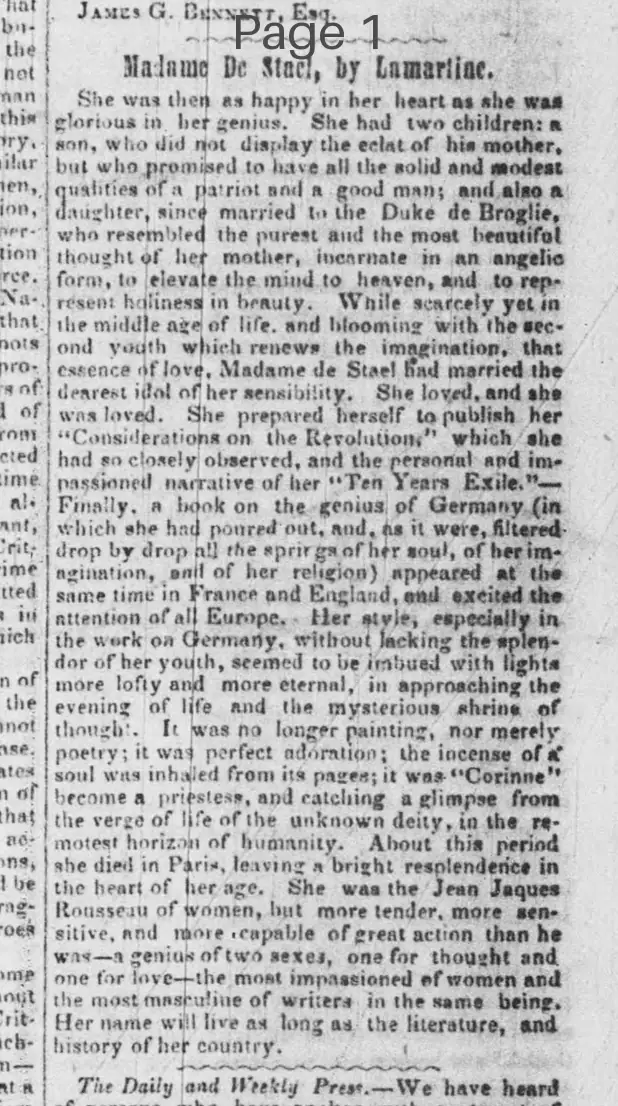
Madame De Stael, by Lamartine.
She was then as happy in her heart as she was
glorious in her genius. She had two children: a
son, who did not display the eclat of his mother,
but who promised to have all the solid and modest
qualities of a patriot and a good man; and also a
daughter, since married to the Duke de Broglie,
who resembled the purest and the most beautiful
thought of her mother, incarnate in an angelic
form, to elevate the mind to heaven, and to represent holiness in beauty. While scarcely yet in
the middle age of life, and blooming with the second youth which renews the imagination, that
essence of love, Madame de Stael had married the
dearest idol of her sensibility. She loved, and she
was loved. She prepared herself to publish her
"Considerations on the Revolution," which she
had so closely observed, and the personal and impassioned narrative of her "Ten Years Exile."—
Finally, a book on the genius of Germany (in
which she had poured out, and, as it were, filtered
drop by drop all the springs of her soul, of her imagination, and of her religion) appeared at the
same time in France and England, and excited the
attention of all Europe. Her style, especially in
the work on Germany, without lacking the splendor of her youth, seemed to be imbued with lights
more lofty and more eternal, in approaching the
evening of life and the mysterious shrine of
thought. It was no longer painting, nor merely
poetry; it was perfect adoration; the incense of
soul was inhaled from its pages; it was "Corinne"
become a priestess, and catching a glimpse from
the verge of life of the unknown deity, in the remotest horizon of humanity. About this period
she died in Paris, leaving a bright resplendence in
the heart of her age. She was the Jean Jacques
Rousseau of women, but more tender, more sensitive, and more capable of great action than he
was—a genius of two sexes, one for thought and
one for love—the most impassioned of women and
the most masculine of writers in the same being.
Her name will live as long as the literature, and
history of her country.
She was then as happy in her heart as she was
glorious in her genius. She had two children: a
son, who did not display the eclat of his mother,
but who promised to have all the solid and modest
qualities of a patriot and a good man; and also a
daughter, since married to the Duke de Broglie,
who resembled the purest and the most beautiful
thought of her mother, incarnate in an angelic
form, to elevate the mind to heaven, and to represent holiness in beauty. While scarcely yet in
the middle age of life, and blooming with the second youth which renews the imagination, that
essence of love, Madame de Stael had married the
dearest idol of her sensibility. She loved, and she
was loved. She prepared herself to publish her
"Considerations on the Revolution," which she
had so closely observed, and the personal and impassioned narrative of her "Ten Years Exile."—
Finally, a book on the genius of Germany (in
which she had poured out, and, as it were, filtered
drop by drop all the springs of her soul, of her imagination, and of her religion) appeared at the
same time in France and England, and excited the
attention of all Europe. Her style, especially in
the work on Germany, without lacking the splendor of her youth, seemed to be imbued with lights
more lofty and more eternal, in approaching the
evening of life and the mysterious shrine of
thought. It was no longer painting, nor merely
poetry; it was perfect adoration; the incense of
soul was inhaled from its pages; it was "Corinne"
become a priestess, and catching a glimpse from
the verge of life of the unknown deity, in the remotest horizon of humanity. About this period
she died in Paris, leaving a bright resplendence in
the heart of her age. She was the Jean Jacques
Rousseau of women, but more tender, more sensitive, and more capable of great action than he
was—a genius of two sexes, one for thought and
one for love—the most impassioned of women and
the most masculine of writers in the same being.
Her name will live as long as the literature, and
history of her country.
What sub-type of article is it?
Essay
Elegy
What themes does it cover?
Political
Love Romance
Liberty Freedom
What keywords are associated?
Madame De Stael
Lamartine
Genius
Revolution
Exile
Germany
Rousseau
Literature
What entities or persons were involved?
By Lamartine
Literary Details
Title
Madame De Stael
Author
By Lamartine
Subject
Tribute To Madame De Stael's Life And Genius
Form / Style
Biographical Prose Reflection
Key Lines
She Was The Jean Jacques Rousseau Of Women, But More Tender, More Sensitive, And More Capable Of Great Action Than He Was—A Genius Of Two Sexes, One For Thought And One For Love—The Most Impassioned Of Women And The Most Masculine Of Writers In The Same Being.
Her Name Will Live As Long As The Literature, And History Of Her Country.