Thank you for visiting SNEWPapers!
Sign up free
Douglas Daily Dispatch
Douglas, Cochise County, Arizona
What is this article about?
Dr. Leland B. Alford's article on the human sense of smell: its minor role, link to taste (only four true tastes), quick fatigue, distant projection, upper nasal location, causes of persistent bad odors or loss (disease, hysteria, injury, age, flu), and particle-based mechanism without weight loss.
Clipping
OCR Quality
Full Text
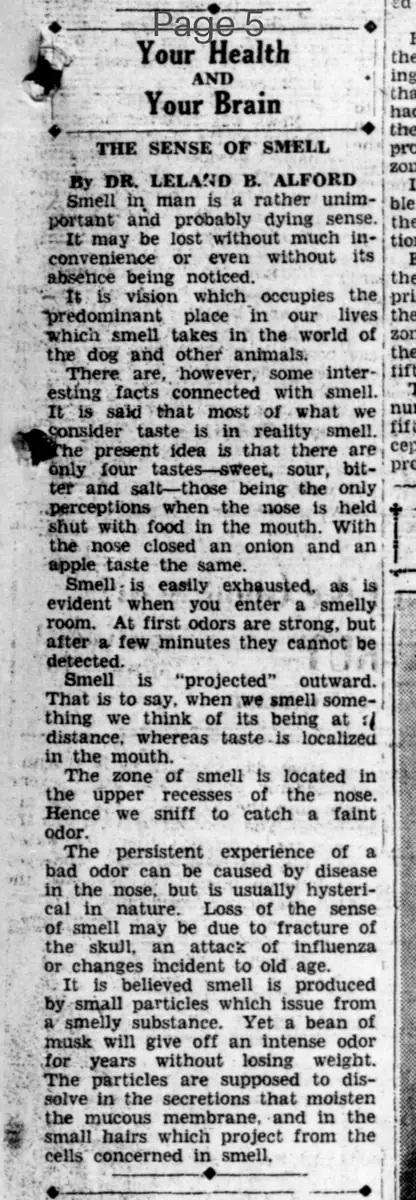
THE SENSE OF SMELL
By DR. LELAND B. ALFORD
Smell in man is a rather unimportant and probably dying sense. It may be lost without much inconvenience or even without its absence being noticed.
It is vision which occupies the predominant place in our lives which smell takes in the world of the dog and other animals.
There are, however, some interesting facts connected with smell. It is said that most of what we consider taste is in reality smell. The present idea is that there are only four tastes—sweet, sour, bitter and salt—these being the only perceptions when the nose is held shut with food in the mouth. With the nose closed an onion and an apple taste the same.
Smell is easily exhausted, as is evident when you enter a smelly room. At first odors are strong, but after a few minutes they cannot be detected.
Smell is "projected" outward. That is to say, when we smell something we think of its being at a distance, whereas taste is localized in the mouth.
The zone of smell is located in the upper recesses of the nose. Hence we sniff to catch a faint odor.
The persistent experience of a bad odor can be caused by disease in the nose, but is usually hysterical in nature. Loss of the sense of smell may be due to fracture of the skull, an attack of influenza or changes incident to old age.
It is believed smell is produced by small particles which issue from a smelly substance. Yet a bean of musk will give off an intense odor for years without losing weight.
The particles are supposed to dissolve in the secretions that moisten the mucous membrane, and in the small hairs which project from the cells concerned in smell.
What sub-type of article is it?
What keywords are associated?
What entities or persons were involved?
Story Details
Key Persons
Story Details
The article discusses the sense of smell in humans as unimportant and often unnoticed when lost, contrasting it with vision's dominance and animals' reliance on smell. It explains that most taste is actually smell, with only four true tastes; smell fatigues quickly; odors are perceived as distant; the olfactory zone is in the upper nose; bad odors can be hysterical or due to disease; loss from skull fracture, flu, or age; and smell via particles dissolving in nasal secretions.