Thank you for visiting SNEWPapers!
Sign up free
Literary
May 31, 1806
Herald Of The United States
Warren, Bristol County, Rhode Island
What is this article about?
Satirical essay mocking 'affected sensibility' through the character Belinda, who laments killing a louse but neglects her family, servants, and the poor, contrasting her feigned compassion for animals with real human indifference.
Clipping
OCR Quality
98%
Excellent
Full Text
From the Massachusetts Magazine.
AFFECTED SENSIBILITY;
A LAMENTATION OVER AN UNFORTUNATE ANIMALCULE.
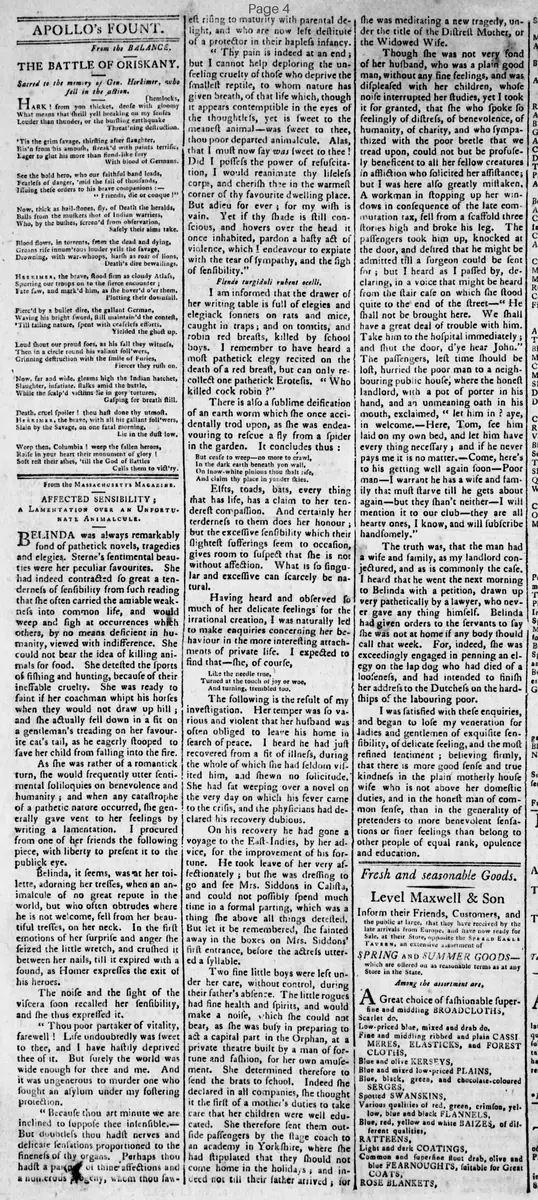
Belinda was always remarkably fond of pathetick novels, tragedies and elegies. Sterne's sentimental beauties were her peculiar favourites. She had indeed contracted so great a tenderness of sensibility from such reading that she often carried the amiable weakness into common life, and would weep and sigh at occurrences which others, by no means deficient in humanity, viewed with indifference. She could not bear the idea of killing animals for food. She detested the sports of fishing and hunting, because of their ineffable cruelty. She was ready to faint if her coachman whipt his horses when they would not draw up hill: and She actually fell down in a fit on a gentleman's treading on her favourite cat's tail, as he eagerly stooped to save her child from falling into the fire.
As she was rather of a romantick turn, she would frequently utter sentimental soliloquies on benevolence and humanity; and when any catastrophe of a pathetic nature occurred, she generally gave vent to her feelings by writing a lamentation. I procured from one of her friends the following piece, with liberty to present it to the publick eye.
Belinda, it seems, was at her toilette, adorning her tresses, when an animalcule of no great repute in the world, but who often obtrudes where he is not welcome, fell from her beautiful tresses, on her neck. In the first emotions of her surprize and anger she seized the little wretch, and crushed it between her nails, till it expired with a sound, as Homer expresses the exit of his heroes.
The noise and the sight of the viscera soon recalled her sensibility, and she thus expressed it.
"Thou poor partaker of vitality, farewell! Life undoubtedly was sweet to thee, and I have hastily deprived thee of it. But surely the world was wide enough for thee and me. And it was ungenerous to murder one who sought an asylum under my fostering protection.
"Because thou art minute we are inclined to suppose thee insensible. But doubtless thou hadst nerves and delicate sensations proportioned to the fineness of thy organs. Perhaps thou hadst a page of thine affections and a numerous progeny, whom thou wert bringing to maturity with parental delight, and who are now left destitute of a protector in their hapless infancy.
"Thy pain is indeed at an end; but I cannot help deploring the unfeeling cruelty of those who deprive the smallest reptile, to whom nature has given breath, of that life which, though it appears contemptible in the eyes of the thoughtless, yet is sweet to the meanest animal--was sweet to thee, thou poor departed animalcule. Alas, that I must now say was sweet to thee! Did I possess the power of resuscitation, I would reanimate thy lifeless corpse, and cherish thee in the warmest corner of thy favourite dwelling place. But adieu for ever; for my wish is vain. Yet if thy Shade is still conscious, and hovers over the head it once inhabited, pardon a hasty act of violence, which I endeavour to expiate with the tear of sympathy, and the sigh of sensibility."
Flendo turgiduli rubentocelli.
I am informed that the drawer of her writing table is full of elegies and elegiack sonnets on rats and mice, caught in traps; and on tomtits, and robin red breasts, killed by school boys. I remember to have heard a most pathetick elegy recited on the death of a red breast, but can only recollect one pathetick Erotema. "Who killed cock robin?"
There is also a sublime deification of an earth worm which she once accidentally trod upon, as she was endeavouring to rescue a fly from a spider in the garden. It concludes thus:
But cease to weep-no more to crawl,
In the dark earth beneath yon wall,
On snow-white pinions thou shalt rise,
And claim thy place in yonder skies.
Elfs, toads, bats, every thing that has life, has a claim to her tenderest compassion. And certainly her tenderness to them does her honour; but the excessive sensibility which their slightest sufferings seem to occasion, gives room to suspect that she is not without affectation. What is so singular and excessive can scarcely be natural.
Having heard and observed so much of her delicate feelings for the irrational creation, I was naturally led to make enquiries concerning her behaviour in the more interesting attachments of private life. I expected to find that-she, of course,
Like the needle true,
Turned at the touch of joy or woe,
And turning, trembled too.
The following is the result of my investigation. Her temper was so various and violent that her husband was often obliged to leave his home in search of peace. I heard he had just recovered from a fit of illness, during the whole of which she had seldom visited him, and shewn no solicitude. She had sat weeping over a novel on the very day on which his fever came to the crisis, and the physicians had declared his recovery dubious.
On his recovery he had gone a voyage to the East-Indies, by her advice, for the improvement of his fortune. He took leave of her very affectionately; but She was dressing to go and see Mrs. Siddons in Cato, and could not possibly spend much time in a formal parting, which was a thing he above all things detested. But let it be remembered, she fainted away in the boxes on Mrs. Siddons' first entrance, before the actress uttered a syllable.
Two fine little boys were left under her care, without control, during their father's absence. The little rogues had fine health and spirits, and would make a noise, which she could not bear, as she was busy in preparing to act a capital part in the Orphan, at a private theatre built by a man of fortune and fashion, for her own amusement. She determined therefore to send the brats to school. Indeed She declared in all companies, she thought it the first of a mother's duties to take care that her children were well educated. She therefore sent them outside passengers by the stage coach to an academy in Yorkshire, where She had stipulated that they should not come home in the holidays; and indeed not till their father arrived; for she was meditating a new tragedy, under the title of the Distrest Mother, or the Widowed Wife.
Though she was not very fond of her husband, who was a plain good man, without any fine feelings, and was displeased with her children, whose noise interrupted her studies, yet I took it for granted, that she who spoke so feelingly of distress, of benevolence, of humanity, of charity, and who sympathized with the poor beetle that we tread upon, could not but be profusely beneficent to all her fellow creatures in affliction who solicited her assistance: but I was here also greatly mistaken.
A workman in stopping up her windows in consequence of the late commutation tax, fell from a scaffold three stories high and broke his leg. The passengers took him up, knocked at the door, and desired that he might be admitted till a surgeon could be sent for; but I heard as I passed by, declaring, in a voice that might be heard from the stair case on which she stood quite to the end of the street-"He shall not be brought here. We shall have a great deal of trouble with him. Take him to the hospital immediately; and shut the door, d'ye hear John."
The passengers, lest time should be lost, hurried the poor man to a neighbouring public house, where the honest landlord, with a pot of porter in his hand, and an unmeaning oath in his mouth, exclaimed, "let him in? aye, in welcome.-Here, Tom, see him laid on my own bed, and let him have every thing necessary; and if he never pays me it is no matter.-Come, here's to his getting well again soon-Poor man-I warrant he has a wife and family that must starve till he gets about again but they shan't neither-I will mention it to our club-they are all hearty ones, I know, and will subscribe handsomely."
The truth was, that the man had a wife and family, as my landlord conjectured, and as is commonly the case. I heard that he went the next morning to Belinda with a petition, drawn up very pathetically by a lawyer, who never gave any thing himself. Belinda had given orders to the servants to say she was not at home if any body should call that week. For, indeed, she was exceedingly engaged in penning an elegy on the lap dog who had died of a looseness, and had intended to finish her address to the Dutchess on the hardships of the labouring poor.
I was satisfied with these enquiries, and began to lose my veneration for ladies and gentlemen of exquisite sensibility, of delicate feeling, and the most refined sentiment; believing firmly, that there is more good sense and true kindness in the plain motherly house wife who is not above her domestic duties, and in the honest man of common sense, than in the generality of pretenders to more benevolent sensations or finer feelings than belong to other people of equal rank, opulence and education.
AFFECTED SENSIBILITY;
A LAMENTATION OVER AN UNFORTUNATE ANIMALCULE.
Belinda was always remarkably fond of pathetick novels, tragedies and elegies. Sterne's sentimental beauties were her peculiar favourites. She had indeed contracted so great a tenderness of sensibility from such reading that she often carried the amiable weakness into common life, and would weep and sigh at occurrences which others, by no means deficient in humanity, viewed with indifference. She could not bear the idea of killing animals for food. She detested the sports of fishing and hunting, because of their ineffable cruelty. She was ready to faint if her coachman whipt his horses when they would not draw up hill: and She actually fell down in a fit on a gentleman's treading on her favourite cat's tail, as he eagerly stooped to save her child from falling into the fire.
As she was rather of a romantick turn, she would frequently utter sentimental soliloquies on benevolence and humanity; and when any catastrophe of a pathetic nature occurred, she generally gave vent to her feelings by writing a lamentation. I procured from one of her friends the following piece, with liberty to present it to the publick eye.
Belinda, it seems, was at her toilette, adorning her tresses, when an animalcule of no great repute in the world, but who often obtrudes where he is not welcome, fell from her beautiful tresses, on her neck. In the first emotions of her surprize and anger she seized the little wretch, and crushed it between her nails, till it expired with a sound, as Homer expresses the exit of his heroes.
The noise and the sight of the viscera soon recalled her sensibility, and she thus expressed it.
"Thou poor partaker of vitality, farewell! Life undoubtedly was sweet to thee, and I have hastily deprived thee of it. But surely the world was wide enough for thee and me. And it was ungenerous to murder one who sought an asylum under my fostering protection.
"Because thou art minute we are inclined to suppose thee insensible. But doubtless thou hadst nerves and delicate sensations proportioned to the fineness of thy organs. Perhaps thou hadst a page of thine affections and a numerous progeny, whom thou wert bringing to maturity with parental delight, and who are now left destitute of a protector in their hapless infancy.
"Thy pain is indeed at an end; but I cannot help deploring the unfeeling cruelty of those who deprive the smallest reptile, to whom nature has given breath, of that life which, though it appears contemptible in the eyes of the thoughtless, yet is sweet to the meanest animal--was sweet to thee, thou poor departed animalcule. Alas, that I must now say was sweet to thee! Did I possess the power of resuscitation, I would reanimate thy lifeless corpse, and cherish thee in the warmest corner of thy favourite dwelling place. But adieu for ever; for my wish is vain. Yet if thy Shade is still conscious, and hovers over the head it once inhabited, pardon a hasty act of violence, which I endeavour to expiate with the tear of sympathy, and the sigh of sensibility."
Flendo turgiduli rubentocelli.
I am informed that the drawer of her writing table is full of elegies and elegiack sonnets on rats and mice, caught in traps; and on tomtits, and robin red breasts, killed by school boys. I remember to have heard a most pathetick elegy recited on the death of a red breast, but can only recollect one pathetick Erotema. "Who killed cock robin?"
There is also a sublime deification of an earth worm which she once accidentally trod upon, as she was endeavouring to rescue a fly from a spider in the garden. It concludes thus:
But cease to weep-no more to crawl,
In the dark earth beneath yon wall,
On snow-white pinions thou shalt rise,
And claim thy place in yonder skies.
Elfs, toads, bats, every thing that has life, has a claim to her tenderest compassion. And certainly her tenderness to them does her honour; but the excessive sensibility which their slightest sufferings seem to occasion, gives room to suspect that she is not without affectation. What is so singular and excessive can scarcely be natural.
Having heard and observed so much of her delicate feelings for the irrational creation, I was naturally led to make enquiries concerning her behaviour in the more interesting attachments of private life. I expected to find that-she, of course,
Like the needle true,
Turned at the touch of joy or woe,
And turning, trembled too.
The following is the result of my investigation. Her temper was so various and violent that her husband was often obliged to leave his home in search of peace. I heard he had just recovered from a fit of illness, during the whole of which she had seldom visited him, and shewn no solicitude. She had sat weeping over a novel on the very day on which his fever came to the crisis, and the physicians had declared his recovery dubious.
On his recovery he had gone a voyage to the East-Indies, by her advice, for the improvement of his fortune. He took leave of her very affectionately; but She was dressing to go and see Mrs. Siddons in Cato, and could not possibly spend much time in a formal parting, which was a thing he above all things detested. But let it be remembered, she fainted away in the boxes on Mrs. Siddons' first entrance, before the actress uttered a syllable.
Two fine little boys were left under her care, without control, during their father's absence. The little rogues had fine health and spirits, and would make a noise, which she could not bear, as she was busy in preparing to act a capital part in the Orphan, at a private theatre built by a man of fortune and fashion, for her own amusement. She determined therefore to send the brats to school. Indeed She declared in all companies, she thought it the first of a mother's duties to take care that her children were well educated. She therefore sent them outside passengers by the stage coach to an academy in Yorkshire, where She had stipulated that they should not come home in the holidays; and indeed not till their father arrived; for she was meditating a new tragedy, under the title of the Distrest Mother, or the Widowed Wife.
Though she was not very fond of her husband, who was a plain good man, without any fine feelings, and was displeased with her children, whose noise interrupted her studies, yet I took it for granted, that she who spoke so feelingly of distress, of benevolence, of humanity, of charity, and who sympathized with the poor beetle that we tread upon, could not but be profusely beneficent to all her fellow creatures in affliction who solicited her assistance: but I was here also greatly mistaken.
A workman in stopping up her windows in consequence of the late commutation tax, fell from a scaffold three stories high and broke his leg. The passengers took him up, knocked at the door, and desired that he might be admitted till a surgeon could be sent for; but I heard as I passed by, declaring, in a voice that might be heard from the stair case on which she stood quite to the end of the street-"He shall not be brought here. We shall have a great deal of trouble with him. Take him to the hospital immediately; and shut the door, d'ye hear John."
The passengers, lest time should be lost, hurried the poor man to a neighbouring public house, where the honest landlord, with a pot of porter in his hand, and an unmeaning oath in his mouth, exclaimed, "let him in? aye, in welcome.-Here, Tom, see him laid on my own bed, and let him have every thing necessary; and if he never pays me it is no matter.-Come, here's to his getting well again soon-Poor man-I warrant he has a wife and family that must starve till he gets about again but they shan't neither-I will mention it to our club-they are all hearty ones, I know, and will subscribe handsomely."
The truth was, that the man had a wife and family, as my landlord conjectured, and as is commonly the case. I heard that he went the next morning to Belinda with a petition, drawn up very pathetically by a lawyer, who never gave any thing himself. Belinda had given orders to the servants to say she was not at home if any body should call that week. For, indeed, she was exceedingly engaged in penning an elegy on the lap dog who had died of a looseness, and had intended to finish her address to the Dutchess on the hardships of the labouring poor.
I was satisfied with these enquiries, and began to lose my veneration for ladies and gentlemen of exquisite sensibility, of delicate feeling, and the most refined sentiment; believing firmly, that there is more good sense and true kindness in the plain motherly house wife who is not above her domestic duties, and in the honest man of common sense, than in the generality of pretenders to more benevolent sensations or finer feelings than belong to other people of equal rank, opulence and education.
What sub-type of article is it?
Satire
Essay
What themes does it cover?
Moral Virtue
Social Manners
What keywords are associated?
Affected Sensibility
Satire
Hypocrisy
Benevolence
Animal Compassion
Family Neglect
Charity Pretense
Literary Details
Title
Affected Sensibility; A Lamentation Over An Unfortunate Animalcule.
Form / Style
Satirical Prose Narrative
Key Lines
"Thou Poor Partaker Of Vitality, Farewell! Life Undoubtedly Was Sweet To Thee, And I Have Hastily Deprived Thee Of It."
"Because Thou Art Minute We Are Inclined To Suppose Thee Insensible."
But Cease To Weep No More To Crawl, In The Dark Earth Beneath Yon Wall, On Snow White Pinions Thou Shalt Rise, And Claim Thy Place In Yonder Skies.
"He Shall Not Be Brought Here. We Shall Have A Great Deal Of Trouble With Him. Take Him To The Hospital Immediately; And Shut The Door, D'ye Hear John."