Thank you for visiting SNEWPapers!
Sign up free
Literary
October 15, 1736
The Virginia Gazette
Richmond, Williamsburg, Richmond County, Virginia
What is this article about?
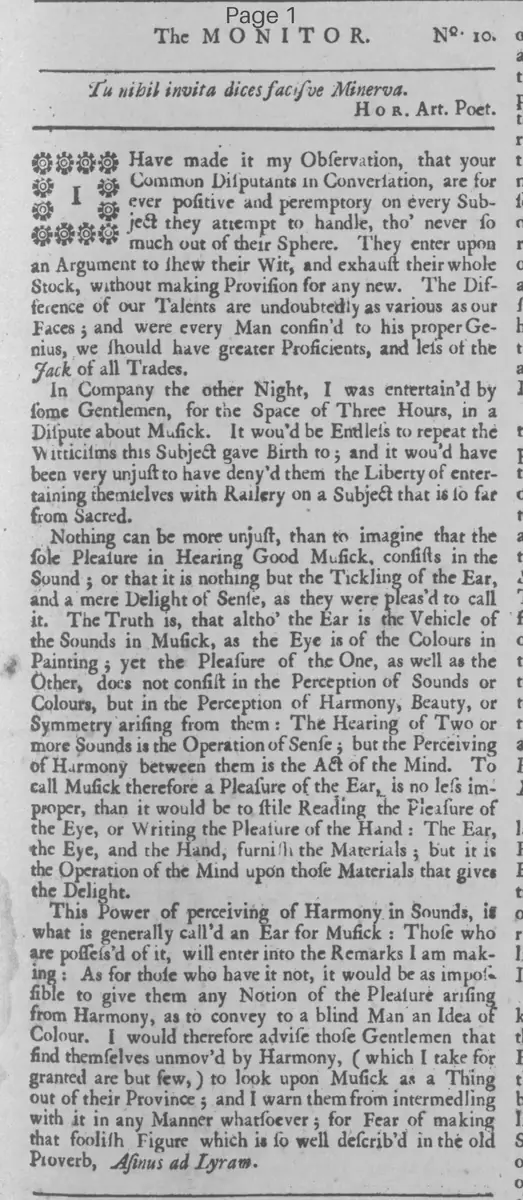
An essay in 'The Monitor, No. 10' observes that disputants often overreach their talents, as seen in a conversation on music. It argues that music's pleasure derives from the mind's perception of harmony, not mere sensory tickling, and advises those lacking an ear for music to avoid meddling, lest they appear foolish like 'Asinus ad Lyram.'
Clipping
OCR Quality
95%
Excellent
Full Text
The MONITOR.
No. 10.
Tu nihil invita dices facitve Minerva.
Hor. Art. Poet.
Have made it my Observation, that your Common Disputants in Conversation, are ever positive and peremptory on every Subject they attempt to handle, tho' never so much out of their Sphere. They enter upon an Argument to shew their Wit, and exhaust their whole Stock, without making Provision for any new. The Difference of our Talents are undoubtedly as various as our Faces; and were every Man confin'd to his proper Genius, we should have greater Proficients, and less of the Jack of all Trades.
In Company the other Night, I was entertain'd by Some Gentlemen, for the Space of Three Hours, in a Dispute about Musick. It wou'd be Endless to repeat the Witticisms this Subject gave Birth to; and it wou'd have been very unjust to have deny'd them the Liberty of entertaining themselves with Raillery on a Subject that is so far from Sacred.
Nothing can be more unjust, than to imagine that the Sole Pleasure in Hearing Good Musick, consists in the Sound; or that it is nothing but the Tickling of the Ear, and a mere Delight of Sense, as they were pleas'd to call it. The Truth is, that altho' the Ear is the Vehicle of the Sounds in Musick, as the Eye is of the Colours in Painting; yet the Pleasure of the One, as well as the Other, does not consist in the Perception of Sounds or Colours, but in the Perception of Harmony, Beauty, or Symmetry arising from them: The Hearing of Two or more Sounds is the Operation of Sense; but the Perceiving of Harmony between them is the Act of the Mind. To call Musick therefore a Pleasure of the Ear, is no less improper, than it would be to stile Reading the Pleasure of the Eye, or Writing the Pleasure of the Hand: The Ear, the Eye, and the Hand, furnish the Materials; but it is the Operation of the Mind upon those Materials that gives the Delight.
This Power of perceiving of Harmony in Sounds, is what is generally call'd an Ear for Musick: Those who are possess'd of it, will enter into the Remarks I am making: As for those who have it not, it would be as impossible to give them any Notion of the Pleasure arising from Harmony, as to convey to a blind Man an Idea of Colour. I would therefore advise those Gentlemen that find themselves unmov'd by Harmony, (which I take for granted are but few,) to look upon Musick as a Thing out of their Province; and I warn them from intermedling with it in any Manner whatsoever; for Fear of making that foolish Figure which is so well describ'd in the old Proverb, Asinus ad Lyram.
No. 10.
Tu nihil invita dices facitve Minerva.
Hor. Art. Poet.
Have made it my Observation, that your Common Disputants in Conversation, are ever positive and peremptory on every Subject they attempt to handle, tho' never so much out of their Sphere. They enter upon an Argument to shew their Wit, and exhaust their whole Stock, without making Provision for any new. The Difference of our Talents are undoubtedly as various as our Faces; and were every Man confin'd to his proper Genius, we should have greater Proficients, and less of the Jack of all Trades.
In Company the other Night, I was entertain'd by Some Gentlemen, for the Space of Three Hours, in a Dispute about Musick. It wou'd be Endless to repeat the Witticisms this Subject gave Birth to; and it wou'd have been very unjust to have deny'd them the Liberty of entertaining themselves with Raillery on a Subject that is so far from Sacred.
Nothing can be more unjust, than to imagine that the Sole Pleasure in Hearing Good Musick, consists in the Sound; or that it is nothing but the Tickling of the Ear, and a mere Delight of Sense, as they were pleas'd to call it. The Truth is, that altho' the Ear is the Vehicle of the Sounds in Musick, as the Eye is of the Colours in Painting; yet the Pleasure of the One, as well as the Other, does not consist in the Perception of Sounds or Colours, but in the Perception of Harmony, Beauty, or Symmetry arising from them: The Hearing of Two or more Sounds is the Operation of Sense; but the Perceiving of Harmony between them is the Act of the Mind. To call Musick therefore a Pleasure of the Ear, is no less improper, than it would be to stile Reading the Pleasure of the Eye, or Writing the Pleasure of the Hand: The Ear, the Eye, and the Hand, furnish the Materials; but it is the Operation of the Mind upon those Materials that gives the Delight.
This Power of perceiving of Harmony in Sounds, is what is generally call'd an Ear for Musick: Those who are possess'd of it, will enter into the Remarks I am making: As for those who have it not, it would be as impossible to give them any Notion of the Pleasure arising from Harmony, as to convey to a blind Man an Idea of Colour. I would therefore advise those Gentlemen that find themselves unmov'd by Harmony, (which I take for granted are but few,) to look upon Musick as a Thing out of their Province; and I warn them from intermedling with it in any Manner whatsoever; for Fear of making that foolish Figure which is so well describ'd in the old Proverb, Asinus ad Lyram.
What sub-type of article is it?
Essay
What themes does it cover?
Moral Virtue
Social Manners
What keywords are associated?
Music
Harmony
Perception
Conversation
Talents
Disputants
Aesthetics
Literary Details
Title
The Monitor. No. 10.
Subject
On The Nature Of Music And Conversation
Form / Style
Prose Essay With Philosophical Reflection
Key Lines
Nothing Can Be More Unjust, Than To Imagine That The Sole Pleasure In Hearing Good Musick, Consists In The Sound; Or That It Is Nothing But The Tickling Of The Ear, And A Mere Delight Of Sense.
The Ear, The Eye, And The Hand, Furnish The Materials; But It Is The Operation Of The Mind Upon Those Materials That Gives The Delight.
Asinus Ad Lyram.