Thank you for visiting SNEWPapers!
Sign up free
The National Intelligencer And Washington Advertiser
Washington, District Of Columbia
What is this article about?
In Dublin, Owen Kirwan was tried for high treason related to the July 23 uprising. Witnesses testified to his suspicious activities and inflammatory actions. Defense by Mr. Curran highlighted government moderation. Jury found him guilty.
Clipping
OCR Quality
Full Text
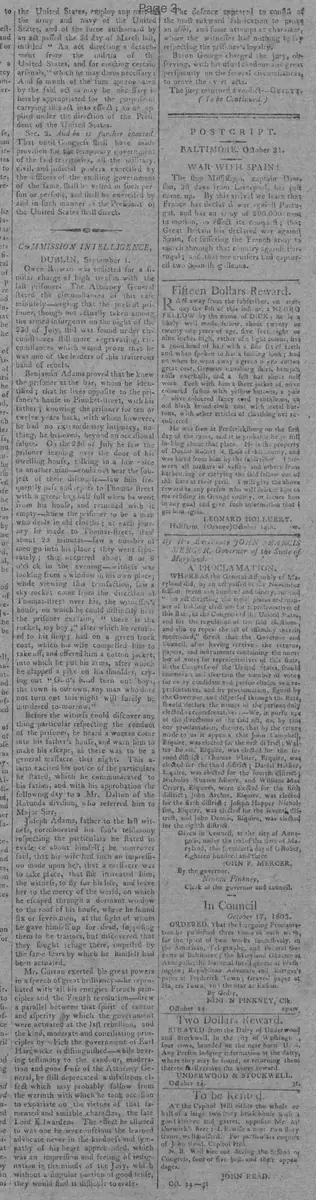
DUBLIN, September 1.
Owen Kirwan was indicted for a similar charge of high treason with the last prisoner. The Attorney General stated the circumstances of this case minutely—urging that the present prisoner, though not actually taken among the armed insurgents on the night of the 23d of July, still was found under circumstances still more aggravating, circumstances which would prove that he was one of the leaders of this traitorous band of rebels.
Benjamin Adams proved that he knew the prisoner at the bar, whom he identified; that he lives opposite to the prisoner's house in Plunket-street, with his father; knowing the prisoner for ten or twelve years back, with whom however, he had no extraordinary intimacy, nothing, he believed, beyond an occasional salute. On the 23d of July he saw the prisoner leaning over the door of his dwelling house, talking in a low voice to another man—could not hear the subject of their discourse—saw him frequently pass and repass to Thomas street with a green bag half full when he went from his house, and returned with it empty—knew the prisoner to be a man who deals in old cloaths; at each journey he made to Thomas-street, staid about 25 minutes—saw a number of men go into his place; they went separately; this occurred about 8 or 9 o'clock in the evening—witness was looking from a window in his own place; while viewing this transaction, saw a sky rocket come from the direction of Thomas-street over his, the witness's house, on which he could distinctly hear the prisoner exclaim, "there is the rocket, my boy;" after which he returned to his shop; had on a green frock coat, which his wife compelled him to take off, and offered him a cotton jacket, into which he put his arms, after which he clapped a pike on his shoulder, crying out "G..d's b...d turn out boys, the town is our own, any man who does not turn out this night will surely be murdered to-morrow."
Before the witness could discover any thing particular respecting the conduct of the prisoner, he heard a woman come into his father's house, and warn him to make his escape, as there was to be a general massacre that night. This alarm excited his notice of the particulars he stated, which he communicated to his father, and with his approbation the following day to a Mr. Dalton of the Rotunda division, who referred him to Major Sirr.
Joseph Adams, father to the last witness, corroborated his son's testimony respecting the particulars he stated in evidence about himself; he moreover said, that his wife had such an impression made upon her, that a massacre was to take place, that he requested him, the witness, to fly for his life, and leave her to the mercy of the world, on which he escaped through a dormant window to the roof of his house, where he found six or seven men, at the sight of whom he gave himself up for dead, supposing them to be traitors, but discovered that they sought refuge there, impelled by the same fears by which he himself had been actuated.
Mr. Curran exerted his great powers in a speech of great brilliancy—he reprobated with all his energies French principles and the French revolution—drew a parallel between that spirit of rancor and asperity by which the government were actuated at the last rebellion, and the kind, moderate and conciliating principles by which the government of Earl Hardwicke is distinguished—while bearing testimony to the candour, moderation and good sense of the Attorney General, he still deprecated a disastrous effect which may probably follow from the warmth with which he took occasion to expatiate on the virtues of that lamented and amiable character, the late Lord Kilwarden. The effect he alluded to was one he was conscious the learned advocate never in the kindness and sympathy of his heart apprehended, which was an impression and feeling of indignation in the minds of the Jury, which without a singular portion of good sense, they would find it difficult to eradicate.
The defence appeared to consist of the most awkward fabrication to prove an alibi, and some attempt at character, where the witnesses had nothing to say respecting the prisoner's loyalty.
Baron George charged the jury, observing, with his usual candour and great perpicuity on the several circumstances to prove the overt acts.
The jury returned a verdict—GUILTY.
(To be Continued.)
What sub-type of article is it?
What keywords are associated?
What entities or persons were involved?
Where did it happen?
Foreign News Details
Primary Location
Dublin
Event Date
23d Of July; Trial September 1
Key Persons
Outcome
verdict: guilty
Event Details
Owen Kirwan indicted for high treason linked to the July 23 insurgents. Witnesses Benjamin and Joseph Adams testified to his movements, carrying a green bag to Thomas Street, exclaiming at a rocket, and urging men to arm with pikes amid massacre fears. Defense by Mr. Curran criticized French principles but praised government moderation. Alibi defense failed; jury convicted him.