Thank you for visiting SNEWPapers!
Sign up free
Morning Star
Limerick, York County, Maine
What is this article about?
At the American Anti-Slavery Society's second anniversary in New York on May 12, President Arthur Tappan presided. James G. Birney delivered a speech arguing that free states must use moral power to eradicate slavery for the Union's safety, critiquing national inconsistencies, church complicity, and predicting dissolution without immediate emancipation.
Clipping
OCR Quality
Full Text
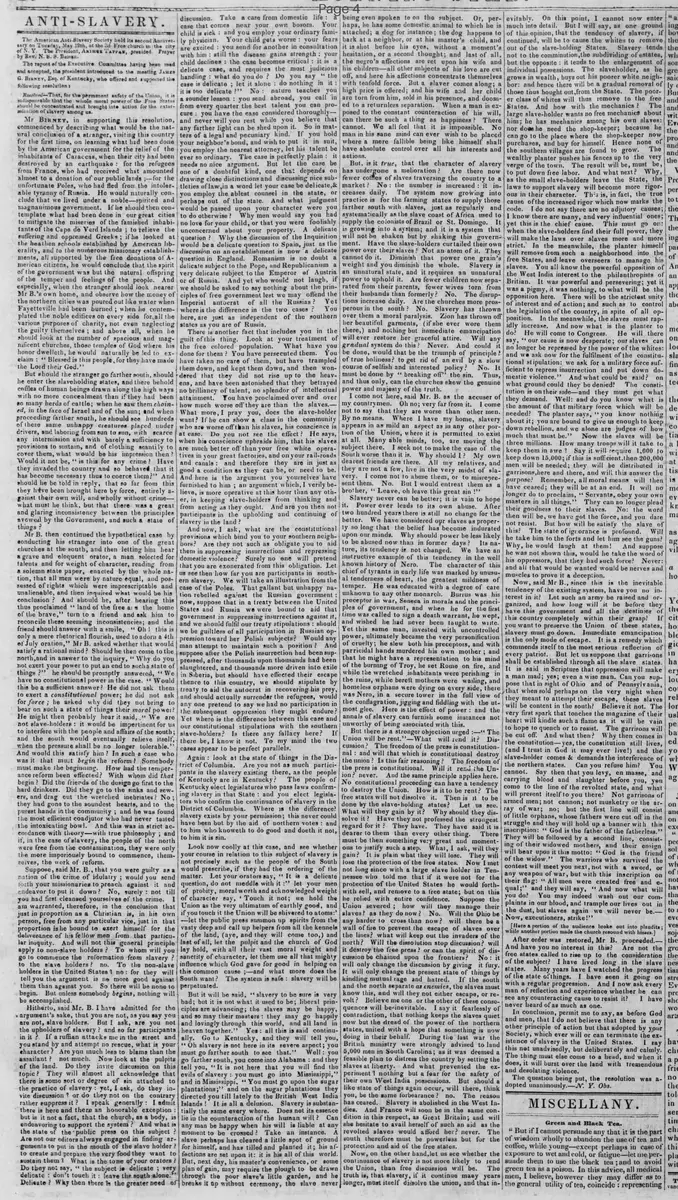
The American Anti-Slavery Society held its second Anniversary on Tuesday, May 12th, at the 3d Free church in the city of N. Y. The President, Arthur Tappan, presided. Prayer by Rev. N. S. S. Beman.
The report of the Executive Committee having been read and accepted, the president introduced to the meeting James G. Birney, Esq. of Kentucky, who offered and supported the following resolution:
Resolved—That, for the permanent safety of the Union, it is indispensable that the whole moral power of the Free States should be concentrated and brought into action for the extermination of slavery among us.
Mr. Birney, in supporting this resolution, commenced by describing what would be the natural conclusion of a stranger, visiting this country for the first time, on learning what had been done by the American government for the relief of the inhabitants of Caraccas, when their city had been destroyed by an earthquake; for the refugees from France, who had received what amounted almost to a donation of our public lands;—for the unfortunate Poles, who had fled from the intolerable tyranny of Russia. He would naturally conclude that we lived under a noble-spirited and magnanimous government. If he should then contemplate what had been done in our great cities to mitigate the miseries of the famished inhabitants of the Cape de Verd Islands; to relieve the suffering and oppressed Greeks; if he looked at the heathen schools established by American liberality, and to the numerous missionary establishments, all supported by the free donations of American citizens, he would conclude that the spirit of the government was but the natural offspring of the temper and feelings of the people. And especially, when the stranger should look nearer Mr. B.'s own home, and observe how the money of the northern cities was poured out like water when Fayetteville had been burned; when he contemplated the noble edifices on every side for all the various purposes of charity, not even neglecting the guilty themselves; and above all, when he should look at the number of spacious and magnificent churches, those temples of God where his honor dwelleth, he would naturally be led to exclaim: "Blessed is this people, for they have made the Lord their God."
But should the stranger go farther south, should he enter the slaveholding states, and there behold coffles of human beings drawn along the highways with no more concealment than if they had been so many herds of cattle; when he saw them chained, in the face of Israel and of the sun; and when proceeding farther south, he should see hundreds of these same unhappy creatures placed under drivers, and laboring from sun to sun, with scarce any intermission and with barely a sufficiency of provisions to sustain, and of clothing scantily to cover them, what would be his impression then?
Would it not be, "Is this for any crime? Have they invaded the country and so behaved that it has become necessary thus to coerce them?" And should he be told in reply, that so far from this they have been brought here by force, entirely against their own will, and wholly without crime—what must he think, but that there was a great and glaring inconsistency between the principles avowed by the Government, and such a state of things?
Mr. B. then continued the hypothetical case by conducting his stranger into one of the great churches at the south, and then letting him hear a grave and eloquent orator, a man selected for talents and for weight of character, reading from a solemn state paper, enacted by the whole nation, that all men were by nature equal, and possessed of rights which were imprescriptible and unalienable, and then inquired what would be his conclusion? And should he, after hearing this thus proclaimed "land of the free and the home of the brave," turn to a friend and ask him to reconcile these seeming inconsistencies; and the friend should answer with a smile, "Oh! this is only a mere rhetorical flourish, used to adorn a 4th of July oration," Mr. B. asked whether that would satisfy a rational mind? Should he then come to the north, and in answer to the inquiry, "Why do you not exert your power to put an end to such a state of things?" he should be promptly answered, "We have no constitutional power in the case." Would this be a sufficient answer? He did not ask them to exert a constitutional power; he did not ask for force; he asked why did they not bring to bear on such a state of things their moral power?
He might then probably hear it said, "We are not slave-holders: it would be impertinent for us to interfere with the people and affairs of the south; and the south would eventually relieve itself, when the pressure shall be no longer tolerable."
And would this satisfy him? In such a case who was it that must begin the reform? Somebody must make the beginning. How had the temperance reform been effected? With whom did that begin? Did the friends of the design go first to the hard drinkers? Did they go to the sinks and sewers, and drag out the wretched inebriates? No; they had gone to the soundest hearts, and to the purest hands in the community; and he was found the most efficient coadjutor who had never tasted the intoxicating bowl. And this was in strict accordance with theory—with true philosophy; and if, in the case of slavery, the people of the north were free from the contamination, they were only the more imperiously bound to commence, themselves, the work of reform.
Suppose, said Mr. B., that you were guilty as a nation of the crime of idolatry; would you send forth your missionaries to preach against it and endeavor to put it down? No, surely: not till you had first cleansed yourselves of the crime. I am warranted, therefore, in the conclusion that just in proportion as a Christian is, in his own person, free from any particular vice, just in that proportion is he bound to exert himself for the deliverance of his fellow men from that particular iniquity. And will not this general principle apply to non-slave holders? To whom will you go to commence the reformation from slavery? To the slave holders? No. To the non-slave holders in the United States? No: or they will tell you the argument is no more good against them than against you. So there will be none to begin. But unless somebody begins, nothing will be accomplished.
Hitherto, said Mr. B., I have admitted for the argument's sake, that you are not, as you say you are not, slave holders. But I ask, are you not the upholders of slavery? and so far participants in it? If a ruffian attacks me in the street and you stand by and attempt no rescue, what is your character? Are you much less to blame than the assailant? Not much. Now look at the pulpits of the land. Do they invite discussion on this subject? They will almost all acknowledge that there is some sort or degree of sin attached to the practice of slavery: yet, I ask, do they invite discussion? or do they not on the contrary rather suppress it? I speak generally: I admit there is here and there an honorable exception: but is it not a fact, that the church, as a body, is endeavoring to support the system? And what is the state of the public press on this subject?
Are not our editors always engaged in finding arguments to put in the mouth of the slave holder? to create and prepare the very food they want to sustain them? What is the tone of your orators? Do they not say, "the subject is delicate; very delicate: don't touch it: leave the south alone."
Delicate? Why then there is the greater need of discussion. Take a case from domestic life: a case that comes near your own bosom. Your child is sick: and you employ your ordinary family physician. Your child gets worse: your fears are excited: you send for another in consultation with him: still the disease gains strength: your child declines: the case becomes critical: it is a delicate case, and requires the most judicious handling: what do you do? Do you say "the case is delicate; let it alone: do nothing in it: it is too delicate?" No: nature teaches you a sounder lesson: you send abroad, you call in from every quarter the best talent you can procure: you have the case considered thoroughly—and never will you rest while you believe that any farther light can be shed upon it. So in matters of a legal and pecuniary kind. If you hold your neighbor's bond, and wish to put it in suit, you employ the nearest attorney, let his talent be ever so ordinary. The case is perfectly plain: it needs no nice argument. But let the case be one of a doubtful kind, one that depends on drawing close distinctions and discussing nice subtleties of law in a word let your case be delicate, and you employ the ablest counsel in the state, or perhaps out of the state. And what judgment would be passed upon your character were you to do otherwise? Why men would say you had no love for your child, or that you were foolishly unconcerned about your property. A delicate question? Why the discussion of the Inquisition would be a delicate question to Spain, just as the discussion on an establishment is now a delicate question in England. Romanism is no doubt a delicate subject to the Pope, and Republicanism a very delicate subject to the Emperor of Austria or of Russia. And yet who would not laugh, if we should be asked to say nothing about the principles of free government lest we may offend the Imperial autocrat of all the Russias? Yet where is the difference in the two cases? You here, are just as independent of the southern states as you are of Russia.
There is another fact that includes you in the guilt of this thing. Look at your treatment of the free colored population. What have you done for them? You have persecuted them. You have taken no care of them, but have trampled them down, and kept them down, and then wondered that they did not rise up to the heavens, and have been astonished that they betrayed no brilliancy of talent, no splendor of intellectual attainment. You have proclaimed over and over how much worse off they are than the slaves.—What more, I pray you, does the slave-holder want? If he can show a class in the community who are worse off than his slaves, his conscience is at ease. Do you not see the effect? He says, when his conscience upbraids him, that his slaves are much better off than your free white operatives in your great factories, and on your rail-roads and canals: and therefore they are in just as good a condition as they can be, or need to be.
And here is the argument you yourselves have furnished to him; an argument which, I verily believe, is more operative at this hour than any other, in keeping slave-holders from thinking and from acting as they ought. And are you then not participants in the upholding and continuing of slavery in the land?
And now, I ask, what are the constitutional provisions which bind you to your southern neighbors? Are they not such as obligate you to aid them in suppressing insurrections and repressing domestic violence? Surely no one will pretend that you are exonerated from this obligation. Let us see then how far you are participants in southern slavery. We will take an illustration from the case of the Poles. That gallant but unhappy nation rebelled against the Russian government: now, suppose that in a treaty between the United States and Russia we were bound to aid that government in suppressing insurrections against it, and we should fulfil our treaty stipulations: should we be guiltless of all participation in Russian oppression toward her Polish subjects? Would any man attempt to maintain such a position? And suppose after the Polish insurrection had been suppressed, after thousands upon thousands had been slaughtered, and thousands more driven into exile in Siberia, but should have effected their escape thence to this country, we should stipulate by treaty to aid the autocrat in recovering his prey, and should actually surrender the refugees, would any one pretend to say we had no participation in the subsequent oppression they might endure?
Yet where is the difference between this case and our constitutional stipulations with the southern slave-holders? Is there any fallacy here? If there be, I know it not. To my mind the two cases appear to be perfect parallels.
Again: look at the state of things in the District of Columbia. Are you not as much participants in the slavery existing there, as the people of Kentucky are in Kentucky? The people of Kentucky elect legislatures who pass laws confirming slavery in that State: and you elect legislators who confirm the continuance of slavery in the District of Columbia. Where is the difference? Slavery exists by your permission; this never could have been but by the aid of northern votes: and to him who knoweth to do good and doeth it not, to him it is sin.
Look now coolly at this case, and see whether your course in relation to this subject of slavery is not precisely such as the people of the South would prescribe, if they had the ordering of the matter. Let your orators say, "It is a delicate question, do not meddle with it:" let your men of probity, moral worth and acknowledged weight of character say, Touch it not; we hold the Union as the very ultimatum of earthly good, and if you touch it the Union will be shivered to atoms;"—let the public press summon up spirits from the vasty deep and call up helpers from all the kennels of the land, (aye, and they will come too,) and last of all, let the pulpit and the church of God lay hold, with all their vast moral weight and sanctity of character, let them use all that mighty influence which God gave for good in helping on this common cause;—and what more does the South want? The system is safe: slavery will be perpetuated.
But it will be said, "slavery to be sure is very bad; but it is not what it used to be; liberal principles are advancing; the slaves may be happy, and so may their masters: they may go happily and lovingly through this world, and all land in heaven together." Yes: all this is said continually. Go to Kentucky, and they will tell you, "Oh slavery is not here in its severe aspect; you must go farther south to see that." Well: you go farther south, you come into Alabama: and they tell you, "It is not here that you will find the evils of slavery: you must go into Mississippi," and in Mississippi. "You must go upon the sugar plantations;" and on the sugar plantations they directed you till lately to the British West India Islands! It is all a delusion. Slavery is substantially the same everywhere. Does not its essence lie in the counteraction of the human will? Can any man be happy when his will is liable at any moment to be crossed? Take an instance. A slave perhaps has cleared a little spot of ground for himself, and has tilled and planted it; his affections are set upon it: it is his all of this world. But, next day, his master's convenience, or some plan of gain, may require the plough to be drawn through the poor slave's little garden, and he breaks it up without ceremony, the slave never being even spoken to on the subject. Or, perhaps, he has some domestic animal to which he is attached; a dog for instance; the dog happens to bark at a neighbor, or at his master's child, and it is shot before his eyes, without a moment's hesitation, or a second thought; and last of all, the negro's affections are set upon his wife and his children—all other subjects of his love are cut off, and here his affections concentrate themselves with tenfold force. But a slaver comes along; a high price is offered; and his wife and her child are torn from him, sold in his presence, and doomed to a returnless separation. When a man is exposed to the constant counteraction of his will, can there be such a thing as happiness? There cannot. We all feel that it is impossible. No man in his sane mind can ever wish to be placed where a mere fallible being like himself shall have absolute control over all his interests and actions.
But, is it true, that the character of slavery has undergone a melioration? Are there now fewer coffles of slaves traversing the country to a market? No: the number is increased: it increases daily. The system now growing into practice is for the farming states to supply those farther south with slaves, just as regularly and systematically as the slave coast of Africa used to supply the colonists of Brazil or St. Domingo. It is growing into a system; and it is a system that will not be shaken but by shaking this government. Have the slave-holders curtailed their own power over their slaves? Not an atom of it. They cannot do it. Diminish that power one grain's weight and you diminish the whole. Slavery is an unnatural state, and it requires an unnatural power to uphold it. Are fewer children now separated from their parents, fewer wives torn from their husbands than formerly? No. The disruptions increase daily. Are the churches more prosperous in the south? No. Slavery has thrown over them a moral paralysis. Zion has thrown off her beautiful garments, (if she ever wore them there,) and nothing but immediate emancipation will ever restore her graceful attire. Will any gradual system do this? Never. And could it be done, would that be the triumph of principle? of true holiness? to get rid of an evil by a slow course of selfish and interested policy? No. It must be done by "breaking off" the sin. Thus, and thus only, can the churches show the genuine power and majesty of the truth.
I come not here, said Mr. B. as the accuser of my countrymen. Oh no; very far from it. I come not to say that they are worse than other men. By no means. Where I have my home, slavery appears in as mild an aspect as in any other portion of the Union, where it is permitted to exist at all. Many able minds, too, are moving the subject there. I seek not to make the case of the South worse than it is. Why should I? My own dearest friends are there. All my relatives, and they are not a few, live in the very midst of slavery. I come not to abuse them, or to misrepresent them. No. But I would entreat them as a brother, "Leave, oh leave this great sin!" Slavery never can be better; it is vain to hope it. Power ever leads to its own abuse. After two hundred years there is still no change for the better. We have considered our slaves as property so long that the belief has become indurated upon our minds. Why should power be less likely to be abused now than in former days? Its nature, its tendency is not changed. We have an instructive example of this tendency in the well known history of Nero. The character of this chief of tyrants in early life was marked by unusual tenderness of heart, the greatest mildness of temper. He was educated with a degree of care unknown to any other monarch. Burrus was his preceptor in war, Seneca in morals and the principles of government, and when he for the first time was called to sign a death warrant, he wept, and wished he had never been taught to write. Yet this same man, invested with uncontrolled power, ultimately became the very personification of cruelty; he slew both his preceptors, and with parricidal hands murdered his own mother; and that he might have a representation to his mind of the burning of Troy, he set Rome on fire, and while the wretched inhabitants were perishing in the ruins, while bereft mothers were wailing, and homeless orphans were dying on every side, there was Nero, in a secure tower in the full view of the conflagration, jigging and fiddling with the utmost glee. Here is the effect of power: and the annals of slavery can furnish some instances not unworthy of being associated with this.
But there is a stronger objection urged:—"The Union will be rent." What will rend it? Discussion? The freedom of the press is constitutional: and will that which is constitutional destroy the union? Is this fair reasoning? The freedom of the press is constitutional. Will it rend the Union? Never. And the same principle applies here. No constitutional proceeding can have a tendency to destroy the Union. How is it to be rent? The free states will not dissolve it. Then is it to be done by the slave-holding states? Let us see. What will they gain by it? Why should they dissolve it? Have they not professed the strongest regard for it? They have. They have said it is dearer to them than every other thing. There must be then something very great and momentous to justify such a step. What, I ask, will they gain? It is plain what they will lose. They will lose the protection of the free states. Now I met not long since with a large slave holder in Tennessee who told me that if it were not for the protection of the United States he would forthwith sell, and remove to a free state; but on this he relied with entire confidence. Suppose the Union severed; how will they manage their slaves? as they do now? No. Will the Ohio be any harder to cross than now? will there be a wall of fire to prevent the escape of slaves over the lines? what will keep out the invaders of the north? Will the dissolution stop discussion? will it destroy the free press? or can the spirit of discussion be chained upon the frontiers? No: it will only change the discussion by giving it fury. It will only change the present state of things by kindling mutual rage and hatred. If the south and the north separate as enemies, the slaves must know this, and will they not either escape, or revolt? Believe me one or the other of these consequences will be inevitable. I say it fearlessly of contradiction, that nothing keeps the slaves quiet now but the dread of the power of the northern states, united with a hope that something is now doing in their behalf. During the last war the British ministry were strongly advised to land 5,000 men in South Carolina; as it was deemed a feasible plan to distress the country by setting the slaves at liberty. And what prevented the experiment? nothing but a fear of the safety of their own West India possessions. But should a like state of things again occur, will there, think you, be the same forbearance? no. The reason has ceased. Slavery is abolished in the West Indies. And France will soon be in the same condition in this respect, as Great Britain; and will she hesitate to avail herself of such an aid as the revolted slaves would afford her? never. The south therefore must be powerless but for the protection and aid of the free states.
Now, on the other hand, let us see whether the continuance of slavery is not more likely to rend the Union, than free discussion will be. The truth is, that slavery, if it continue many years longer, must itself dissolve the union, and that inevitably. On this point, I cannot now enter much into detail. But I will say, as one ground of this opinion, that the tendency of slavery, if continued, will be to cause the whites to remove out of the slave-holding States. Slavery tends not to the comminution, the subdividing of estates, but the opposite: it tends to the enlargement of individual possessions. The slaveholder, as he grows in wealth, buys out his poorer white neighbor: and hence there will be a gradual removal of those thus bought out, from the State. The poorer class of whites will thus remove to the free States. And how with the mechanics? The large slave-holder wants no free mechanics about him; he has mechanics among his own slaves: nor does he need the shop-keeper; because he can go to the place where the shop-keeper now purchases, and buy for himself. Hence none of the southern villages are found to grow. The wealthy planter pushes his fences up to the very verge of the town. The result will be, must be, to put down free labor. And what next? Why, as the small slave-holders leave the State, the laws to support slavery will become more rigorous in their character. This is, in fact, the true cause of the increased rigor which now marks the code. I do not say there are no adjutory causes; I know there are many, and very influential ones; yet this is the chief cause. This must go on: when the slave-holders find their full power, they will make the laws over slaves more and more strict. In the meanwhile, the planter himself will remove from such a neighborhood into the free States, and leave overseers to manage his slaves. You all know the powerful opposition of the West India interest to the philanthropists of Britain. It was powerful and persevering; yet it was a pigmy, it was nothing, to what will be the opposition here. There will be the strictest unity of interest and of action; and such as to control the legislation of the country, in spite of all opposition. In the meanwhile, the slaves must rapidly increase. And now what is the planter to do? He will come to Congress. He will there say, "our cause is now desperate; our slaves can no longer be repressed by the power of the whites: and we ask now for the fulfilment of the constitutional stipulation: we ask for a military force sufficient to repress insurrection and put down domestic violence." And what could be said? on what ground could they be denied! The constitution is on their side—and they must get what they demand. Well: and do you know what is the amount of that military force which will be needed? The planter says, "you know nothing about it; you are bound to give us enough to keep down rebellion, and we alone are judges of how much that must be." Now the slaves will be three millions. How many troops will it take to keep them in awe? Say it will require 1,000 to keep down 15,000; if this is sufficient, then 200,000 men will be needed; they will be distributed in garrisons, here and there, and will this answer the purpose? Remember, all moral means will then have ceased; they will be at an end. It will no longer do to proclaim, "Servants, obey your own masters in all things." They can no longer plead their goodness to their slaves. No: the word then will be, we have got the force, and you dare not resist. But how will he satisfy the slave of this? The state of ignorance is profound. Will he take him to the forts and let him see the guns? Why, he would laugh at them! And suppose he was not shown this, would he take the word of his oppressors, that they had such force? Never: and all that would be wanted would be nerves and muscles to prove it a deception.
Now, said Mr. B., since this is the inevitable tendency of the existing system, have you no interest in it? Let such an army be raised and organized, and how long will it be before they have this government and all the destinies of this country completely within their grasp? If you want to preserve the Union of these states, slavery must go down. Immediate emancipation is the only mode of escape. It is a remedy which commends itself to the most serious reflection of every patriot. But let us suppose that garrisons shall be established through all the slave states. It is said in Scripture that oppression will make a man mad; yes; even a wise man. Can you suppose that in sight of Ohio and of Pennsylvania, that when sold perhaps on the very night when they meant to attempt their escape, these slaves will be content in the south? Believe it not. The very first spark that touches the magazine of their heart will kindle such a flame as it will be vain to hope to quench or to resist. The garrisons will be cut off. And what then? Why then comes in the constitution—yes, the constitution still lives, (and I trust in God it may ever live!) and the slave-holder comes and demands the interference of the northern states. Can you refuse him? You cannot. Say then that you levy, en masse, and carrying blood and slaughter before you, you come to the line of the revolted state, and what will present itself to you there? Not garrisons of armed men; not cannon; not musketry or the array of war; no; but the first line will consist of little orphans, whose fathers were cut off in the struggle and they will hold up a banner with this inscription: "God is the father of the fatherless." They will be followed by a second line, consisting of their widowed mothers, and their ensign will bear upon it this motto: "God is the friend of the widow." The warriors who survived the contest will meet you next, not with a sword, or any weapon of war, but with this inscription on their flag: "All men were created free and equal;" and they will say, "And now what will you do? You may indeed wash out our complaints in our blood, and trample our lives out in the dust, but slaves again we will never be.—Now, executioners, strike!"
[Here a portion of the audience broke out into plaudits while another portion made the church resound with hisses. After order was restored, Mr. B. proceeded.—]
And have you no interest in this? Are not the free states called to rise up to the consideration of the subject? I have lived long in the slave states. Many years have I watched the progress of this state of things. I have seen it going on with a regular progression. And I now ask every man of reflection and experience whether he can see any counteracting cause to resist it?
I have never heard of as much as one.
In conclusion, permit me to say, as before God and men, that I do not believe that there is any other principle of action but that adopted by your Society, which ever will or can terminate the existence of slavery in the United States. I say this not unadvisedly, but deliberately and calmly. The thing must else come to a head, and when it does, it will burst over the land with tremendous and desolating violence.
The question being put, the resolution was adopted unanimously.—N. Y. Obs.
What sub-type of article is it?
What themes does it cover?
What keywords are associated?
What entities or persons were involved?
Where did it happen?
Story Details
Key Persons
Location
3d Free Church In The City Of N. Y.
Event Date
Tuesday, May 12th
Story Details
James G. Birney's speech at the American Anti-Slavery Society's second anniversary urges free states to deploy moral power against slavery, highlighting inconsistencies in American principles, complicity of churches and press, treatment of free Blacks, constitutional obligations, and the need for immediate emancipation to preserve the Union, warning of inevitable violent dissolution otherwise.