Thank you for visiting SNEWPapers!
Sign up free
Weekly Trinity Journal
Weaverville, Trinity County, California
What is this article about?
Judah P. Benjamin's 1860 San Francisco speech allegorically defended the Union against dissolution, yet he soon joined the Confederacy, earning condemnation as a traitor in this Sacramento Bee commentary.
Clipping
OCR Quality
Full Text
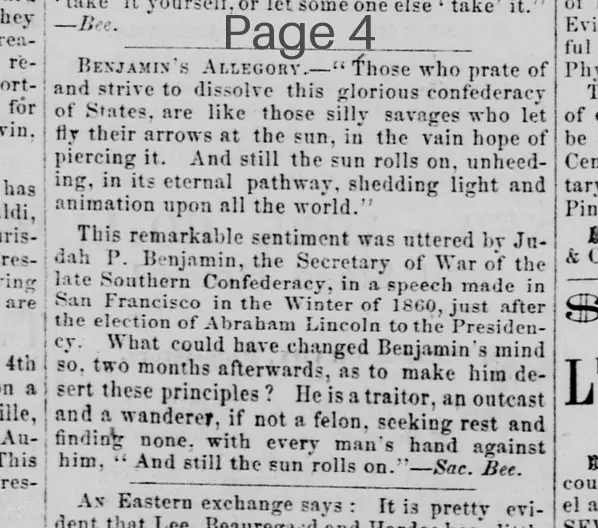
This remarkable sentiment was uttered by Judah P. Benjamin, the Secretary of War of the late Southern Confederacy, in a speech made in San Francisco in the Winter of 1860, just after the election of Abraham Lincoln to the Presidency. What could have changed Benjamin's mind so, two months afterwards, as to make him desert these principles? He is a traitor, an outcast and a wanderer, if not a felon, seeking rest and finding none, with every man's hand against him, "And still the sun rolls on."—Sac. Bee.
What sub-type of article is it?
What keywords are associated?
What entities or persons were involved?
Where did it happen?
Domestic News Details
Primary Location
San Francisco
Event Date
Winter Of 1860
Key Persons
Outcome
benjamin deserted his principles, became secretary of war for the southern confederacy, and is described as a traitor, outcast, wanderer, and possible felon.
Event Details
Judah P. Benjamin delivered a speech in San Francisco in Winter 1860, shortly after Lincoln's election, using an allegory to defend the Union against dissolution. The commentary questions his change of mind two months later and condemns his role in the Confederacy.