Thank you for visiting SNEWPapers!
Sign up free
Gazette Of The United States And Daily Evening Advertiser
Philadelphia, Philadelphia County, Pennsylvania
What is this article about?
On August 5, the French National Convention adopted a decree presented by Cambon restructuring government committees, renaming the Committee of Public Safety as the Central Committee of Government, establishing new oversight bodies, and listing current members including Barrere and Carnot.
Clipping
OCR Quality
Full Text
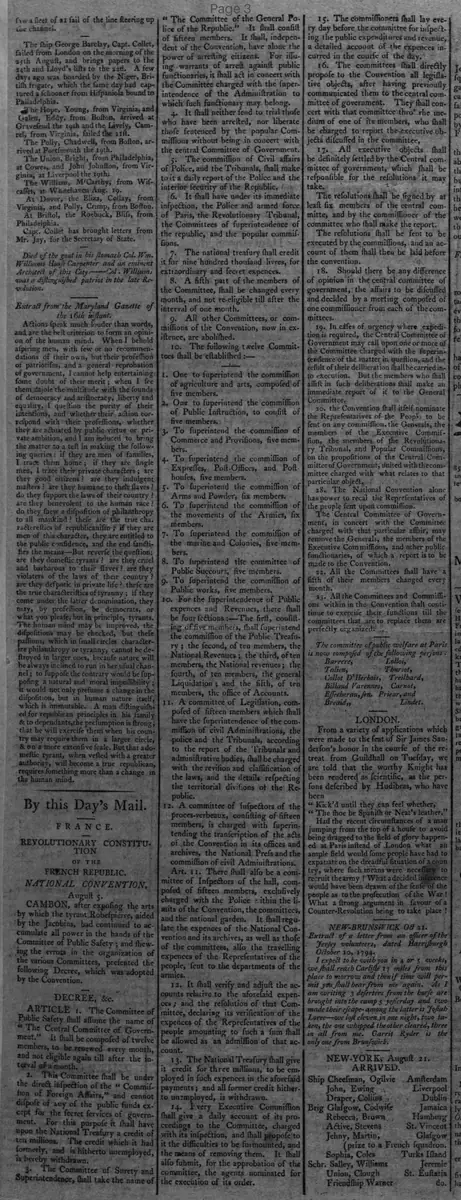
FRANCE.
REVOLUTIONARY CONSTITUTION
OF THE
FRENCH REPUBLIC.
NATIONAL CONVENTION,
August 5.
CAMBON, after exposing the arts by which the tyrant Robespierre, aided by the Jacobins, had continued to accumulate all power in the hands of the Committee of Public Safety; and showing the errors in the organization of the various Committees, presented the following Decree, which was adopted by the Convention.
DECREE, &c.
ARTICLE 1. The Committee of Public Safety shall assume the name of "The Central Committee of Government." It shall be composed of twelve members, to be renewed every month, and not eligible again till after the interval of a month.
2. This Committee shall be under the direct inspection of the "Commission of Foreign Affairs," and cannot dispose of any of the public funds except for the secret services of government. For this purpose it shall have upon the National Treasury a credit of ten millions. The credit which it had formerly, and is hitherto unemployed, is hereby withdrawn.
3. The Committee of Surety and Superintendence, shall take the name of "The Committee of the General Police of the Republic." It shall consist of fifteen members. It Shall, independent of the Convention, have alone the power of arresting citizens. For issuing warrants of arrest against public functionaries, it shall act in concert with the Committee charged with the superintendence of the Administration to which such functionary may belong.
4. It shall neither send to trial those who have been arrested, nor liberate those sentenced by the popular Commissions without being in concert with the central Committee of Government.
5. The commission of Civil affairs of Police, and the Tribunals, shall make to it a daily report of the Police and the interior security of the Republic,
6. It shall have under its immediate inspection, the Police and armed force of Paris, the Revolutionary Tribunal, the Committees of superintendence of the republic, and the popular commissions.
7. The national treasury shall credit it for nine hundred thousand livres, for extraordinary and secret expences.
8. A fifth part of the members of the Committee, shall be changed every month, and not re-eligible till after the interval of one month.
9. All other Committees, or commissions of the Convention, now in existence, are abolished.
10. The following twelve Committees shall be established :—
I. One to superintend the commission of agriculture and arts, composed of five members.
2. One to superintend the commission of Public Instruction, to consist of five members.
3. To superintend the commission of Commerce and Provisions, five members.
4. To superintend the commission of Express, Post-Offices, and Post. houses, five members.
5. To superintend the commission of Arms and Powder, six members.
6. To superintend the commission of the movements of the Armies, six members.
7. To superintend the commission of the marine and Colonies, five members.
8. To superintend the committee of Public Succours, five members.
9. To superintend the commission of Public works, five members.
10. For the superintendence of Public expences and Revenues, there shall be four sections: The first, consisting of five members, shall superintend the commission of the Public Treasury; the second, of ten members, the National Revenues: the third, of ten members, the National revenues; the fourth, of ten members, the general Liquidation; and the fifth, of ten members, the office of Accounts.
11. A committee of Legislation, composed of fifteen members which shall have the superintendence of the commission of civil Administrations, the police and the Tribunals, according to the report of the Tribunals and administrative bodies, shall be charged with the revision and classification of the laws, and the details respecting the territorial divisions of the Republic.
12. A committee of inspectors of the proces-verbaux, consisting of fifteen members, is charged with superintending the transcription of the acts of the Convention in its offices and archives, the National Press and the commission of civil Administrations.
Art. II. There shall also be a committee of Inspectors of the hall, composed of fifteen members, exclusively charged with the Police within the limits of the Convention, the committees, and the national garden. It shall regulate the expences of the National Convention and its archives, as well as those of the committees, also the travelling expences of the Representatives of the people, sent to the departments of the armies.
13. It shall verify and adjust the accounts relative to the aforesaid expences; and the resolution of that Committee, declaring its verification of the expences of the Representatives of the people amounting to such a sum shall be allowed as an admission of that account.
14. The National Treasury shall give it credit for three millions, to be employed in such expences in the aforesaid payments; and all former credit hitherto unemployed, is withdrawn.
15. Every Executive Commission shall give a daily account of its proceedings to the Committee, charged with its inspection, and shall propose to it the difficulties to be surmounted, and the means of removing them. "It shall also submit, for the approbation of the committee, the agents nominated for the execution of its orders.
16. The commissioners shall lay every day before the committee for inspecting the public expenditures and revenue, a detailed account of the expences incurred in the course of the day.
17. The committees shall directly propose to the Convention all legislative objects, after having previously communicated them to the central committee of government. They shall concert with that committee thro' the medium of one of its members, who shall be charged to report the executive objects discussed in the committee,
18. All executive objects shall be definitely settled by the Central committee of government, which shall be responsible for the resolutions it may take.
The resolutions shall be signed by at least six members of this central committee, and by the commissioner of the committee who shall make the report.
The resolutions shall be sent to be executed by the commissions, and an account of them shall then be laid before the convention.
19. Should there be any difference of opinion in the central committee of government, the affairs to be discussed and decided by a meeting composed of one commissioner from each of the committees.
20. In cases of urgency where expedition is required, the Central Committee of Government may call upon one or more of the Committee charged with the superintendence of the matter in question, and the result of their deliberation shall be carried into execution. But the members who shall sit in such deliberations shall make an immediate report of it to the General Committee.
21. the Convention shall itself nominate the Representatives of the People to be sent on any commission, the Generals, the members of the Executive Commission, the members of the Revolutionary Tribunal, and Popular Commissions, on the propositions of the Central Committee of Government, united with the committee charged with what relates to that particular object,
22. The National Convention alone has power to recall the Representatives of the people sent upon commission.
The Central Committee of Government, in concert with the Committee charged with that particular affair, may remove the Generals, the members of the Executive Commissions, and other public functionaries, of which a report is to be made to the Convention.
23. All the Committees shall have a fifth of their members changed every month.
24. All the Committees and Commissions within in the Convention shall continue to exercise their functions till the committees that are to replace them are perfectly organized.
The committee of public welfare at Paris is now composed of the following persons:
Barrere,
Loloi,
Talien,
Thuriot,
Collot D'Herbois, Treilhard,
Billaud Varennes, Carnot,
Escheraud, en. Prieur, and
Breal,
Lindet.
What sub-type of article is it?
What keywords are associated?
What entities or persons were involved?
Where did it happen?
Foreign News Details
Primary Location
France
Event Date
August 5
Key Persons
Outcome
decree adopted restructuring committees, renaming committee of public safety to central committee of government, establishing new committees, and abolishing others.
Event Details
Cambon presented a decree to the National Convention exposing Robespierre's power accumulation and proposing reorganization of committees, which was adopted. It renames and restructures various committees, sets membership and renewal rules, defines powers and inspections, establishes new committees for agriculture, instruction, commerce, etc., and lists current members of the committee of public welfare.