Thank you for visiting SNEWPapers!
Sign up free
Letter to Editor
August 28, 1832
Event 1 of 2
Richmond Enquirer
Richmond, Richmond County, Virginia
What is this article about?
Cholera cases and deaths are declining in major US cities, with detailed reports from Baltimore, Norfolk, Portsmouth, and Old Point Comfort, and none yet in Richmond.
Merged-components note: Single letter to the editor split across two components on page 3; merged for coherence.
Clipping
OCR Quality
95%
Excellent
Full Text
This is Event 1 of 2. The full text below covers all events in this component.
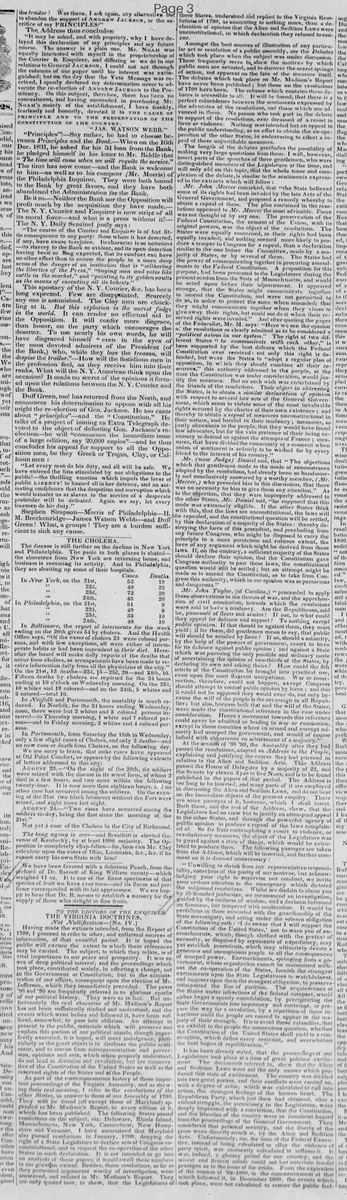
THE CHOLERA.
The disease is still further on the decline in New York and Philadelphia. The panic in both places is abated—the absentees from New York are returning home, and business is resuming its activity. And in Philadelphia, they are shutting up some of their hospitals.
In Baltimore, the report of interments for the week ending on the 20th gives 54 by cholera. And the Health Office says, "Of the cases of cholera 25 were colored persons, and with few exceptions, all were either of intemperate habits or had been imprudent in their diet. Hereafter the board will make daily reports of the deaths that occur from cholera, as arrangements have been made to receive information daily from all the physicians of the city."
On the 21st, 13 deaths—22d, 15—23d, 29 and 24th, 10.
Fifteen deaths by cholera are reported for the 24 hours ending at 10 o'clock on Wednesday morning. On the 23d. 10 whites and 19 colored—and on the 24th, 5 whites and 5 colored—total 10.
In Norfolk and Portsmouth, the mortality is much reduced. In Norfolk, for the 24 hours ending Wednesday, noon, there were but 2 whites and 3 colored persons interred—to Thursday morning, 1 white and 7 colored persons—and to Friday morning, 2 whites and 4 colored persons.
In Portsmouth, from Saturday the 18th to Wednesday only a few slight cases of Cholera, and only 2 deaths—and no new case or death from Cholera, on the following day.
We are sorry to learn, that some cases have appeared at Old Point Comfort, as appears by the following extracts of letters addressed to this city:
August 23.—"On the night of the 20th, six soldiers were seized with the disease in its worst form, of whom 2 died in a few hours, and two more within the following twenty-four. It is now more than eighteen hours, and no other case has occurred among the soldiers. On the evening of the 21st two black labourers without the Fort were seized, and eight more last night.
August 24.—"Two cases have occurred among the soldiers to-day, being the first since the morning of the 21st."
Not yet a case of the Cholera in the City of Richmond.
At the session of '98 '99, the Assembly after they had passed the resolutions, adopted an Address to the People, explaining and justifying the course they had pursued in relation to the Alien and Sedition Acts. This Address passed the House of Delegates by a majority of 22, and the Senate by eleven Ayes to five Noes, and is to be found published in the papers of that period. The Address is too long to be inserted, and many parts of it are employed in discussing the Alien and Sedition Laws, and do not bear on the immediate objects of the present enquiry. There are some passages of it, however, which I shall insert. Both these, and the rest of the Address, shew, that the Legislature had no view but to justify an attempted appeal to the other States, and through the powerful agency of public opinion to produce a repeal of the laws complained of. So far from contemplating a resort to violence, or revolutionary measures, the object of the Legislature was to guard against a state of things, which would be calculated to produce them. The following passages are taken from the Address, which will be inserted, and further comment on it is deemed unnecessary :
" Unwilling to shrink from our representative responsibility, conscious of the purity of our motives, but acknowledging your right to supervise our conduct, we invite your serious attention to the emergency which dictated the subjoined resolutions. Whilst we disdain to alarm you by ill-founded jealousies, we recommend an investigation, guided by the coolness of wisdom, and a decision bottomed on firmness, but tempered with moderation. It would be perfidious in those entrusted with the guardianship of the State sovereignty, and acting under the solemn obligation of the following oath: 'I do swear that I will support the Constitution of the United States,' not to warn you of encroachments, which, though clothed with the pretext of necessity, or disguised by arguments of expediency, may yet establish precedents, which may ultimately devote a generous and unsuspicious people to all the consequences of usurped power. Encroachments, springing from a government, whose organization cannot be maintained without the co-operation of the States, furnish the strongest excitements upon the State Legislatures to watchfulness, and imposes upon them the strongest obligation, to preserve unimpaired the line of partition. The acquiescence of the States under infractions of the federal compact, would either beget a speedy consolidation, by precipitating the State Governments into impotency and contempt, or prepare the way for a revolution, by a repetition of these infractions until the people are roused to appear in the majesty of their strength. It is to avoid these calamities, that we exhibit to the people the momentous question, whether the Constitution of the United States shall yield to a construction, which defies every restraint, and overwhelms the best hopes of republicanism.'"
It has been already stated, that the proceedings of our Legislature took place at a time of great political excitement The documents referred to, shew that the Alien and Sedition Laws were not the only causes which produced this state of excitement. The country was divided into two great parties, and their conflicts were carried on, with a degree of ardor, which was calculated to call into action, the strongest feelings of the human heart. The Republican Party, which just then had obtained, after a violent struggle, the ascendancy in the Legislature, were deeply impressed with a conviction, that the Constitution, and the liberties of the country were in imminent hazard from the proceedings of the General Government. They considered that personal security, and the liberty of the press were directly struck at, by the Alien and Sedition Acts. Unfortunately, too, the tone of the Federal Executive, instead of being calculated to allay the violence of party spirit, was eminently calculated to inflame it. It was, indeed, a gloomy period for our country, and the wisest and firmest minds could not but entertain fearful presages as to the issue of the crisis. From the expiration of the session of '99-1800, to the commencement of that which followed it, in December 1800. the events which took place, were not calculated to restore the public feeling to tranquillity, but on the contrary, to exasperate it During the interval between the two sessions, the Alien and Sedition Laws were rigidly executed, in some parts of the country. Mr. Lyon, a member of Congress from Vermont, had been convicted, fined, and imprisoned under this law. Mr. Cooper, a distinguished literary man, had shared the same fate. He had suffered his imprisonment under the act, and paid his fine. And finally James Thompson Callender, an inhabitant of this State, had been fined, and imprisoned, and was actually in confinement in Richmond. when the Assembly met in December in 1800; and so continued, until pardoned by Mr. Jefferson after he came into office. The incidents of this last trial had been such, as were calculated to make the Sedition Law more odious to the People. But, under all these circumstances, the law was enforced, without the slightest resistance or tumult, by the agency of the ordinary officers of the Courts; and this too, in a community, a great majority of whom most conscientiously believed that the law under which the sentence was inflicted, violated, and that, palpably, and flagrantly too, the provisions of the Constitution. When the Assembly met in December 1800, Governor Monroe, who was elected by the very body which adopted Mr. Madison's report, in which, it is well known, he most cordially concurred, addressed in his message, the following remarks to the Legislature:
"As soon as the requisite number of copies of the Report of the Select Committee of the last session on the answers of several of the States to the Resolutions of the General Assembly, which passed at the preceding session, relative to the Alien and Sedition Laws of the United States, and the instructions to the Senators of this State to the Congress of the United States were printed, the Executive hastened to distribute them among the several counties of the Commonwealth, in compliance with the Resolution of the 20th of January last. It is believed, that no public documents illustrative of public transactions, however interesting, were ever more generally read or thoroughly approved, than those were; nor can it be doubted, that the light which they communicated on the very important subject to which they referred, tended to increase in a high degree, the confidence of the good people of this Commonwealth, in the wisdom and policy which governed the General Assembly. In connection with that subject, it is proper to add, that since your last session, the Sedition Law, one of the Acts complained of, has been carried into effect in this Commonwealth by the decision of a Federal Court. I notice this event, not with a view of censuring or criticising it. The transaction has gone to the world. and the impartial will judge of it as it deserves. I notice it for the purpose of remarking, that the decision was executed with the same order and tranquil submission on the part of the people, as could have been shewn by them on a similar occasion, to any the most necessary, constitutional and popular acts of the Government." The constituted authorities and the good people of this Commonwealth are attached to the Union, and cherish it with their fondest wishes. The colonization of their ancestors in this Western world, was generally from the same country, at the same time, and produced by the same cause. They alike groaned under an oppression which repressed their growth and checked their prosperity;— they fought and bled in the same battles, in defence of the same rights, and have since experienced, with unexampled harmony and unanimity, a variety of interesting occurrences which admonish them, they still are and ought to remain forever united. The General Assembly, and the good people of this Commonwealth, have acquitted themselves to their own consciences, and to their brethren in America, in support of a cause which they deem a national one, by the stand which they made, and the sentiments they expressed of those acts of the General Government; but they have looked for a change in that respect, to a CHANGE IN THE PUBLIC OPINION. Which ought to be free, NOT To MEASURES OF VIOLENCE, DISCORD, AND DISUNION, WHICH THEY ABHOR."
The language used by Mr. Monroe, was worthy of a wise and patriotic chief magistrate. There can be no doubt he participated in the strong sense of the unconstitutionality and tyrannical characters of the acts of Congress. But he was attached to the Union and the Constitution of his country; and instead of endeavoring to inflame, he endeavored to calm, the public indignation, and to confine the efforts of the Legislature to peaceful and constitutional means of redress. The Legislature evinced the same feelings, and instead of rushing into measures of resistance and revolution, they adopted resolutions in the same spirit which had marked all their previous proceedings.
In January 1801, they adopted another preamble and resolutions, in which they express their " decided approbation" of the resolutions of '98-'99, and the report of '99-1800,"repeating their solemn protestation" against the sedition act—a report which had their decided approbation, " not only because of the perspicuity, and irresistible force of the argument which it contains, but because a disposition to promote mutual respect, confidence and affection among the members of the Union, is uniformly preserved." They refer also to the enforcement of the sedition law, as realizing all their apprehensions—and they accordingly instruct their Senators, &c. " to avail themselves of every opportunity to obtain a repeal of the said act of Congress, and to oppose any law or resolution containing a recognition of said doctrine," (viz. that the common law is the law of the U. S.)
I have now finished my review of the different acts and proceedings which took place in the Legislative and other departments of the Government of Virginia, in a most trying crisis of our affairs. It will hardly be pretended, that our present situation admits of any comparison with that which I have pourtrayed. The wisdom and moderation then displayed, received their best and highest reward. The obnoxious and unconstitutional measures of the government were abandoned, peace and tranquillity were restored, and the opinions of the General Assembly which had been treated with so much disrespect by many of the States, became the prevailing doctrines of the country. That the same wise course of forbearance and temperate counsels, will produce the same results, I cannot hesitate to hope for and believe.
AGRICOLE.
The disease is still further on the decline in New York and Philadelphia. The panic in both places is abated—the absentees from New York are returning home, and business is resuming its activity. And in Philadelphia, they are shutting up some of their hospitals.
In Baltimore, the report of interments for the week ending on the 20th gives 54 by cholera. And the Health Office says, "Of the cases of cholera 25 were colored persons, and with few exceptions, all were either of intemperate habits or had been imprudent in their diet. Hereafter the board will make daily reports of the deaths that occur from cholera, as arrangements have been made to receive information daily from all the physicians of the city."
On the 21st, 13 deaths—22d, 15—23d, 29 and 24th, 10.
Fifteen deaths by cholera are reported for the 24 hours ending at 10 o'clock on Wednesday morning. On the 23d. 10 whites and 19 colored—and on the 24th, 5 whites and 5 colored—total 10.
In Norfolk and Portsmouth, the mortality is much reduced. In Norfolk, for the 24 hours ending Wednesday, noon, there were but 2 whites and 3 colored persons interred—to Thursday morning, 1 white and 7 colored persons—and to Friday morning, 2 whites and 4 colored persons.
In Portsmouth, from Saturday the 18th to Wednesday only a few slight cases of Cholera, and only 2 deaths—and no new case or death from Cholera, on the following day.
We are sorry to learn, that some cases have appeared at Old Point Comfort, as appears by the following extracts of letters addressed to this city:
August 23.—"On the night of the 20th, six soldiers were seized with the disease in its worst form, of whom 2 died in a few hours, and two more within the following twenty-four. It is now more than eighteen hours, and no other case has occurred among the soldiers. On the evening of the 21st two black labourers without the Fort were seized, and eight more last night.
August 24.—"Two cases have occurred among the soldiers to-day, being the first since the morning of the 21st."
Not yet a case of the Cholera in the City of Richmond.
At the session of '98 '99, the Assembly after they had passed the resolutions, adopted an Address to the People, explaining and justifying the course they had pursued in relation to the Alien and Sedition Acts. This Address passed the House of Delegates by a majority of 22, and the Senate by eleven Ayes to five Noes, and is to be found published in the papers of that period. The Address is too long to be inserted, and many parts of it are employed in discussing the Alien and Sedition Laws, and do not bear on the immediate objects of the present enquiry. There are some passages of it, however, which I shall insert. Both these, and the rest of the Address, shew, that the Legislature had no view but to justify an attempted appeal to the other States, and through the powerful agency of public opinion to produce a repeal of the laws complained of. So far from contemplating a resort to violence, or revolutionary measures, the object of the Legislature was to guard against a state of things, which would be calculated to produce them. The following passages are taken from the Address, which will be inserted, and further comment on it is deemed unnecessary :
" Unwilling to shrink from our representative responsibility, conscious of the purity of our motives, but acknowledging your right to supervise our conduct, we invite your serious attention to the emergency which dictated the subjoined resolutions. Whilst we disdain to alarm you by ill-founded jealousies, we recommend an investigation, guided by the coolness of wisdom, and a decision bottomed on firmness, but tempered with moderation. It would be perfidious in those entrusted with the guardianship of the State sovereignty, and acting under the solemn obligation of the following oath: 'I do swear that I will support the Constitution of the United States,' not to warn you of encroachments, which, though clothed with the pretext of necessity, or disguised by arguments of expediency, may yet establish precedents, which may ultimately devote a generous and unsuspicious people to all the consequences of usurped power. Encroachments, springing from a government, whose organization cannot be maintained without the co-operation of the States, furnish the strongest excitements upon the State Legislatures to watchfulness, and imposes upon them the strongest obligation, to preserve unimpaired the line of partition. The acquiescence of the States under infractions of the federal compact, would either beget a speedy consolidation, by precipitating the State Governments into impotency and contempt, or prepare the way for a revolution, by a repetition of these infractions until the people are roused to appear in the majesty of their strength. It is to avoid these calamities, that we exhibit to the people the momentous question, whether the Constitution of the United States shall yield to a construction, which defies every restraint, and overwhelms the best hopes of republicanism.'"
It has been already stated, that the proceedings of our Legislature took place at a time of great political excitement The documents referred to, shew that the Alien and Sedition Laws were not the only causes which produced this state of excitement. The country was divided into two great parties, and their conflicts were carried on, with a degree of ardor, which was calculated to call into action, the strongest feelings of the human heart. The Republican Party, which just then had obtained, after a violent struggle, the ascendancy in the Legislature, were deeply impressed with a conviction, that the Constitution, and the liberties of the country were in imminent hazard from the proceedings of the General Government. They considered that personal security, and the liberty of the press were directly struck at, by the Alien and Sedition Acts. Unfortunately, too, the tone of the Federal Executive, instead of being calculated to allay the violence of party spirit, was eminently calculated to inflame it. It was, indeed, a gloomy period for our country, and the wisest and firmest minds could not but entertain fearful presages as to the issue of the crisis. From the expiration of the session of '99-1800, to the commencement of that which followed it, in December 1800. the events which took place, were not calculated to restore the public feeling to tranquillity, but on the contrary, to exasperate it During the interval between the two sessions, the Alien and Sedition Laws were rigidly executed, in some parts of the country. Mr. Lyon, a member of Congress from Vermont, had been convicted, fined, and imprisoned under this law. Mr. Cooper, a distinguished literary man, had shared the same fate. He had suffered his imprisonment under the act, and paid his fine. And finally James Thompson Callender, an inhabitant of this State, had been fined, and imprisoned, and was actually in confinement in Richmond. when the Assembly met in December in 1800; and so continued, until pardoned by Mr. Jefferson after he came into office. The incidents of this last trial had been such, as were calculated to make the Sedition Law more odious to the People. But, under all these circumstances, the law was enforced, without the slightest resistance or tumult, by the agency of the ordinary officers of the Courts; and this too, in a community, a great majority of whom most conscientiously believed that the law under which the sentence was inflicted, violated, and that, palpably, and flagrantly too, the provisions of the Constitution. When the Assembly met in December 1800, Governor Monroe, who was elected by the very body which adopted Mr. Madison's report, in which, it is well known, he most cordially concurred, addressed in his message, the following remarks to the Legislature:
"As soon as the requisite number of copies of the Report of the Select Committee of the last session on the answers of several of the States to the Resolutions of the General Assembly, which passed at the preceding session, relative to the Alien and Sedition Laws of the United States, and the instructions to the Senators of this State to the Congress of the United States were printed, the Executive hastened to distribute them among the several counties of the Commonwealth, in compliance with the Resolution of the 20th of January last. It is believed, that no public documents illustrative of public transactions, however interesting, were ever more generally read or thoroughly approved, than those were; nor can it be doubted, that the light which they communicated on the very important subject to which they referred, tended to increase in a high degree, the confidence of the good people of this Commonwealth, in the wisdom and policy which governed the General Assembly. In connection with that subject, it is proper to add, that since your last session, the Sedition Law, one of the Acts complained of, has been carried into effect in this Commonwealth by the decision of a Federal Court. I notice this event, not with a view of censuring or criticising it. The transaction has gone to the world. and the impartial will judge of it as it deserves. I notice it for the purpose of remarking, that the decision was executed with the same order and tranquil submission on the part of the people, as could have been shewn by them on a similar occasion, to any the most necessary, constitutional and popular acts of the Government." The constituted authorities and the good people of this Commonwealth are attached to the Union, and cherish it with their fondest wishes. The colonization of their ancestors in this Western world, was generally from the same country, at the same time, and produced by the same cause. They alike groaned under an oppression which repressed their growth and checked their prosperity;— they fought and bled in the same battles, in defence of the same rights, and have since experienced, with unexampled harmony and unanimity, a variety of interesting occurrences which admonish them, they still are and ought to remain forever united. The General Assembly, and the good people of this Commonwealth, have acquitted themselves to their own consciences, and to their brethren in America, in support of a cause which they deem a national one, by the stand which they made, and the sentiments they expressed of those acts of the General Government; but they have looked for a change in that respect, to a CHANGE IN THE PUBLIC OPINION. Which ought to be free, NOT To MEASURES OF VIOLENCE, DISCORD, AND DISUNION, WHICH THEY ABHOR."
The language used by Mr. Monroe, was worthy of a wise and patriotic chief magistrate. There can be no doubt he participated in the strong sense of the unconstitutionality and tyrannical characters of the acts of Congress. But he was attached to the Union and the Constitution of his country; and instead of endeavoring to inflame, he endeavored to calm, the public indignation, and to confine the efforts of the Legislature to peaceful and constitutional means of redress. The Legislature evinced the same feelings, and instead of rushing into measures of resistance and revolution, they adopted resolutions in the same spirit which had marked all their previous proceedings.
In January 1801, they adopted another preamble and resolutions, in which they express their " decided approbation" of the resolutions of '98-'99, and the report of '99-1800,"repeating their solemn protestation" against the sedition act—a report which had their decided approbation, " not only because of the perspicuity, and irresistible force of the argument which it contains, but because a disposition to promote mutual respect, confidence and affection among the members of the Union, is uniformly preserved." They refer also to the enforcement of the sedition law, as realizing all their apprehensions—and they accordingly instruct their Senators, &c. " to avail themselves of every opportunity to obtain a repeal of the said act of Congress, and to oppose any law or resolution containing a recognition of said doctrine," (viz. that the common law is the law of the U. S.)
I have now finished my review of the different acts and proceedings which took place in the Legislative and other departments of the Government of Virginia, in a most trying crisis of our affairs. It will hardly be pretended, that our present situation admits of any comparison with that which I have pourtrayed. The wisdom and moderation then displayed, received their best and highest reward. The obnoxious and unconstitutional measures of the government were abandoned, peace and tranquillity were restored, and the opinions of the General Assembly which had been treated with so much disrespect by many of the States, became the prevailing doctrines of the country. That the same wise course of forbearance and temperate counsels, will produce the same results, I cannot hesitate to hope for and believe.
AGRICOLE.
What sub-type of article is it?
Informative
What themes does it cover?
Health Medicine
What keywords are associated?
Cholera Decline
Baltimore Deaths
Norfolk Mortality
Old Point Comfort Cases
Richmond Cholera Free
Letter to Editor Details
Main Argument
cholera cases and deaths are declining in major us cities, with detailed reports from baltimore, norfolk, portsmouth, and old point comfort, and none yet in richmond.
Notable Details
25 Of 54 Cholera Cases In Baltimore Were Colored Persons, Mostly Intemperate Or Imprudent In Diet.
Extracts From Letters About Cases At Old Point Comfort Among Soldiers And Laborers.