Thank you for visiting SNEWPapers!
Sign up free
Alexandria Daily Advertiser
Alexandria, Virginia
What is this article about?
US Collector at Fort Stoddart, Edmund P. Gaines, responds to Spanish authorities in Mobile regarding the schooner Cato's passage without stopping, asserting US treaty rights for coasting trade. On return, the vessel was seized by Spanish officers, captain imprisoned briefly, awaiting Governor Folch's decision.
Merged-components note: Merged two components as they form a single continuous letter from Edmund P. Gaines regarding U.S.-Spanish commerce disputes at Mobile; relabeled the second from foreign_news to domestic_news as the content pertains to American domestic trade issues.
Clippings
1 of 2
OCR Quality
Full Text
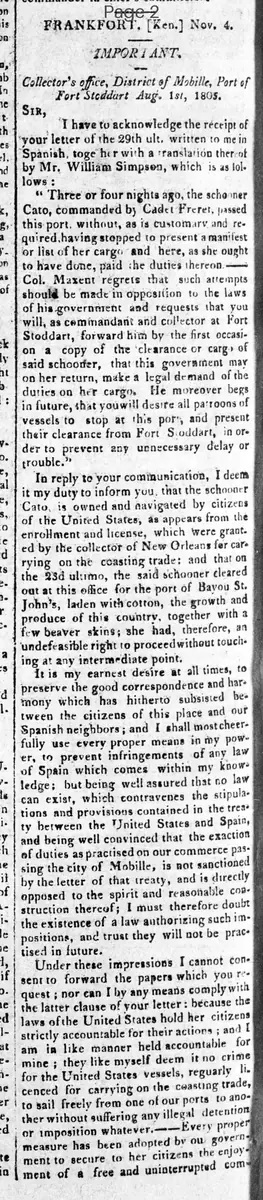
IMPORTANT.
Collector's office, District of Mobile, Port of Fort Stoddart Aug. 1st, 1805.
SIR,
I have to acknowledge the receipt of your letter of the 29th ult. written to me in Spanish, together with a translation thereof by Mr. William Simpson, which is as follows:
"Three or four nights ago, the schooner Cato, commanded by Cadet Frerer, passed this port. without, as is customary and required, having stopped to present a manifest or list of her cargo and here, as she ought to have done, paid the duties thereon.— Col. Maxent regrets that such attempts should be made in opposition to the laws of his government and requests that you will, as commandant and collector at Fort Stoddart, forward him by the first occasion a copy of the clearance or cargo of said schooner, that this government may on her return, make a legal demand of the duties on her cargo. He moreover begs in future, that you will desire all patrons of vessels to stop at this port, and present their clearance from Fort Stoddart, in order to prevent any unnecessary delay or trouble."
In reply to your communication, I deem it my duty to inform you, that the schooner Cato, is owned and navigated by citizens of the United States, as appears from the enrollment and license, which were granted by the collector of New Orleans for carrying on the coasting trade: and that on the 23d ultimo, the said schooner cleared out at this office for the port of Bayou St. John's, laden with cotton, the growth and produce of this country, together with a few beaver skins; she had, therefore, an undefeasible right to proceed without touching at any intermediate point.
It is my earnest desire at all times, to preserve the good correspondence and harmony which has hitherto subsisted between the citizens of this place and our Spanish neighbors; and I shall most cheerfully use every proper means in my power, to prevent infringements of any law of Spain which comes within my knowledge: but being well assured that no law can exist, which contravenes the stipulations and provisions contained in the treaty between the United States and Spain, and being well convinced that the exaction of duties as practised on our commerce passing the city of Mobile, is not sanctioned by the letter of that treaty, and is directly opposed to the spirit and reasonable construction thereof; I must therefore doubt the existence of a law authorizing such impositions, and trust they will not be practised in future.
Under these impressions I cannot consent to forward the papers which you request; nor can I by any means comply with the latter clause of your letter: because the laws of the United States hold her citizens strictly accountable for their actions; and I am in like manner held accountable for mine; they like myself deem it no crime for the United States vessels, regularly licensed for carrying on the coasting trade, to sail freely from one of our ports to another without suffering any illegal detention or imposition whatever.—Every proper measure has been adopted by our government to secure to her citizens the enjoyment of a free and uninterrupted commerce.
Commerce, as far as her own laws can extend; treaties have been entered into with our neighbours, which secure and extend as far as we can expect or wish, those precious privileges. Is it because a few of our timid traders have failed to embrace these privileges, and have submitted to being stripped of almost one eighth of their cargoes, when passing the Mobile from one of our own ports to another; that you now call me to aid you in this iniquitous practice? Or is it because this practice has for some time prevailed in contravention of existing treaties, that it is now to be adopted and the solemn stipulations contained in those treaties disregarded? It is presumed not. Our government possessing in a most extensive degree, the affection and confidence of her citizens, her laws and treaties are observed by them, with the highest respect and veneration. Our treaty with Spain points out how far the privileges of navigation and commerce shall extend, and while that treaty allows us pass with our vessels and effects in the freest manner even to ports belonging to an enemy, we find the officers of Spain at Mobile assuming the power of prohibiting this freedom of commerce to extend from one of our ports to another. These extraordinary proceedings will doubtless undergo a proper investigation by the government of the United States, but in the meantime it is a duty incumbent on the officers and inhabitants of both countries to act in conformity to existing treaties. I have therefore to request your attention to the treaty of friendship, limits and navigation, between the United States of America and the king of Spain, entered into at San Lorenzo el Real, in October seventeen hundred and ninety-five, also the treaty between the United States of America and the French Republic, entered into at Paris the 30th of April 1803-in particular manner to the first article thereof, as well as to the treaty between France and Spain, to which the said first article has reference. I trust, sir, on a candid review of those treaties, you will at once perceive that United States vessels passing from this to the port of Bayou St. Johns, are not obliged to stop at Mobile, and that you have no right to detain or molest such vessels.
I am sir,
Respectfully,
Your ob't. serv't.
EDMUND P. GAINES.
COLO: FRAN CO. MAXIMO.
P. MAXENT,
City of Mobile.
Extract of a letter from a gentleman who communicated the above information.
"Since the above was written the schooner Cato returned (about a month since) from New Orleans, bound to Fort Stoddart. She stopped at Mobile, and was instantly seized, and the captain, who is a Frenchman, was thrown into prison: but he gave information unfavourable to the owner of the cargo and I believe is now liberated.
The vessel and cargo are still in the hands of the Spanish officers, and is supposed will be confiscated—though the owner of part of her cargo, Dr. Strong; was altogether unconcerned in her cargo, when she passed down without calling at Mobile.
The whole waits the determination of governor Folch, who resides at Pensacola."
What sub-type of article is it?
What keywords are associated?
What entities or persons were involved?
Where did it happen?
Domestic News Details
Primary Location
Fort Stoddart And Mobile
Event Date
Aug. 1st, 1805
Key Persons
Outcome
schooner cato seized at mobile on return; captain imprisoned briefly and liberated; vessel and cargo held by spanish officers, possibly to be confiscated; awaits governor folch's determination.
Event Details
US Collector Edmund P. Gaines refuses Spanish request for schooner Cato's clearance papers, citing US-Spain treaties allowing coasting trade without stopping at Mobile. Schooner cleared Fort Stoddart on July 23, 1805, for Bayou St. John's with cotton and beaver skins. On return from New Orleans, about a month after August 1, 1805, schooner stopped at Mobile, was seized, and captain imprisoned.