Thank you for visiting SNEWPapers!
Sign up free
Pine Bluff Daily Graphic
Pine Bluff, Jefferson County, Arkansas
What is this article about?
University of Arkansas to cut six faculty positions due to limited state funds; President Futrall reports 1,569 students, salary losses from discounted warrants, and urges special tax for stable support amid financial strains. (214 characters)
Clipping
OCR Quality
Full Text
(By Clio Harper.)
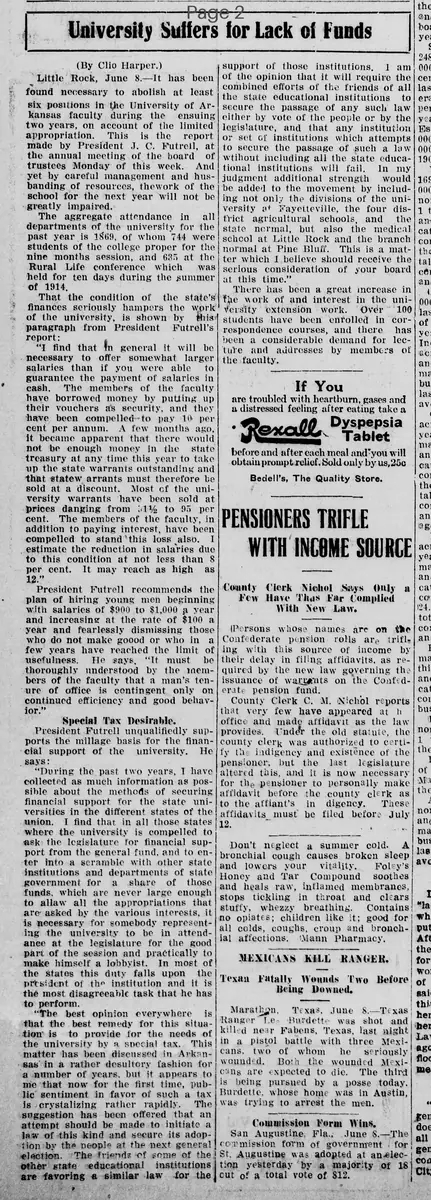
Little Rock, June 8.—It has been found necessary to abolish at least six positions in the University of Arkansas faculty during the ensuing two years, on account of the limited appropriation. This is the report made by President J. C. Futrall, at the annual meeting of the board of trustees Monday of this week. And yet by careful management and husbanding of resources, the work of the school for the next year will not be greatly impaired.
The aggregate attendance in all departments of the university for the past year is 1569, of whom 744 were students of the college proper for the nine months session, and 635 at the Rural Life conference which was held for ten days during the summer of 1914.
That the condition of the state's finances seriously hampers the work of the university, is shown by this paragraph from President Futrall's report:
"I find that in general it will be necessary to offer somewhat larger salaries than if you were able to guarantee the payment of salaries in cash. The members of the faculty have borrowed money by putting up their vouchers as security, and they have been compelled to pay 10 per cent per annum. A few months ago, it became apparent that there would not be enough money in the state treasury at any time this year to take up the state warrants outstanding and that state warrants must therefore be sold at a discount. Most of the university warrants have been sold at prices ranging from 91½ to 95 per cent. The members of the faculty, in addition to paying interest, have been compelled to stand this loss also. I estimate the reduction in salaries due to this condition at not less than 8 per cent. It may reach as high as 12."
President Futrall recommends the plan of hiring young men beginning with salaries of $900 to $1000 a year and increasing at the rate of $100 a year and fearlessly dismissing those who do not make good or who in a few years have reached the limit of usefulness. He says, "It must be thoroughly understood by the members of the faculty that a man's tenure of office is contingent only on continued efficiency and good behavior."
Special Tax Desirable.
President Futrall unqualifiedly supports the millage basis for the financial support of the university. He says:
"During the past two years, I have collected as much information as possible about the methods of securing financial support for the state universities in the different states of the union. I find that in all those states where the university is compelled to ask the legislature for financial support from the general fund, and to enter into a scramble with other state institutions and departments of state government for a share of those funds, which are never large enough to allow all the appropriations that are asked by the various interests, it is necessary for somebody representing the university to be in attendance at the legislature for the good part of the session and practically to make himself a lobbyist. In most of the states this duty falls upon the president of the institution and it is the most disagreeable task that he has to perform.
"The best opinion everywhere is that the best remedy for this situation is to provide for the needs of the university by a special tax. This matter has been discussed in Arkansas in a rather desultory fashion for a number of years, but it appears to me that now for the first time, public sentiment in favor of such a tax is crystallizing rather rapidly. The suggestion has been offered that an attempt should be made to initiate a law of this kind and secure its adoption by the people at the next general election. The friends of some of the other state educational institutions are favoring a similar law for the support of those institutions. I am of the opinion that it will require the combined efforts of the friends of all the state educational institutions to secure the passage of any such law either by vote of the people or by the legislature, and that any institution or set of institutions which attempts to secure the passage of such a law without including all the state educational institutions will fail. In my judgment additional strength would be added to the movement by including not only the divisions of the university at Fayetteville, the four district agricultural schools, and the state normal, but also the medical school at Little Rock and the branch normal at Pine Bluff. This is a matter which I believe should receive the serious consideration of your board at this time."
There has been a great increase in the work of and interest in the university extension work. Over 100 students have been enrolled in correspondence courses, and there has been a considerable demand for lectures and addresses by members of the faculty.
What sub-type of article is it?
What keywords are associated?
What entities or persons were involved?
Where did it happen?
Domestic News Details
Primary Location
Little Rock, Arkansas
Event Date
June 8, 1914
Key Persons
Outcome
abolish at least six faculty positions over two years; salary reductions of 8-12% due to state warrants sold at discount; recommendation for special tax support.
Event Details
University of Arkansas faces funding shortages leading to faculty position cuts; President Futrall reports on attendance, financial hardships including high interest on borrowed salaries, and recommends hiring young faculty with performance-based tenure and a special millage tax for stable funding, involving all state educational institutions.