Thank you for visiting SNEWPapers!
Sign up free
The Enquirer
Richmond, Henrico County, Virginia
What is this article about?
European intelligence reports on the French victory at Jena and Auerstadt, Prussian retreats, failed peace negotiations with Napoleon, Russian reinforcements, and British naval movements amid the ongoing war against Prussia as of November 9, 1806.
Clipping
OCR Quality
Full Text
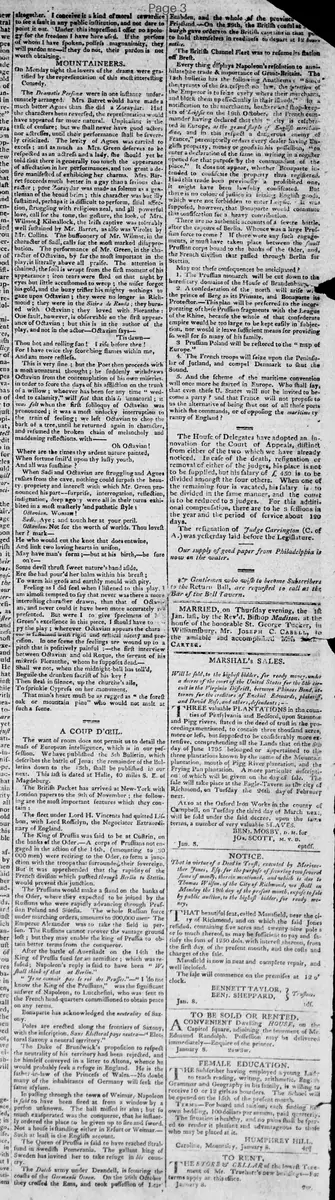
The want of room does not permit us to detail the mass of European intelligence, which is in our possession. We have published the 5th Bulletin, which describes the battle of Jena: the remainder of the Bulletins down to the 13th, shall be published in our next. This last is dated at Halle, 40 miles S. E. of Magdeburg.
The British Packet has arrived at New-York with London papers to the 9th of November; the following are the most important features which they contain:
The fleet under Lord H. Vincent had quitted Lisbon, with Lord Rosslyn, the Negotiator Extraordinary of England.
The King of Prussia was said to be at Custrin, on the banks of the Oder.—A corps of Prussians not engaged in the action of the 14th, (amounting to 30,000 men) were retiring to the Oder, to form a junction with the troops that surround their sovereign. But it was apprehended that the rapidity of the French division which pushed through Berlin to Stettin, would prevent this junction.
The Prussians would make a stand on the banks of the Oder, where they expected to be joined by the Russians who were rapidly advancing through Prussian Poland and Silesia. The whole Russian force under marching orders, amounts to 200,000 men—The Emperor Alexander was to take the field in person. The Russians cannot recover the vantage ground lost; but they may enable the king of Prussia to obtain better terms from the conqueror.
After the battle of Auerstadt on the 14th the King of Prussia sued for an armistice; which was refused; Napoleon's reply is said to have been 'We will think of that at Berlin.'
'Je ne connais pas le roi des Prussiens.'—'I do not know the King of the Prussians,' was the significant answer of Napoleon, to Lucchesini, who was sent to the French head-quarters commissioned to obtain peace on any terms.
Bonaparte has acknowledged the neutrality of Saxony.
Poles are erected along the frontiers of Saxony, with the inscription, Saxe Electoral pays neutral—'Electoral Saxony a neutral territory.'
The Duke of Brunswick's proposition to respect the neutrality of his territory had been rejected, and he himself conveyed in a litter to Altona, whence he would probably seek a refuge in England. He is the father-in-law of the Princess of Wales.—No doubt many of the inhabitants of Germany will seek the same asylum.
In passing through the town of Weimar, Napoleon is said to have been fired at from a window by a person unknown. The ball missed its aim; but so much exasperated was the conqueror, that he instantly ordered the place to be given up to fire and sword. Not a house is standing either in Erfurt or Weimar.—Such at least is the English account.
The Queen of Prussia is said to have reached Stralsund in Swedish Pomerania. The gallant king of Sweden has invited her to take refuge in his country.
The Dutch army under Deandels, is scouring the coasts of the Germanic Ocean. On the 26th October they crossed the Ems, and took possession of Leer, Embden, and the whole of the province Friesland. —On the 29th, the British consul at Hamburg gave orders to the British captains in that port to hold themselves in readiness to depart at 12 hours notice.
The British Channel Fleet was to resume its station off Brest.
Every thing displays Napoleon's resolution to annihilate the trade & importance of Great-Britain. The 19th bulletin has the following Anathema: 'Since the tyrants of the sea respect no law, the great nation of the Emperor is to seize every where their merchants, and block them up securely in their islands.' In a notification to the merchants, bankers and shop-keepers of Leipsic on the 19th October, the French commander having declared that this 'city is celebrated in Europe, as the grand staple of English merchandize, and in this respect a dangerous enemy of France,' peremptorily orders every dealer having English property, money or goods in his possession, 'to enter a declaration of the same in writing in a register opened for that purpose by the commandant of the place.' It does not appear, whether Bonaparte intended to confiscate the property thus registered. Had this trade been previously a prohibited one, it might have been lawfully confiscated. But there is no colour of justice in seizing English goods, which were not forbidden to enter Leipsic: it was supposed, however, that Bonaparte would commute this confiscation for a heavy contribution.
There are no authentic accounts of a severe battle, after the capture of Berlin. Whence was a large Prussian force to come? If there were any such engagements, it must have taken place between the small Prussian corps bound to the banks of the Oder, and the French division that passed through Berlin for Stettin.
May not these consequences be anticipated?
1. The Prussian monarch will be cut down to the hereditary domains of the House of Brandenburg
2. A confederation of the north will arise with the prince of Berg as its Primate, and Bonaparte its Protector.—This plan will be preferred to the incorporating of these Prussian fragments with the League of the Rhine, because the whole of that confederate empire would be too large to be kept easily in subjection, nor would it leave sufficient means for providing so well for so many of his family.
3. Prussian Poland will be restored to the map of Europe.
4. The French troops will seize upon the Peninsula of Jutland, and compel Denmark to shut the Sound.
5. And the scheme of the maritime convention will once more be started in Europe. Who shall say that even these U. States will not be invited to become a party? and that France will not propose to us the alternative of being shut out of all those ports which she commands, or of opposing the maritime tyranny of England?
What sub-type of article is it?
What keywords are associated?
What entities or persons were involved?
Where did it happen?
Foreign News Details
Primary Location
Prussia
Event Date
London Papers To The 9th Of November
Key Persons
Outcome
french victories at jena and auerstadt; prussian retreat and failed armistice; russian advance of 200,000 men; dutch occupation of leer, embden, and friesland; anticipated prussian territorial reduction and northern confederation.
Event Details
Reports detail French advances after battles of Jena and Auerstadt on October 14, Prussian forces retiring to Oder, failed peace negotiations by King of Prussia and Lucchesini, Napoleon's refusal of armistice, acknowledgment of Saxon neutrality, Duke of Brunswick's rejection and flight, alleged destruction of Weimar and Erfurt, Queen of Prussia fleeing to Stralsund, Dutch army actions on Germanic coasts, British fleet movements, and French orders to seize English goods in Leipsic. Speculations on future consequences including Prussian downsizing and maritime conventions.