Thank you for visiting SNEWPapers!
Sign up free
Letter to Editor
September 2, 1816
Alexandria Gazette, Commercial And Political
Alexandria, Virginia
What is this article about?
Philo-Dramaticus responds to Amor Patriae's essays criticizing theatrical entertainments in the Alexandria Gazette, defending the drama as not inherently immoral but capable of promoting virtue and morality, citing examples from Shakespeare and arguing against its total abolition despite acknowledged abuses.
Clipping
OCR Quality
95%
Excellent
Full Text
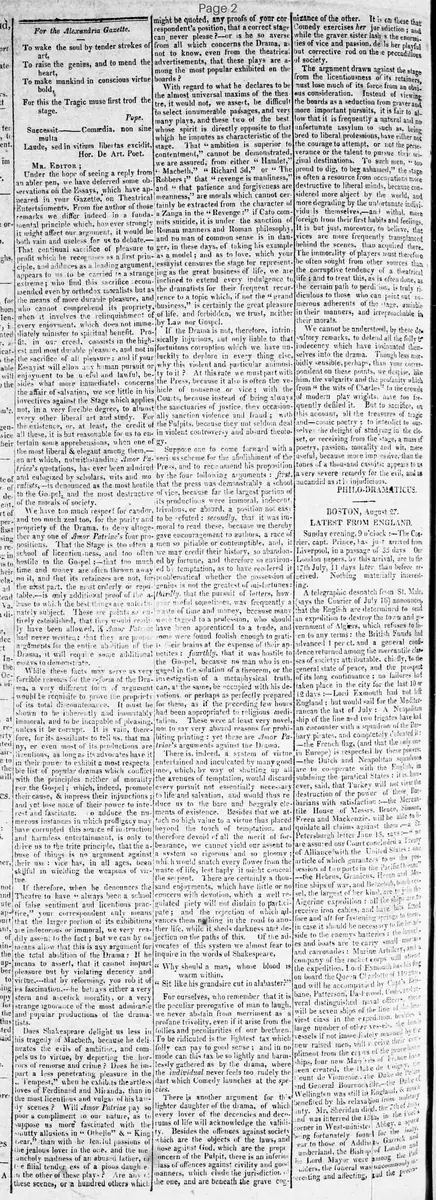
For the Alexandria Gazette:
To wake the soul by tender strokes of art,
To raise the genius, and to mend the heart,
To make mankind in conscious virtue bold,
For this the Tragic muse first trod the stage.
Pope.
Successit--Comædia, non sine multa
Laude, sed in vitium libertas excidit.
Hor. De Art. Poet.
MR. EDITOR;
Under the hope of seeing a reply from an abler pen, we have deferred some observations on the Essays, which have appeared in your Gazette, on Theatrical Entertainments. From the author of those remarks we differ indeed in a fundamental principle which, however strongly it might affect our argument, it would be both vain and useless for us to debate. That continual sacrifice of pleasure to profit which he recognises as a first principle, and adduces as a leading argument. appears to us to be carried to a strange extreme; who find this sacrifice recommended even by orthodox moralists but as the means of more durable pleasure, and who cannot comprehend its propriety. when it involves the relinquishment of every enjoyment, which does not immediately minister to spiritual benefit. Profit, in our creed, consists in the highest and most durable pleasure. and not in the sacrifice of all pleasure; and if your Essayist will allow any human pursuit or enjoyment to be useful and lawful, besides what more immediately concerns the affair of salvation, we see little in his invectives against the Stage which applies not, in a very forcible degree, to almost every other liberal art and study. For the existence. or. at least. the credit of all these, it is but reasonable for us to entertain some apprehensions, when one of the most liberal & elegant among them,-- an art which, notwithstanding Amor Patriae's quotations, has ever been admired and eulogized by scholars, wits and moralists,--is denounced as the most hostile to the Gospel. and the most destructive of the morals of society.
We have too much respect for candor. and too much zeal too. for the purity and propriety of the Drama, to deny altogether any one of Amor Patriae's four propositions. That the Stage is too often a school of licentiousness. and too often hostile to the Gospel :-that too much time and money are often thrown away on it, and that its retainers are not, for the most part, the most orderly or reputable,--is only additional proof of the abuse to which, the best things are unfortunately subject. These are points so entirely established, that they would readily have been allowed. if Amor Patriae had never written: but that there are proper. arguments for the entire abolition of the Drama, it will require some additional essays to demonstrate.
While these facts may serve as very forcible reasons for the reform of the Drama, a very different tone of argument would be requisite to prove the propriety of its total discountenance. It must be shown to be inherently and immutably immoral, and to be incapable of pleasing. unless it be corrupt. It is vain. therefore. for its assailants to tell us, that many, or even most of its productions are licentious, as long as its advocates have it in their power to exhibit a most respectable list of popular dramas which conflict with the principles neither of morality nor the Gospel; which, indeed, promote their cause, & impress their injunctions; and yet lose none of their power to interest and fascinate. To adduce the numerous instances in which profligacy may have corrupted this source of instruction and harmless entertainment, is only to drive us to the trite principle. that the abuse of things is no argument against their use : vice has. in all ages, been skilful in wielding the weapons of virtue.
If therefore, when he denounces the Theatre to have " always been a school of false sentiment and licentious practice," your correspondent only means that the larger portion of its exhibitions are indecorous or immoral, we very readily assent to the fact; but we can by no means allow that this is any argument for the total abolition of the Drama: If he means to assert. that it cannot impart pleasure but by violating decency and virtue.---that by reforming, you rob it of its fascination.---he betrays either a very stern and ascetic morality, or a very strange ignorance of the most admirable and popular productions of the dramatists.
Does Shakespeare delight us less in his tragedy of Macbeth, because he delineates the evils of ambition, and compels us to virtue, by depicting the horrors of remorse and crime ? Does he impart a less penetrating pleasure in the " Tempest," when he exhibits the artless loves of Ferdinand and Miranda. than in the most licentious and vulgar of his bawdy scenes P Will Amor Patriae pay so poor a compliment to our nature, as to suppose us more fascinated with the nutty allusions in " Othello" & " King Lear," than with the fearful passions of the jealous lover in the one, and the melancholy madness of an abused father, of the filial tenderness of a pious daughter. in the other of these plays? Are any of these scenes, or a hundred others which might be quoted, any proofs of your correspondent's position, that a correct stage can never please?--or is he so averse from all which concerns the Drama, as not to know, even from the theatrical advertisements, that these plays are among the most popular exhibited on the boards ?
With regard to what he declares to be the almost universal maxims of the theatre, it would not, we assert, be difficult to select innumerable passages, and very many plays, and these too of the best whose spirit is directly opposite to that which he imputes as characteristic of the stage. That" ambition is superior to contentment," cannot be demonstrated. we are assured, from either " Hamlet," " Macbeth," " Richard 3d," or " The Robbers ;" that " revenge is manliness," and " that patience and forgiveness are meanness," are morals which cannot certainly be extracted from the character of a Zanga in the " Revenge :" if Cato commits suicide, it is under the sanction of Roman manners and Roman philosophy, land no man of common sense is in danger, in these days, of taking his example as a model; and as to love, which your essayist censures the stage for representing as the great business of life, we are inclined to extend every indulgence to the dramatists for their frequent recurrence to a topic which, if not the " grand business," is certainly the great pleasure of life, and forbidden, we trust, neither by Law nor Gospel.
If the Drama is not, therefore, intrinsically injurious, but only liable to that fortuitous corruption which we have unfortunately to deplore in every thing else. why this violent and particular animosity to it ? At this rate we must part with the Press, because it also is often the vehicle of nonsense or vice; with the Courts, because instead of being always the sanctuaries of justice. they occasionally sanction violence and fraud: with the Pulpits, because they not seldom deal in violent controversy and absurd theology:
Suppose one to come forward with a serious scheme for the abolishment of the Press. and to recommend his proposition by the four following arguments : first. that the press was demonstrably a school of vice, because far the largest portion of its productions were immoral, indecent. frivolous, or absurd, a position not easy to be refuted : secondly, that it was immoral to read these, because we thereby gave encouragement to authors. a race of men so pitiable or contemptible, and, if we may credit their history, so abandoned by fortune, and therefore so environed by temptation, as to have rendered it problematical whether the possession of genius is not the greatest of misfortunes: thirdly, that the pursuit of letters, however useful sometimes, was frequently a waste of time and money, because many were urged to a profession. who should have been apprenticed to a trade, and some were found foolish enough to gratify their brains at the expense of their appetites : fourthly, that it was hostile to the Gospel, because no man who is engaged in the solution of a theorem, or the investigation of a metaphysical truth. can, at the same, be occupied with his devotions. or perhaps as perfectly prepared for them, as if the preceding few hours had been appropriated to religious meditation. These were at least very novel, not to say very absurd reasons for prohibiting printing : yet these are Amor Patriae's arguments against the Drama.
There is. indeed, a system of virtue entertained and inculcated by many good men, which, by way of shutting up all the avenues of temptation, would discard every pursuit not essentially necessary to life and salvation, and would thus reduce us to the bare and beggarly elements of existence. Besides that we attach no high value to a virtue thus placed beyond the touch of temptation. and therefore devoid of all the merit of forbearance, we cannot yield our assent to a system so rigorous and so gloomy ; which would snatch every flower from the waste of life. lest haply it might conceal the serpent. There are certainly a thousand enjoyments, which have little or no concern with devotion. which a well regulated piety will not disdain to participate; and the rejection of which advances them nothing in the road to another life, while it sheds darkness and dejection on the paths of this. Of the advocates of this system we almost fear to inquire in the words of Shakespeare,
" Why should a man, whose blood is warm within,
Sit like his grandsire cut in alabaster?"
For ourselves. who remember that it is the peculiar prerogative of man to laugh, we never abstain from merriment as a profane frivolity, even if it arise from the follies and peculiarities of our brethren. To be ridiculed is the lightest tax which folly can pay to good sense; and in no mode can this tax be so lightly and harmlessly gathered as by the drama, where the individual never feels too rudely the dart which Comedy launches at the species.
There is another argument for this lighter daughter of the drama, of which every lover of the decencies and decorums of life will acknowledge the validity. Besides the offences against society which are the objects of the laws, and those against God, which are the proper concern of the Pulpit, there is an inferior class of offences against civility and good manners. which elude the jurisdiction of the one, and are beneath the grave cognizance of the other. It is on these that Comedy exercises her jurisdiction; and while the graver sister lashes the enormities of vice and passion. she plies her playful but corrective rod on these peccadilloes of society.
The argument drawn against the stage from the licentiousness of its retainers must lose much of its force from an obvious consideration. Instead of viewing the boards as a seduction from graver and more important pursuits, it is fair to allow that it is frequently a natural and not unfortunate asylum to such as, being bred to liberal professions, have either not the courage to attempt, or not the perseverance or the talent to pursue their original destinations. To such men, " too proud to dig, to beg ashamed," the stage is often a resource from occupations more destructive to liberal minds, because considered more abject by the world, and more degrading by the unfortunate individuals themselves,-and withal. more foreign from their first habits and feelings. It is but just, moreover, to believe, that vices are more frequently transplanted behind the scenes, than acquired there. The immorality of players must therefore be often sought from other sources than the corruptive tendency of a theatrical life ; and to treat this, as is often done, as the certain path to perdition, is truly ridiculous to those who can point out numerous adherents of the stage, amiable in their manners, and irreproachable in their morals.
We cannot be understood, by these desultory remarks, to defend all the folly & indecency which have insinuated themselves into the drama. Though less morbidly sensible, perhaps, than your correspondent on these points, we despise, like him. the vulgarity and the profanity which from " the wits of Charles" to the crowds of modern play wrights, have too frequently defiled it. But to sacrifice, on this account, all the treasures of tragic and comic poetry ; to interdict to ourselves the delight of studying in the closet, or receiving from the stage, a mass of poetry, passion, morality and wit, more useful, because more impressive, than the tones of a thousand casuists: appears to us a very severe remedy for the evil, and as uncandid as it injudicious.
PHILO-DRAMATICUS,
To wake the soul by tender strokes of art,
To raise the genius, and to mend the heart,
To make mankind in conscious virtue bold,
For this the Tragic muse first trod the stage.
Pope.
Successit--Comædia, non sine multa
Laude, sed in vitium libertas excidit.
Hor. De Art. Poet.
MR. EDITOR;
Under the hope of seeing a reply from an abler pen, we have deferred some observations on the Essays, which have appeared in your Gazette, on Theatrical Entertainments. From the author of those remarks we differ indeed in a fundamental principle which, however strongly it might affect our argument, it would be both vain and useless for us to debate. That continual sacrifice of pleasure to profit which he recognises as a first principle, and adduces as a leading argument. appears to us to be carried to a strange extreme; who find this sacrifice recommended even by orthodox moralists but as the means of more durable pleasure, and who cannot comprehend its propriety. when it involves the relinquishment of every enjoyment, which does not immediately minister to spiritual benefit. Profit, in our creed, consists in the highest and most durable pleasure. and not in the sacrifice of all pleasure; and if your Essayist will allow any human pursuit or enjoyment to be useful and lawful, besides what more immediately concerns the affair of salvation, we see little in his invectives against the Stage which applies not, in a very forcible degree, to almost every other liberal art and study. For the existence. or. at least. the credit of all these, it is but reasonable for us to entertain some apprehensions, when one of the most liberal & elegant among them,-- an art which, notwithstanding Amor Patriae's quotations, has ever been admired and eulogized by scholars, wits and moralists,--is denounced as the most hostile to the Gospel. and the most destructive of the morals of society.
We have too much respect for candor. and too much zeal too. for the purity and propriety of the Drama, to deny altogether any one of Amor Patriae's four propositions. That the Stage is too often a school of licentiousness. and too often hostile to the Gospel :-that too much time and money are often thrown away on it, and that its retainers are not, for the most part, the most orderly or reputable,--is only additional proof of the abuse to which, the best things are unfortunately subject. These are points so entirely established, that they would readily have been allowed. if Amor Patriae had never written: but that there are proper. arguments for the entire abolition of the Drama, it will require some additional essays to demonstrate.
While these facts may serve as very forcible reasons for the reform of the Drama, a very different tone of argument would be requisite to prove the propriety of its total discountenance. It must be shown to be inherently and immutably immoral, and to be incapable of pleasing. unless it be corrupt. It is vain. therefore. for its assailants to tell us, that many, or even most of its productions are licentious, as long as its advocates have it in their power to exhibit a most respectable list of popular dramas which conflict with the principles neither of morality nor the Gospel; which, indeed, promote their cause, & impress their injunctions; and yet lose none of their power to interest and fascinate. To adduce the numerous instances in which profligacy may have corrupted this source of instruction and harmless entertainment, is only to drive us to the trite principle. that the abuse of things is no argument against their use : vice has. in all ages, been skilful in wielding the weapons of virtue.
If therefore, when he denounces the Theatre to have " always been a school of false sentiment and licentious practice," your correspondent only means that the larger portion of its exhibitions are indecorous or immoral, we very readily assent to the fact; but we can by no means allow that this is any argument for the total abolition of the Drama: If he means to assert. that it cannot impart pleasure but by violating decency and virtue.---that by reforming, you rob it of its fascination.---he betrays either a very stern and ascetic morality, or a very strange ignorance of the most admirable and popular productions of the dramatists.
Does Shakespeare delight us less in his tragedy of Macbeth, because he delineates the evils of ambition, and compels us to virtue, by depicting the horrors of remorse and crime ? Does he impart a less penetrating pleasure in the " Tempest," when he exhibits the artless loves of Ferdinand and Miranda. than in the most licentious and vulgar of his bawdy scenes P Will Amor Patriae pay so poor a compliment to our nature, as to suppose us more fascinated with the nutty allusions in " Othello" & " King Lear," than with the fearful passions of the jealous lover in the one, and the melancholy madness of an abused father, of the filial tenderness of a pious daughter. in the other of these plays? Are any of these scenes, or a hundred others which might be quoted, any proofs of your correspondent's position, that a correct stage can never please?--or is he so averse from all which concerns the Drama, as not to know, even from the theatrical advertisements, that these plays are among the most popular exhibited on the boards ?
With regard to what he declares to be the almost universal maxims of the theatre, it would not, we assert, be difficult to select innumerable passages, and very many plays, and these too of the best whose spirit is directly opposite to that which he imputes as characteristic of the stage. That" ambition is superior to contentment," cannot be demonstrated. we are assured, from either " Hamlet," " Macbeth," " Richard 3d," or " The Robbers ;" that " revenge is manliness," and " that patience and forgiveness are meanness," are morals which cannot certainly be extracted from the character of a Zanga in the " Revenge :" if Cato commits suicide, it is under the sanction of Roman manners and Roman philosophy, land no man of common sense is in danger, in these days, of taking his example as a model; and as to love, which your essayist censures the stage for representing as the great business of life, we are inclined to extend every indulgence to the dramatists for their frequent recurrence to a topic which, if not the " grand business," is certainly the great pleasure of life, and forbidden, we trust, neither by Law nor Gospel.
If the Drama is not, therefore, intrinsically injurious, but only liable to that fortuitous corruption which we have unfortunately to deplore in every thing else. why this violent and particular animosity to it ? At this rate we must part with the Press, because it also is often the vehicle of nonsense or vice; with the Courts, because instead of being always the sanctuaries of justice. they occasionally sanction violence and fraud: with the Pulpits, because they not seldom deal in violent controversy and absurd theology:
Suppose one to come forward with a serious scheme for the abolishment of the Press. and to recommend his proposition by the four following arguments : first. that the press was demonstrably a school of vice, because far the largest portion of its productions were immoral, indecent. frivolous, or absurd, a position not easy to be refuted : secondly, that it was immoral to read these, because we thereby gave encouragement to authors. a race of men so pitiable or contemptible, and, if we may credit their history, so abandoned by fortune, and therefore so environed by temptation, as to have rendered it problematical whether the possession of genius is not the greatest of misfortunes: thirdly, that the pursuit of letters, however useful sometimes, was frequently a waste of time and money, because many were urged to a profession. who should have been apprenticed to a trade, and some were found foolish enough to gratify their brains at the expense of their appetites : fourthly, that it was hostile to the Gospel, because no man who is engaged in the solution of a theorem, or the investigation of a metaphysical truth. can, at the same, be occupied with his devotions. or perhaps as perfectly prepared for them, as if the preceding few hours had been appropriated to religious meditation. These were at least very novel, not to say very absurd reasons for prohibiting printing : yet these are Amor Patriae's arguments against the Drama.
There is. indeed, a system of virtue entertained and inculcated by many good men, which, by way of shutting up all the avenues of temptation, would discard every pursuit not essentially necessary to life and salvation, and would thus reduce us to the bare and beggarly elements of existence. Besides that we attach no high value to a virtue thus placed beyond the touch of temptation. and therefore devoid of all the merit of forbearance, we cannot yield our assent to a system so rigorous and so gloomy ; which would snatch every flower from the waste of life. lest haply it might conceal the serpent. There are certainly a thousand enjoyments, which have little or no concern with devotion. which a well regulated piety will not disdain to participate; and the rejection of which advances them nothing in the road to another life, while it sheds darkness and dejection on the paths of this. Of the advocates of this system we almost fear to inquire in the words of Shakespeare,
" Why should a man, whose blood is warm within,
Sit like his grandsire cut in alabaster?"
For ourselves. who remember that it is the peculiar prerogative of man to laugh, we never abstain from merriment as a profane frivolity, even if it arise from the follies and peculiarities of our brethren. To be ridiculed is the lightest tax which folly can pay to good sense; and in no mode can this tax be so lightly and harmlessly gathered as by the drama, where the individual never feels too rudely the dart which Comedy launches at the species.
There is another argument for this lighter daughter of the drama, of which every lover of the decencies and decorums of life will acknowledge the validity. Besides the offences against society which are the objects of the laws, and those against God, which are the proper concern of the Pulpit, there is an inferior class of offences against civility and good manners. which elude the jurisdiction of the one, and are beneath the grave cognizance of the other. It is on these that Comedy exercises her jurisdiction; and while the graver sister lashes the enormities of vice and passion. she plies her playful but corrective rod on these peccadilloes of society.
The argument drawn against the stage from the licentiousness of its retainers must lose much of its force from an obvious consideration. Instead of viewing the boards as a seduction from graver and more important pursuits, it is fair to allow that it is frequently a natural and not unfortunate asylum to such as, being bred to liberal professions, have either not the courage to attempt, or not the perseverance or the talent to pursue their original destinations. To such men, " too proud to dig, to beg ashamed," the stage is often a resource from occupations more destructive to liberal minds, because considered more abject by the world, and more degrading by the unfortunate individuals themselves,-and withal. more foreign from their first habits and feelings. It is but just, moreover, to believe, that vices are more frequently transplanted behind the scenes, than acquired there. The immorality of players must therefore be often sought from other sources than the corruptive tendency of a theatrical life ; and to treat this, as is often done, as the certain path to perdition, is truly ridiculous to those who can point out numerous adherents of the stage, amiable in their manners, and irreproachable in their morals.
We cannot be understood, by these desultory remarks, to defend all the folly & indecency which have insinuated themselves into the drama. Though less morbidly sensible, perhaps, than your correspondent on these points, we despise, like him. the vulgarity and the profanity which from " the wits of Charles" to the crowds of modern play wrights, have too frequently defiled it. But to sacrifice, on this account, all the treasures of tragic and comic poetry ; to interdict to ourselves the delight of studying in the closet, or receiving from the stage, a mass of poetry, passion, morality and wit, more useful, because more impressive, than the tones of a thousand casuists: appears to us a very severe remedy for the evil, and as uncandid as it injudicious.
PHILO-DRAMATICUS,
What sub-type of article is it?
Persuasive
Philosophical
Ethical Moral
What themes does it cover?
Morality
Religion
Social Issues
What keywords are associated?
Theater Defense
Moral Drama
Shakespeare
Amor Patriae
Stage Abolition
Gospel Hostility
Comedy Reform
Liberal Arts
What entities or persons were involved?
Philo Dramaticus
Mr. Editor
Letter to Editor Details
Author
Philo Dramaticus
Recipient
Mr. Editor
Main Argument
the drama is not inherently immoral or hostile to the gospel but can promote virtue and provide harmless entertainment; abuses warrant reform, not total abolition, as evidenced by moral works like shakespeare's plays.
Notable Details
Quotes Pope On Tragedy's Moral Purpose
Quotes Horace On Comedy
References Shakespeare Plays: Macbeth, Tempest, Othello, King Lear, Hamlet, Richard Iii
Analogy Comparing Theater Criticism To Potential Abolition Of Press, Courts, And Pulpits
Defends Actors' Morality And Comedy's Role In Correcting Social Peccadilloes