Thank you for visiting SNEWPapers!
Sign up free
Jenks' Portland Gazette. Maine Advertiser
Portland, Cumberland County, Maine
What is this article about?
Federalist opinion piece in New-York Herald refutes claims that Jefferson did not pay Callender for anti-administration writings, accuses Jefferson of treachery, paying for slanders against Washington and Adams, and contrasts him unfavorably with Federalist leaders during the 1800 election.
Clipping
OCR Quality
Full Text
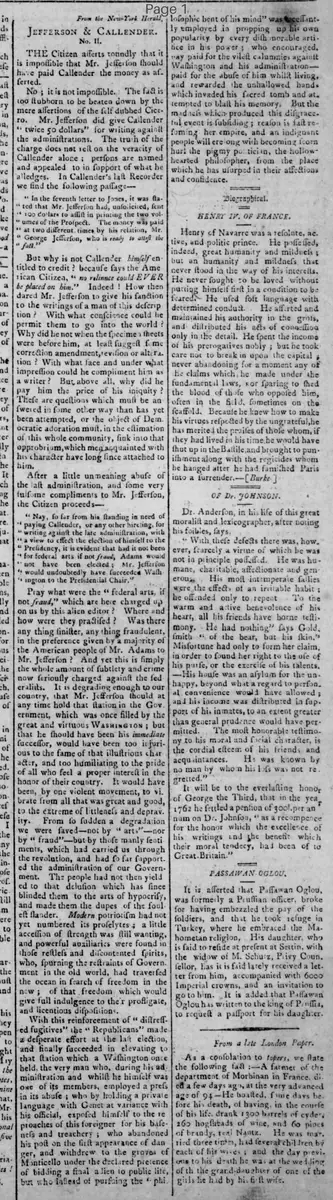
Jefferson & Callender.
No. II.
THE Citizen asserts roundly that it is impossible that Mr. Jefferson should have paid Callender the money as asserted.
No; it is not impossible. The fact is too stubborn to be beaten down by the mere assertions of the self dubbed Cicero. Mr. Jefferson did give Callender "twice 50 dollars" for writing against the administrations. The truth of the charge does not rest on the veracity of Callender alone: persons are named and appealed to in support of what he alleges. In Callender's last Recorder we find the following passage:
"In the seventh letter to Jones, it was stated that Mr. Jefferson had, unsolicited, sent two coolers to assist in printing the two volumes of the Prospect. The money was paid at two different times by his relation, Mr. George Jefferson, who is ready to attest the fact."
But why is not Callender himself entitled to credit? because says the American Citizen, "no reliance could EVER be placed on him." Indeed! How then dared Mr. Jefferson to give his sanction to the writings of a man of this description? With what conscience could he permit them to go into the world? Why did he not when the specimen sheets were before him, at least suggest some correction amendment, revision or alteration? With what face and under what impression could he compliment him as a writer? But above all, why did he pay him the price of his iniquity?
These are questions which must be answered in some other way than has yet been attempted, or the object of Democratic adoration must, in the estimation of this whole community, sink into that opprobrium, which men acquainted with his character have long since attached to him.
After a little unmeaning abuse of the last administration, and some very fulsome compliments to Mr. Jefferson, the Citizen proceeds:
"Nay, so far from his standing in need of paying Callender, or any other hireling, for writing against the late administration, with a view to effect the election of himself to the Presidency, it is evident that had it not been for federal arts if not fraud, Adams would not have been elected; Mr. Jefferson would undoubtedly have succeeded Washington to the Presidential Chair."
Pray what were the "federal arts, if not fraud," which are here charged upon us by this alien editor? Where and how were they practiced? Was there any thing sinister, any thing fraudulent, in the preference given by a majority of the American people of Mr. Adams to Mr. Jefferson? And yet this is simply the whole amount of subtlety and crime now seriously charged against the federalists. It is degrading enough to our country, that Mr. Jefferson should at any time hold that station in the Government, which was once filled by the great and virtuous Washington; but that he should have been his immediate successor, would have been too injurious to the fame of that illustrious character, and too humiliating to the pride of all who feel a proper interest in the honor of their country. It would have been, by one violent movement, to vibrate from all that was great and good, to the extreme of littleness and depravity. From so sudden a degradation we were saved—not by "arts"—nor by "fraud"—but by those manly sentiments, which had carried us through the revolution, and had so far supported the administration of our Government. The people had not then yielded to that delusion which has since blinded them to the arts of hypocrisy, and made them the dupes of the foulest slander. Modern patriotism had not yet numbered its proselytes; a little accession of strength was still wanting, and powerful auxiliaries were found in those restless and discontented spirits, who, spurning the restraints of Government in the old world, had traversed the ocean in search of freedom in the new; of that freedom which would give full indulgence to the profligate, and licentious dispositions.
With this reinforcement of "directed fugitives" the "Republicans" made a desperate effort at the last election, and finally succeeded in elevating to that station which a Washington once held, the very man who, during his administration and whilst he himself was one of its members, employed a press in its abuse; who by holding a private language with Genet at variance with his official, exposed himself to the reproaches of this foreigner for his baseness and treachery; who abandoned his post on the first appearance of danger, and withdrew to the groves of Monticello under the declared pretence of bidding a final adieu to public life, but who instead of pursuing the "philosophic bent of his mind" was secretly employed in propping up his own popularity by every dishonorable artifice in his power; who encouraged—nay paid for the vilest calumnies against Washington and his administration—paid for the abuse of him whilst living, and rewarded the unhallowed hands which invaded his sacred tomb and attempted to blast his memory. But the madness which produced this disgraceful event is subsiding; reason is fast resuming her empire, and an indignant people will erelong with becoming scorn hurl the pigmy politician, the hollow hearted philosopher, from the place which he has usurped in their affections and confidence.
What sub-type of article is it?
What themes does it cover?
What keywords are associated?
What entities or persons were involved?
Where did it happen?
Story Details
Key Persons
Location
United States
Event Date
1800 Election Period
Story Details
The article argues that Jefferson paid Callender $100 for writings against the Federalist administration, cites George Jefferson as witness, questions Jefferson's association with Callender, defends the 1800 election of Adams as honest, accuses Jefferson of treachery with Genet, abandoning his post, and paying for slanders against Washington, predicting his downfall.