Thank you for visiting SNEWPapers!
Sign up free
Editorial
July 9, 1842
New York Daily Tribune
New York, New York County, New York
What is this article about?
This editorial defends protectionism and a national bank against Loco-Focoist criticisms that cite distress in England's manufacturing districts despite her protective tariff and bank. It argues England's woes stem from national debt, feudal systems, and church tithes, not protection, and advocates balanced home production and markets over exclusive agriculture or manufacturing for export.
Clipping
OCR Quality
95%
Excellent
Full Text
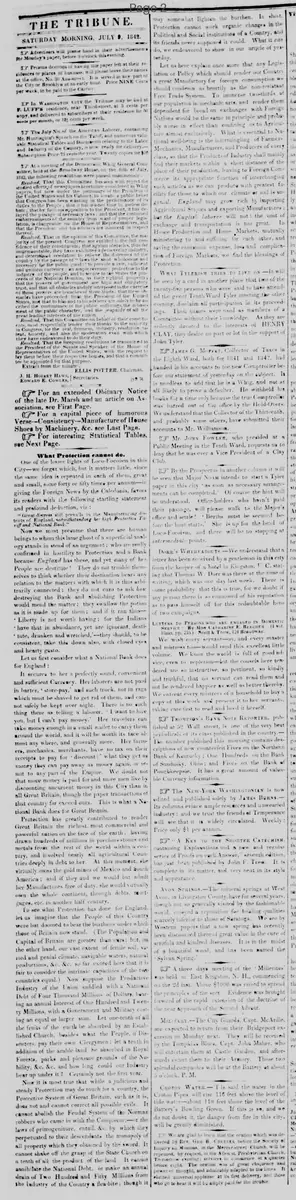
What Protection cannot do.
One of the lesser lights of Loco-Focoism in this City—we forget which, but it matters little, since the same idea is repeated in each of them, great and small, some forty or fifty times per annum—in giving the Foreign News by the Caledonia, favors its readers with the following startling statement and profound deduction, viz:
"Great distress still prevails in the Manufacturing districts of England, notwithstanding her high Protective Tariff and National Bank."
Now we must presume that there are human beings to whom this lame ghost of a superficial analogy stands in stead of an argument: who are really confirmed in hostility to Protection and a Bank because England has these, and yet many of her People are destitute! They do not trouble themselves to think whether their destitution bears any relation to the matters with which it is thus arbitrarily connected: they do not care to ask how destroying the Bank and abolishing Protection would mend the matter: they swallow the potion as it is made up for them: and if it ran thus—Liberty is not worth having: for the Indians have that in abundance, yet are ignorant, destitute, drunken and wretched,'—they should, to be consistent, take this down also, with closed eyes and hearty gusto.
Let us first consider what a National Bank does for England:
It secures to her a perfectly sound, convenient and sufficient Currency. Her laborers are not paid in barter, 'store-pay,' and such truck, nor in rags which must be shaved to get rid of them, and cannot safely be kept over night. There is no such thing there as telling a laborer, 'I want to hire you, but I can't pay money.' Her travelers can take money enough in a small wallet to carry them round the world, and it will be worth its face almost anywhere, and generally more. Her farmers, mechanics, merchants, have no tax on their receipts to pay for 'discount:' what they get as money they can pay away as money again, or remit to any part of the Empire. We doubt not that more money is paid for and more men live by discounting uncurrent money in this City than in all Great Britain, though the paper transactions of that country far exceed ours. This is what a National Bank does for Great Britain.
Protection has greatly contributed to render Great Britain the richest, most commercial and powerful nation on the face of the earth: having drawn hundreds of millions in precious stones and metals from the rest of the world within a century, and involved nearly all agricultural Countries deeply in debt to her. At this moment, she virtually owns the gold mines of Mexico and South America; and if they and we would but admit her Manufactures free of duty, she would virtually own the whole continent, through debts, mortgages, etc. in another half century.
To see what Protection has done for England let us imagine that the People of this Country were but doomed to bear the burthens under which those of Britain now stand. (The Population and Capital of Britain are greater than ours: but, on the other hand, our vast extent of fertile soil, varied and genial climate, navigable waters, natural productions, &c. &c. so far exceed hers that it is fair to consider the intrinsic capacities of the two countries equal.) Now suppose the Productive Industry of the Union saddled with a National Debt of Four Thousand Millions of Dollars, bearing an annual Interest of One Hundred and Twenty Millions, with a Government and Military costing an equal or larger sum. Let one-tenth of all the fruits of the earth be absorbed by an Established Church, besides what the People, if Dissenters, pay their own Clergymen: let a tenth in addition of the arable land be absorbed in Royal Forests, parks and pleasure grounds of the Nobility, &c. &c. and how long could our Industry bear up under it? (Certainly not the first year.)
Now it is most true that while a judicious and steady Protection may do much for a country, the Protective System of Great Britain, such as it is, does not and cannot correct all possible evils. It cannot abolish the Feudal System of the Norman robbers who came in with the Conqueror,—or the laws of primogeniture, entail, &c. by which they perpetuated to their descendants the monopoly of all property which they obtained by the sword. It cannot shake off the grasp of the State Church on a tenth of all the product of the land. It cannot annihilate the National Debt, or make an annual drain of Two Hundred and Fifty Millions from the Industry of the Country a flea-bite; though it may somewhat lighten the burthen. In short, Protection cannot work organic changes in the Political and Social institutions of a Country, and its friends never supposed it could. What it can do, we endeavored to show in our article of yesterday.
Let us here explain once more that any Legislation or Policy which should render our Country a great Manufactory for foreign consumption we should condemn as heartily as the non-resistant Free Trade System. To immerse two-thirds of our population in mechanic arts, and render them dependent for bread on exchanges with Foreign Nations would be the same in principle and probably worse in effect than confining us to Agriculture almost exclusively. What is essential to National well-being is the intermingling of Farmers, Mechanics, Manufacturers, and Producers of every class, so that the Products of Industry shall mainly find their markets within a short distance of the place of their production, leaving to Foreign Commerce its appropriate function of interchanging such articles as we can produce with greatest facility for those to which our climate or soil is ungenteel. England may grow rich by importing Agricultural Staples and exporting Manufactures: but the English laborer will not: the cost of exchange and transportation is too great. In Home Production and Home Markets, mutually ministering to and sufficing for each other, and saving the enormous expense, loss and complication of Foreign Markets, we find the blessings of Protection.
One of the lesser lights of Loco-Focoism in this City—we forget which, but it matters little, since the same idea is repeated in each of them, great and small, some forty or fifty times per annum—in giving the Foreign News by the Caledonia, favors its readers with the following startling statement and profound deduction, viz:
"Great distress still prevails in the Manufacturing districts of England, notwithstanding her high Protective Tariff and National Bank."
Now we must presume that there are human beings to whom this lame ghost of a superficial analogy stands in stead of an argument: who are really confirmed in hostility to Protection and a Bank because England has these, and yet many of her People are destitute! They do not trouble themselves to think whether their destitution bears any relation to the matters with which it is thus arbitrarily connected: they do not care to ask how destroying the Bank and abolishing Protection would mend the matter: they swallow the potion as it is made up for them: and if it ran thus—Liberty is not worth having: for the Indians have that in abundance, yet are ignorant, destitute, drunken and wretched,'—they should, to be consistent, take this down also, with closed eyes and hearty gusto.
Let us first consider what a National Bank does for England:
It secures to her a perfectly sound, convenient and sufficient Currency. Her laborers are not paid in barter, 'store-pay,' and such truck, nor in rags which must be shaved to get rid of them, and cannot safely be kept over night. There is no such thing there as telling a laborer, 'I want to hire you, but I can't pay money.' Her travelers can take money enough in a small wallet to carry them round the world, and it will be worth its face almost anywhere, and generally more. Her farmers, mechanics, merchants, have no tax on their receipts to pay for 'discount:' what they get as money they can pay away as money again, or remit to any part of the Empire. We doubt not that more money is paid for and more men live by discounting uncurrent money in this City than in all Great Britain, though the paper transactions of that country far exceed ours. This is what a National Bank does for Great Britain.
Protection has greatly contributed to render Great Britain the richest, most commercial and powerful nation on the face of the earth: having drawn hundreds of millions in precious stones and metals from the rest of the world within a century, and involved nearly all agricultural Countries deeply in debt to her. At this moment, she virtually owns the gold mines of Mexico and South America; and if they and we would but admit her Manufactures free of duty, she would virtually own the whole continent, through debts, mortgages, etc. in another half century.
To see what Protection has done for England let us imagine that the People of this Country were but doomed to bear the burthens under which those of Britain now stand. (The Population and Capital of Britain are greater than ours: but, on the other hand, our vast extent of fertile soil, varied and genial climate, navigable waters, natural productions, &c. &c. so far exceed hers that it is fair to consider the intrinsic capacities of the two countries equal.) Now suppose the Productive Industry of the Union saddled with a National Debt of Four Thousand Millions of Dollars, bearing an annual Interest of One Hundred and Twenty Millions, with a Government and Military costing an equal or larger sum. Let one-tenth of all the fruits of the earth be absorbed by an Established Church, besides what the People, if Dissenters, pay their own Clergymen: let a tenth in addition of the arable land be absorbed in Royal Forests, parks and pleasure grounds of the Nobility, &c. &c. and how long could our Industry bear up under it? (Certainly not the first year.)
Now it is most true that while a judicious and steady Protection may do much for a country, the Protective System of Great Britain, such as it is, does not and cannot correct all possible evils. It cannot abolish the Feudal System of the Norman robbers who came in with the Conqueror,—or the laws of primogeniture, entail, &c. by which they perpetuated to their descendants the monopoly of all property which they obtained by the sword. It cannot shake off the grasp of the State Church on a tenth of all the product of the land. It cannot annihilate the National Debt, or make an annual drain of Two Hundred and Fifty Millions from the Industry of the Country a flea-bite; though it may somewhat lighten the burthen. In short, Protection cannot work organic changes in the Political and Social institutions of a Country, and its friends never supposed it could. What it can do, we endeavored to show in our article of yesterday.
Let us here explain once more that any Legislation or Policy which should render our Country a great Manufactory for foreign consumption we should condemn as heartily as the non-resistant Free Trade System. To immerse two-thirds of our population in mechanic arts, and render them dependent for bread on exchanges with Foreign Nations would be the same in principle and probably worse in effect than confining us to Agriculture almost exclusively. What is essential to National well-being is the intermingling of Farmers, Mechanics, Manufacturers, and Producers of every class, so that the Products of Industry shall mainly find their markets within a short distance of the place of their production, leaving to Foreign Commerce its appropriate function of interchanging such articles as we can produce with greatest facility for those to which our climate or soil is ungenteel. England may grow rich by importing Agricultural Staples and exporting Manufactures: but the English laborer will not: the cost of exchange and transportation is too great. In Home Production and Home Markets, mutually ministering to and sufficing for each other, and saving the enormous expense, loss and complication of Foreign Markets, we find the blessings of Protection.
What sub-type of article is it?
Economic Policy
Trade Or Commerce
What keywords are associated?
Protectionism
National Bank
England Distress
Tariffs
Free Trade
Home Markets
Loco Focoism
What entities or persons were involved?
Loco Focoism
England
Great Britain
Caledonia
Norman Robbers
Conqueror
Editorial Details
Primary Topic
Defense Of Protectionism And National Bank Against Analogies To England's Distress
Stance / Tone
Supportive Of Protection And National Bank, Critical Of Simplistic Anti Protection Arguments
Key Figures
Loco Focoism
England
Great Britain
Caledonia
Norman Robbers
Conqueror
Key Arguments
England's National Bank Provides Sound Currency Unlike U.S. Issues
Protection Has Made Britain The Richest Nation By Drawing Wealth Globally
England's Distress Due To National Debt, Church Tithes, Feudal Systems, Not Protection
Protection Cannot Fix All Social And Political Evils But Lightens Burdens
Advocate Balanced Home Production And Markets Over Export Focused Manufacturing Or Exclusive Agriculture