Thank you for visiting SNEWPapers!
Sign up free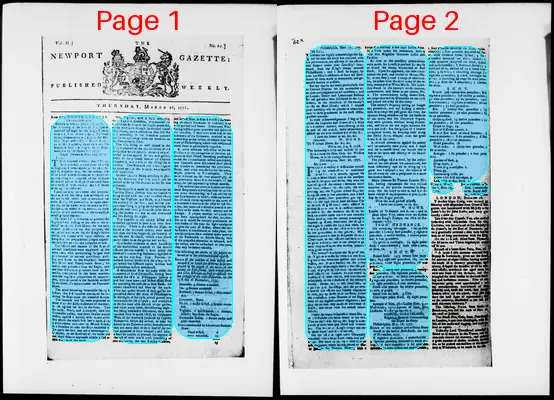
The Newport Gazette
Newport, Newport County, Rhode Island
What is this article about?
British naval and army forces under Viscount Howe and General Howe attacked and captured rebel fortifications on Mud Island (Fort Mifflin) in the Delaware River on November 15-16, 1777, silencing artillery, evacuating the fort, and destroying rebel shipping. Lord Cornwallis took Red Bank. Provisions made for Burgoyne's surrendered troops. British casualties low: 6 killed, 19 wounded.
Merged-components note: These two components form a single coherent report from the London Gazette, including extracts of letters from Viscount Howe and General Howe detailing military operations in the Delaware River area in November 1777, along with casualty returns and ordnance inventories. The second component continues directly from the first, so they are merged under foreign_news, changing the label of the second from 'story'.
Clippings
1 of 2
OCR Quality
Full Text
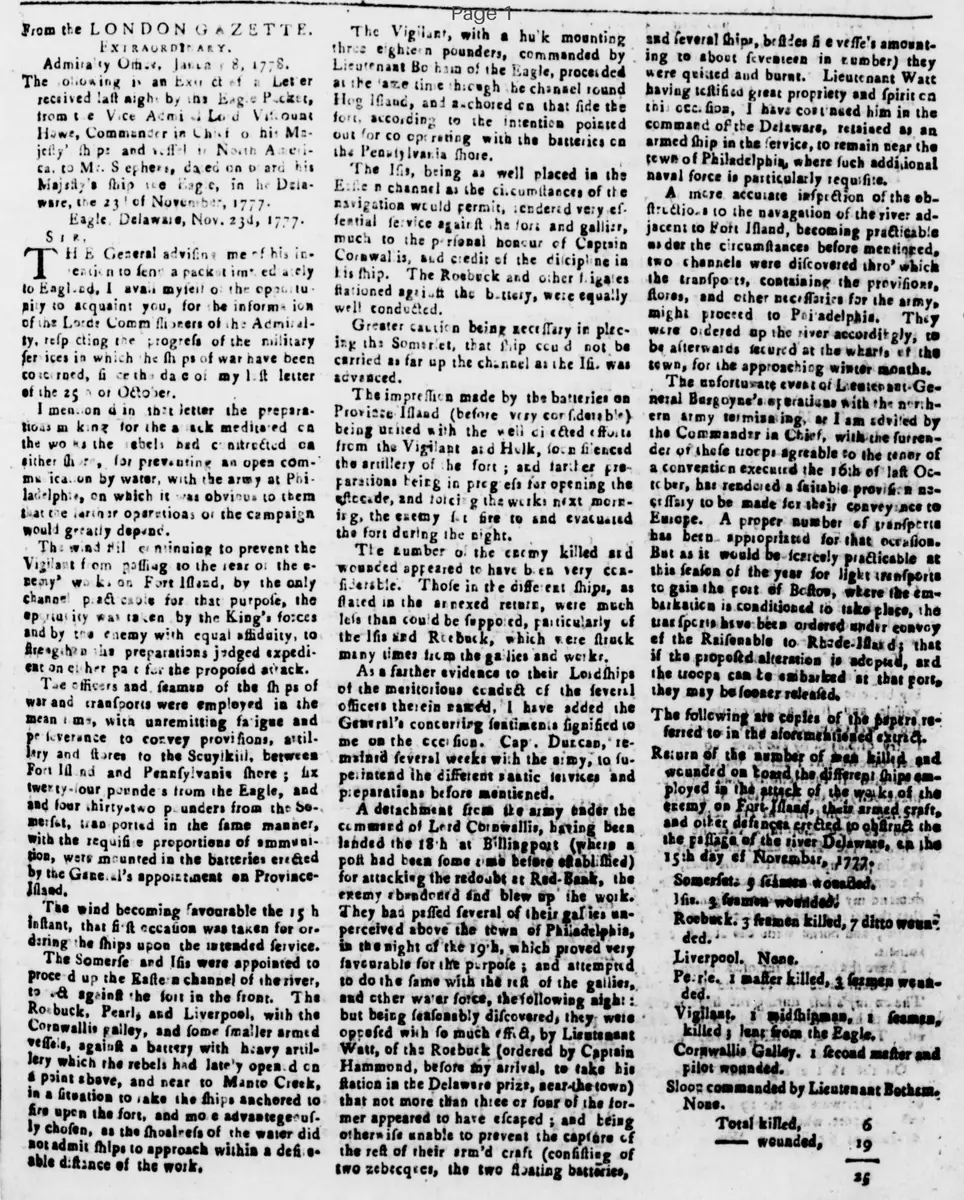
EXTRAORDINARY.
Admiralty Office, January 8, 1778.
The Following is an Extract of a Letter
received last night by the Eagle Packet,
from the Vice Admiral Viscount
Howe, Commander in Chief of His Majesty's
Ships and Vessels in North America,
to Mr. Stephens, dated on board his
Majesty's Ship the Eagle, in the Dela-
ware, the 23d of November, 1777:
Eagle, Delaware, Nov. 23d, 1777.
SIR,
The General acquaints me of his in-
tention to send a packet immediately
to England. I avail myself of the oppor-
tunity to acquaint you, for the informa-
tion
of the Lords Commissioners of the Admi-
ralty, respecting the progress of the military
services in which the ships of war have been
concerned, since the date of my last letter
of the 25th of October.
I mentioned in that letter the prepara-
tions making for the attack meditated on
the works the rebels had constructed on
either side, for preventing an open com-
munication by water, with the army at Phi-
ladelphia, on which it was obvious to them
that the further operations of the campaign
would greatly depend.
The wind still continuing to prevent the
Vigilant from passing to the rear of the e-
nemy's work on Fort Island, by the only
channel passable for that purpose, the
opportunity was taken by the King's forces
and by the enemy with equal assiduity, to
strengthen their preparations judged expe-
dient on either part for the proposed attack.
The officers and seamen of the ships of
war and transports were employed in the
mean time, with unremitting fatigue and
perseverance to convey provisions, artil-
lery and stores to the Schuylkill, between
Fort Island and Pennsylvania Shore; six
twenty-four pounders from the Eagle, and
four thirty-two pounders from the So-
merest, transported in the same manner,
with the requisite proportions of ammuni-
tion, were mounted in the batteries erected
by the General's appointment on Province-
Island.
The wind becoming favourable the 15th
instant, that first occasion was taken for or-
dering the ships upon the intended service.
The Somerset and Isis were appointed to
proceed up the Eastern channel of the river,
to act against the fort in the front.
The Roebuck, Pearl, and Liverpool, with the
Cornwallis galley, and some smaller armed
vessels, against a battery with heavy artil-
ery which the rebels had lately opened on
point above, and near to Mud Island,
in a situation to rake the ships anchored to
cover the fort, and most advantageously
chosen, as the shallowness of the water did
not admit ships to approach within a desi-
rable distance of the work.
The Vigilant, with a hulk mounting
three eighteen pounders, commanded by
Lieutenant Boman of the Eagle, proceeded
at the same time through the channel round
Hog Island, and anchored on that side the
fort, according to the intention pointed
out for co-operating with the batteries on
the Pennsylvania shore.
The Isis, being as well placed in the
Eastern channel as the circumstances of the
navigation would permit, rendered very ef-
fectual service against the fort and galleys,
much to the personal honour of Captain
Cornwallis, and credit of the discipline in
his ship. The Roebuck and other vessels
stationed against the battery, were equally
well conducted.
Greater caution being necessary in pla-
cing the Somerset, that ship could not be
carried as far up the channel as the Isis was
advanced.
The impression made by the batteries on
Province-Island (before very considerable)
being united with the well directed efforts
from the Vigilant and Hulk, soon silenced
the artillery of the fort; and further pre-
parations being in progress for opening the
chevaux-de-frise, and forcing the work next morn-
ing, the enemy set fire to and evacuated
the fort during the night.
The number of the enemy killed and
wounded appeared to have been very con-
siderable. Those in the different ships, as
stated in the annexed return, were much
less than could be supposed, particularly of
the Isis and Roebuck, which were struck
many times from the galleys and works.
As a further evidence to their Lordships
of the meritorious conduct of the several
officers therein named, I have added the
General's concurring sentiments signified to
me on the occasion. Capt. Duncan, re-
mained several weeks with the army, to su-
perintend the different nautical services and
preparations before mentioned.
A detachment from the army under the
command of Lord Cornwallis, having been
landed the 15th at Billingport (where a
post had been some time before established)
for attacking the redoubt at Red-Bank, the
enemy abandoned and blew up the work.
They had passed several of their galleys un-
perceived above the town of Philadelphia,
in the night of the 14th, which proved very
favourable for the purpose; and attempted
to do the same with the rest of the galleys,
and other water force, the following night;
but being seasonably discovered, they were
opposed with so much effect, by Lieutenant
Watt, of the Roebuck (ordered by Captain
Hammond, before my arrival, to take his
station in the Delaware prize, near the town)
that not more than three or four of the for-
mer appeared to have escaped; and being
otherwise unable to prevent the capture of
the rest of their armed craft (consisting of
two xebecs, the two floating batteries,
and several ships, besides the vessels amount-
ing to about seventeen in number) they
were quitted and burnt. Lieutenant Watt
having signified great propriety and spirit on
this occasion, I have continued him in the
command of the Delaware, retained as an
armed ship in the service, to remain near the
town of Philadelphia, where such additional
naval force is particularly requisite.
More accurate inspection of the ob-
structions to the navigation of the river ad-
joining to Fort Island, becoming practicable
after the circumstances before mentioned,
two channels were discovered thro' which
the transports, containing the provisions,
stores, and other necessaries for the army,
might proceed to Philadelphia.
They were ordered up the river accordingly, to
be afterwards secured at the wharfs of the
town, for the approaching winter months.
The unfortunate event of Lieutenant-Ge-
neral Burgoyne's operations with the nor-
thern army terminating, as I am advised by
the Commander in Chief, with the surren-
der of these troops agreeable to the tenor of
a convention executed the 16th of last Oc-
Tober, has rendered a suitable provision ne-
cessary to be made for their conveyance to
Europe.
A proper number of transports
have been appropriated for that occasion.
But as it would be scarcely practicable at
this season of the year for light transports
to gain the port of Boston, where the em-
barkation is conditioned to take place, the
transports have been ordered under convoy
of the Raisonnable to Rhode Island; that
if the proposed alteration is adopted, and
the troops can be embarked at that port,
they may be sooner released.
The following are copies of the papers re-
ferred to in the aforementioned extract.
Return of the number of men killed and
wounded on board the different ships em-
ployed in the attack of the works of the
enemy on Fort Island, their armed craft,
and other defences erected to obstruct the
passage of the river Delaware, on the
15th day of November, 1777:
Somerset: 1 seaman wounded.
Isis: 3 seamen killed, 7 ditto wounded.
Roebuck: 3 seamen killed, 7 ditto wounded.
Liverpool: None.
Pearl: 1 master killed, 3 seamen woun-
ded.
Vigilant:
1 midshipman, 4 seamen,
killed: lent from the Eagle.
Cornwallis Galley: 1 second master and
pilot wounded.
Sloop commanded by Lieutenant Boman:
None.
Total killed,
6
wounded;
19
Philadelphia, Nov. 17, 1777.
My Lord,
I cannot too highly acknowledge the signal services the army has received from the perseverance and activity of the officers and seamen under your Lordship's command, since the King's troops entered Philadelphia: and I shall be happy, by your Lordship's assistance, to have my sentiments of them made as acceptable, and generally known as possible.
But my thanks are more particularly due to Captain Duncan for his unwearied attention and judgment on all occasions; and to Captains Henry and Lieutenant Botham for the gallantry they displayed on the 15th instant, in the reduction of the enemy's works on Mud Island; which I request your Lordship will be pleased to communicate to those gentlemen in the most distinguished manner.
In these acknowledgments I beg to include the Captains and Crews of the ships in the rear, contributing to the success of the attack, more immediately assisted by the well directed fire of the ships.
I have the honor to be, &c. &c.
(Signed)
W. HOWE.
To Viscount Howe, &c. &c. &c.
Whitehall, Jan. 8, 1778.
The following is copy and extract of two letters from the Hon. Gen. Sir William Howe, to Lord George Germaine:
Philadelphia, Nov. 28, 1777.
My Lord,
By a variety of difficulties attending the construction of or additional batteries, on a morass, against the fort upon Mud-Island, and in the transportation of the guns and horses, they were not opened against the enemy's defence until the latter end of the 15th, the wind proving fair, the Vigilant armed ship, carrying 16 twenty-four pounders, and a brig with 3 twenty-four pounders, got up to the forts through the channel between Province and Hog Island; she, assisted by several ships of war in a crescent line, as well as by the batteries on shore, did such execution upon the fort and collateral block houses, that the enemy dreading an impending assault, evacuated the island in the night between the 15th and 16th, and it was possessed on the 16th at day-break, by the grenadiers of the guards. Much commendation is due to Brigadier General Cleveland, to the officers and men of the corps of artillery, and to the troops employed on this service, animated with great gallantry.
The enemy's fire upon the ships of war, the Vigilant and Hulk, from the two floating batteries, several galleys and armed vessels, and from a battery on the Jersey shore, was exceedingly heavy; But the gallantry displayed by Lieutenant Commanders, their officers and seamen, on this occasion, frustrated their effect, and contributed principally to the reduction of the enemy's works. Permit me, in this time, to report to your Lordship, the perseverance of the seamen employed in bringing up stores to the vessels, under the conduct of Capt. Duncan of the Eagle demands my highest acknowledgments; and that the services they rendered were most effectual, and done with the utmost cheerfulness.
I have the honor to enclose a return No. 1, of the cannon and stores found in the fort.
The enemy's loss during this siege is computed to have been 400 killed and wounded. The loss in King's troops was only seven killed and five wounded.
On the 18th a detachment Lord Cornwallis marched with a corps from camp, And passed over the Delaware on the 19th from Chester to Billingsport, where he was joined by Major Gen. Sir Thomas Wilson, with a corps that arrived a few days before from New York under his command, having with him Brigadier General Leslie and Patterson.
As soon as the necessary preparations were made, his Lordship pursued his march to attack the enemy entrenched at Red Bank. Upon his approach, the rebels evacuated the post, and retired to Mount-Holly, where they joined a corps of observation, detached from the main army of the rebels, encamped at White Marsh. His Lordship found in the enemy's works cannon, ammunition, and stores as per return, No. 2. The intrenchment being demolished, his corps returned by Gloucester on the 27th and joined the army in this camp.
The enemy's shipping having no longer any protection, and not finding it advisable to attempt the passage of the river, the channel being commanded by the batteries of the town, and the Delaware frigate, they were quitted, without being dismantled, and burnt on the night between the 20th and 21st: but the galley of a smaller draught of water, by keeping close along the Jersey shore, escaped from the great breadth of the river.
A forward movement against the enemy will immediately take place, and I hope will be attended with the success that is due to the spirit and activity of his Majesty's troops.
The passage of the river, by the reduction of the two places above mentioned, has been sufficiently opened to bring up frigates and transports; but the removal of the chevaux de frise is postponed to a more favourable season.
Major General Sir Thomas Spencer Wilson, having represented the very critical situation of his private concerns in England, has my leave to return, and his packet charge of my dispatches to your Lordship by the Eagle packet.
With the most perfect respect
I have the honour to be, &c.
W. HOWE.
Return of Ordnance and Stores found in Mud Island Fort, taken from the Rebels by the King's Troops, the 16th of November, 1777.
IRON.
Ordnance.
On travelling carriages. 1 thirty-two pounder. 1 twenty four pounder, 7 eighteen pounders, 2 unserviceable, 1 twelve pounder, 2 four pounders.
On garrison carriages. 14 eight pounders, unserviceable: 1 sunk with a scow of forts,.10.
Round shot:
1475 twenty four pound, 843 eighteen pounders, 165 twelve pounders, 1100 six pounders, 16 four pounders.
Bar. 6 thirty-twos pounders, 4 twenty four pounders, 169 eighteens pounders.
Grape quilted. 12 thirty-two pounders 84 eighteens pounders, 20 twelve pounders, 1 to eight pounders, 8 four pounders.
Fixed with powder for twelve pounders. 11 cases, 9 grapes 2
Small iron for cards.
Cartridges paper filled, 68 eight pounder.
Sponges of forts, 36--Ladles ditto, 9.
Wad-books, 15 Aprons of lead
Ladstocke. 6 -Balls ce barrels 2.
SAMUEL CLEVELAND
Brigadier General Commanding the Royal Artillery.
Philadelphia, Nov. 18, 1777:
Return of the artillery and military Stores found in the fort of Red Bank, the 22d of November, 1777:
Eighteen pounders, 1 unserviceable :
3 eighteen pounders mounted on truck carriages unserviceable & 2 fixed pounders mounted on ditto, spiked and unserviceable ;
1 four pounder mounted on ditto, cast viceable; 4 four pounder mounted on ditto, with elevated screw, spiked; 3 four pounders mounted on ditto, spiked;1 three pounder mounted on ditto, spiked and unserviceable; 8 howitzer mortars ; 4 howitzer ditto, carried off by a naval Captain; 3 swivels ; 1 travelling carriage for eighteen pounders; 5 track carriages for ditto; 1 travelling carriage for nine pounders ; 4 ditto for 6 pounders ; 3 limbers for ditto.
SHOT.
Round. 506 twenty-four pounders; 818 eighteens pounders ; 156 twelve pounders; 91 nine pounders; 23 six pounders: 1301 four pounders; 73 three pounders; 20 one pounders; 32 half pounders.
Bar. 7 twenty four pounders ; 2 twelve pounders; 50 nine pounders.; three pounders.
Grapes quilted. 14 twelve pounder ; 54 six pounders ; 28 four pounders.
Grape in bags, 24.
Box of different nature, 1.
Round shot fixed to wood bottoms. 1 twelve pounders ; 6 six pounders; 6 four pounders ; 16 three pounders.
Hand grenades, 18.
Wad-books. 1 thirty-two pounder, 1 six pounder.
Sponges.. 1 six pounder ; 2 four pounder.
Aprons of lead, 4.
Drag ropes, 3
Travelling handspike, 1.
Pikes, 93.
Intrenching tools, 30.
Boxes with ball cartridges, 9.
Cask with grape balls, 1.
Camp at Woodbury, Nov. 23, 1777.
SAMUEL CLEVELAND
Brig. Gen. Commanding the Royal Artillery in N. America.
What sub-type of article is it?
What keywords are associated?
What entities or persons were involved?
Where did it happen?
Foreign News Details
Primary Location
Delaware River, Philadelphia
Event Date
November 15 28, 1777
Key Persons
Outcome
british: 6 killed, 19 wounded in naval action; 7 killed, 5 wounded overall. rebels: ~400 killed/wounded at mud island; fort evacuated and burned; red bank abandoned and blown up; ~17 armed vessels captured or burned, few galleys escaped. captured ordnance and stores listed. channels opened for transports. provisions for burgoyne's surrendered troops.
Event Details
British ships (Somerset, Isis, Roebuck, Pearl, Liverpool, Vigilant) and land batteries attacked rebel Fort Island (Mud Island) on November 15, silencing artillery; rebels evacuated and burned fort overnight. Lord Cornwallis's detachment took Red Bank on November 20-22. Rebel galleys and vessels attempted escape but most destroyed by Lieutenant Watt. Obstructions cleared, transports proceeded to Philadelphia. Mention of Burgoyne's surrender on October 16 and transport arrangements.