Thank you for visiting SNEWPapers!
Sign up free
Editorial
February 24, 1818
The Rhode Island American, And General Advertiser
Providence, Providence County, Rhode Island
What is this article about?
Reprinted editorial from Baltimore Federal Republican condemns sympathy for Napoleon's St. Helena imprisonment, highlighting his bloody past conquests in Egypt and Russia, and contrasts this with the peaceful triumphs of Christianity, where European monarchs submit to the Prince of Peace.
Clipping
OCR Quality
95%
Excellent
Full Text
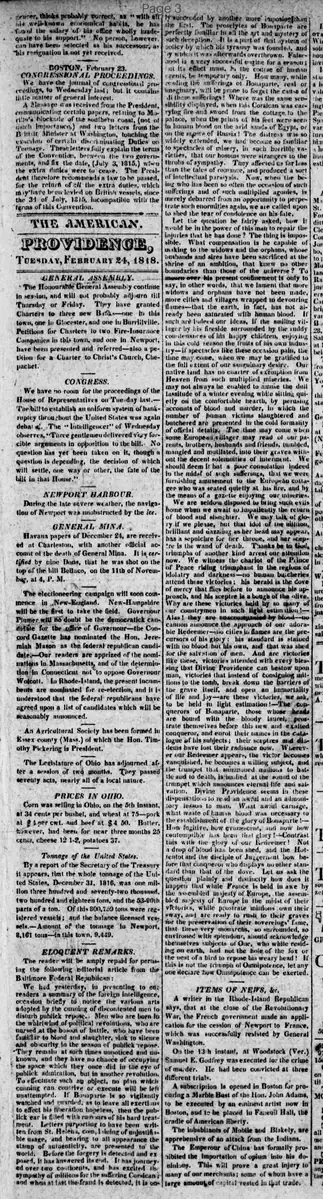
ELOQUENT REMARKS
The reader will be amply repaid for perusing the following editorial article from the Baltimore Federal Republican:
We had yesterday, in presenting to our readers a summary of the foreign intelligence, occasion briefly to notice the various arts adopted by the cunning of discontented men to disturb public repose. Men who are born in the whirlwind of political revolutions, who are nursed at the bosom of battle, who have been familiar to blood and slaughter, sink to silence and obscurity in the season of public repose.—They remain at such times unnoticed and unknown, and they have no chance of occupying the space which they once did in the eye of public admiration, but in another revolution. To effectuate such an object, no plan which cunning can contrive or execute will be left unattempted. If Bonaparte is so vigilantly watched and guarded, as to leave all exertions to effect his liberation hopeless, then the public ear is filled with rumours of his hard treatment. Letters purporting to have been written from St. Helena, complaining of unjustifiable usage, and bearing to all appearance the stamp of authenticity, are presented to the world: Before the forgery is detected and exposed, it has answered its end. It has journeyed over two continents, and has excited the sympathy of millions for the suffering Corsican; and when at last the fraud is detected, it is only succeeded by another more imposing than the first. The proselytes of Bonaparte are perfectly familiar in all the art and mystery of such deception. It is a part of that system of policy by which his tyranny was founded, and by which it was afterwards overthrown. Falsehood is a very successful engine for a season; but its effect must, in the course of human events, be temporary only. How many, while reading the sufferings of Bonaparte, real or imaginary, will be prone to forget the cause of his these sufferings! Where was the same sensibility displayed, when this Corsican was carrying fire and sword from the cottage, to the palace, when the prints of his feet were seen in human blood on the arid sands of Egypt, or on the snows of Russia! The distress was so widely extended, we had become so familiar to spectacles of misery, in such horrible varieties, that our bosoms were strangers to the throbs of sympathy. They affected us far less than the tales of romance, and produced a sort of intellectual paralysis. Now, when the being who has been so often the occasion of such sufferings and of such multiplied agonies, is merely debarred from an opportunity to perpetrate such enormities again, we are called upon to shed the tear of condolence on his fate. Let the question be fairly asked, how it would be in the power of this man to repair the injuries that he has done? The thing is impossible. What compensation is he capable of making to the widows and the orphans, whose husbands and sires have been sacrificed at the shrine of an ambition, that knew no other boundaries than those of the universe? To mourn over his present confinement is only to say, in other words, that we lament that more widows and orphans have not been made, more cities and villages wrapped in devouring flames—that the earth, in fact, has not already been saturated with human blood. If such are indeed our ideas, if the smiling villager by his fireside surrounded by the ruddy countenances of his happy children, enjoying in this cold season the fruits of his own industry—if spectacles like these occasion pain, the time may come, when we may be gratified to the full extent of our sanguinary desire. Our native land has no charter of exemption from Heaven from such multiplied miseries. We may not always be enabled to amuse the dull lassitude of a winter evening while sitting quietly on the comfortable hearth, by perusing accounts of blood and murder, in which the number of human victims slaughtered and butchered are presented in the cold formality of official details. The time may come when some European villager may read of our parents, brothers, husbands and friends, tumbled, mangled and mutilated, into their graves without the decent solemnities of interment. We should deem it but a poor consolation indeed in the midst of such sufferings, that we were furnishing amusement to the European cottager who was seated quietly at his fire, and by the means of a gazette enjoying our miseries. We are seldom disposed to bring such evils home when we await so impatiently the return of blood and slaughter. We may talk of glory if we please, but that idol of the million, brilliant and dazzling as her head may appear, has a sepulchre for her throne, and her sceptre is the wand of death. Thanks be to God, triumphs of another kind arrest our attention now. We witness the chariot of the Prince of Peace riding triumphant in the regions of idolatry and darkness—no human butcheries attend these victories: his herald is the dove of mercy that flies before to announce his approach, and his sceptre is a bough of the olive. Why are these victories held by so many of our countrymen in such light estimation!—Alas! they are unaccompanied by blood—no cannon announce the approach of our adorable Redeemer—no cities in flames are the precursors of his glory: his standard is stained with no blood but his own, and that was shed for the salvation of men. And are victories like these, victories attended with every blessing that Divine Providence can bestow upon man, victories that instead of consigning millions to the tomb, break down the barriers of the grave itself, and open an immortality of life and joy—are these victories, we ask, to be held in light estimation!—The conquerors of Bonaparte, those whose heads are bound with the bloody laurel, prostrate themselves before this new and exalted conqueror, and enrol their names in the Catalogue of his subjects; their sceptres and diadems have lost their radiance now. Wherever our Redeemer appears, the victor becomes vanquished, he becomes a willing subject, and the trumpet that summoned millions to battle and to death, is hushed at the sound of the trumpet which announces eternal life and salvation. Divine Providence seems in these dispensations to read an awful and an admonitory lesson to man. What awful carnage, what waste of human blood was necessary to the establishment of the glory of Bonaparte!—How fugitive, how evanescent, and now how contemptible has been that glory!—Contrast this with the glory of our Redeemer! Not a drop of blood has been shed, and the Hottentot and the disciple of Juggernaut bow before that conqueror who displays no other standard than that of the dove. Let us ask the question plainly and distinctly how does it happen that while France is held in awe by the assembled majesty of Europe,—the assembled majesty of Europe in the midst of their victories, while prostrate millions own their sway, and are ready to rush to their graves for the preservation of their sovereigns' fame, that these very monarchs, so surrounded, so environed with splendour, should acknowledge themselves subjects of One, who while residing on earth, had not the hole of the fox or the nest of a bird to repose his weary head! If this is not the triumph of Omnipotence, let any one declare how Omnipotence can be exerted.
The reader will be amply repaid for perusing the following editorial article from the Baltimore Federal Republican:
We had yesterday, in presenting to our readers a summary of the foreign intelligence, occasion briefly to notice the various arts adopted by the cunning of discontented men to disturb public repose. Men who are born in the whirlwind of political revolutions, who are nursed at the bosom of battle, who have been familiar to blood and slaughter, sink to silence and obscurity in the season of public repose.—They remain at such times unnoticed and unknown, and they have no chance of occupying the space which they once did in the eye of public admiration, but in another revolution. To effectuate such an object, no plan which cunning can contrive or execute will be left unattempted. If Bonaparte is so vigilantly watched and guarded, as to leave all exertions to effect his liberation hopeless, then the public ear is filled with rumours of his hard treatment. Letters purporting to have been written from St. Helena, complaining of unjustifiable usage, and bearing to all appearance the stamp of authenticity, are presented to the world: Before the forgery is detected and exposed, it has answered its end. It has journeyed over two continents, and has excited the sympathy of millions for the suffering Corsican; and when at last the fraud is detected, it is only succeeded by another more imposing than the first. The proselytes of Bonaparte are perfectly familiar in all the art and mystery of such deception. It is a part of that system of policy by which his tyranny was founded, and by which it was afterwards overthrown. Falsehood is a very successful engine for a season; but its effect must, in the course of human events, be temporary only. How many, while reading the sufferings of Bonaparte, real or imaginary, will be prone to forget the cause of his these sufferings! Where was the same sensibility displayed, when this Corsican was carrying fire and sword from the cottage, to the palace, when the prints of his feet were seen in human blood on the arid sands of Egypt, or on the snows of Russia! The distress was so widely extended, we had become so familiar to spectacles of misery, in such horrible varieties, that our bosoms were strangers to the throbs of sympathy. They affected us far less than the tales of romance, and produced a sort of intellectual paralysis. Now, when the being who has been so often the occasion of such sufferings and of such multiplied agonies, is merely debarred from an opportunity to perpetrate such enormities again, we are called upon to shed the tear of condolence on his fate. Let the question be fairly asked, how it would be in the power of this man to repair the injuries that he has done? The thing is impossible. What compensation is he capable of making to the widows and the orphans, whose husbands and sires have been sacrificed at the shrine of an ambition, that knew no other boundaries than those of the universe? To mourn over his present confinement is only to say, in other words, that we lament that more widows and orphans have not been made, more cities and villages wrapped in devouring flames—that the earth, in fact, has not already been saturated with human blood. If such are indeed our ideas, if the smiling villager by his fireside surrounded by the ruddy countenances of his happy children, enjoying in this cold season the fruits of his own industry—if spectacles like these occasion pain, the time may come, when we may be gratified to the full extent of our sanguinary desire. Our native land has no charter of exemption from Heaven from such multiplied miseries. We may not always be enabled to amuse the dull lassitude of a winter evening while sitting quietly on the comfortable hearth, by perusing accounts of blood and murder, in which the number of human victims slaughtered and butchered are presented in the cold formality of official details. The time may come when some European villager may read of our parents, brothers, husbands and friends, tumbled, mangled and mutilated, into their graves without the decent solemnities of interment. We should deem it but a poor consolation indeed in the midst of such sufferings, that we were furnishing amusement to the European cottager who was seated quietly at his fire, and by the means of a gazette enjoying our miseries. We are seldom disposed to bring such evils home when we await so impatiently the return of blood and slaughter. We may talk of glory if we please, but that idol of the million, brilliant and dazzling as her head may appear, has a sepulchre for her throne, and her sceptre is the wand of death. Thanks be to God, triumphs of another kind arrest our attention now. We witness the chariot of the Prince of Peace riding triumphant in the regions of idolatry and darkness—no human butcheries attend these victories: his herald is the dove of mercy that flies before to announce his approach, and his sceptre is a bough of the olive. Why are these victories held by so many of our countrymen in such light estimation!—Alas! they are unaccompanied by blood—no cannon announce the approach of our adorable Redeemer—no cities in flames are the precursors of his glory: his standard is stained with no blood but his own, and that was shed for the salvation of men. And are victories like these, victories attended with every blessing that Divine Providence can bestow upon man, victories that instead of consigning millions to the tomb, break down the barriers of the grave itself, and open an immortality of life and joy—are these victories, we ask, to be held in light estimation!—The conquerors of Bonaparte, those whose heads are bound with the bloody laurel, prostrate themselves before this new and exalted conqueror, and enrol their names in the Catalogue of his subjects; their sceptres and diadems have lost their radiance now. Wherever our Redeemer appears, the victor becomes vanquished, he becomes a willing subject, and the trumpet that summoned millions to battle and to death, is hushed at the sound of the trumpet which announces eternal life and salvation. Divine Providence seems in these dispensations to read an awful and an admonitory lesson to man. What awful carnage, what waste of human blood was necessary to the establishment of the glory of Bonaparte!—How fugitive, how evanescent, and now how contemptible has been that glory!—Contrast this with the glory of our Redeemer! Not a drop of blood has been shed, and the Hottentot and the disciple of Juggernaut bow before that conqueror who displays no other standard than that of the dove. Let us ask the question plainly and distinctly how does it happen that while France is held in awe by the assembled majesty of Europe,—the assembled majesty of Europe in the midst of their victories, while prostrate millions own their sway, and are ready to rush to their graves for the preservation of their sovereigns' fame, that these very monarchs, so surrounded, so environed with splendour, should acknowledge themselves subjects of One, who while residing on earth, had not the hole of the fox or the nest of a bird to repose his weary head! If this is not the triumph of Omnipotence, let any one declare how Omnipotence can be exerted.
What sub-type of article is it?
Moral Or Religious
War Or Peace
Foreign Affairs
What keywords are associated?
Napoleon
Bonaparte
St Helena
Christian Victories
Peace Vs War
European Monarchs
Divine Providence
What entities or persons were involved?
Bonaparte
Prince Of Peace
European Monarchs
Editorial Details
Primary Topic
Critique Of Sympathy For Napoleon's Sufferings And Contrast With Christian Victories
Stance / Tone
Strongly Anti Napoleon And Pro Christian Peace
Key Figures
Bonaparte
Prince Of Peace
European Monarchs
Key Arguments
Sympathy For Napoleon's Imprisonment Ignores His Past Atrocities
Napoleon's Glory Was Built On Bloodshed And Is Now Contemptible
Christian Victories Bring Peace Without Violence And True Salvation
False Rumors About Napoleon's Treatment Are Deceptive Tactics
Human Ambition Leads To Misery, While Divine Conquest Offers Eternal Life