Thank you for visiting SNEWPapers!
Sign up free
Editorial
August 29, 1865
The Hillsdale Standard
Hillsdale, Hillsdale County, Michigan
What is this article about?
The editorial discusses the passage of the 13th Amendment by Congress on February 1, 1865, abolishing slavery, and emphasizes Congress's enforcement power to protect freed people's rights against Southern opposition, ensuring their perpetual freedom.
Clipping
OCR Quality
98%
Excellent
Full Text
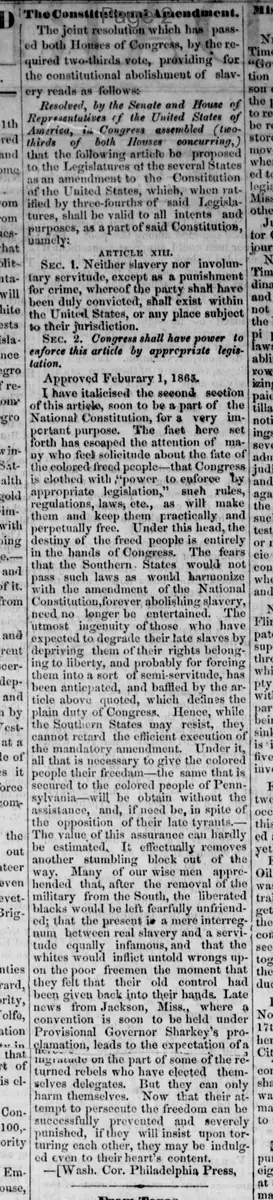
The joint resolution which has passed both Houses of Congress, by the required two-thirds vote, providing for the constitutional abolishment of slavery reads as follows:
Resolved, by the Senate and House of Representatives of the United States of America, in Congress assembled (two-thirds of both Houses concurring,) that the following article be proposed to the Legislatures of the several States as an amendment to the Constitution of the United States, which, when ratified by three-fourths of said Legislatures, shall be valid to all intents and purposes, as a part of said Constitution, namely:
ARTICLE XIII.
Sec. 1. Neither slavery nor involuntary servitude, except as a punishment for crime, whereof the party shall have been duly convicted, shall exist within the United States, or any place subject to their jurisdiction.
Sec. 2. Congress shall have power to enforce this article by appropriate legislation.
Approved February 1, 1865.
I have italicised the second section of this article, soon to be a part of the National Constitution, for a very important purpose. The act here set forth has escaped the attention of many who feel solicitude about the fate of the colored freed people--that Congress is clothed with "power to enforce by appropriate legislation," such rules, regulations, laws, etc., as will make them and keep them practically and perpetually free. Under this head, the destiny of the freed people is entirely in the hands of Congress. The fears that the Southern States would not pass such laws as would harmonize with the amendment of the National Constitution, forever abolishing slavery, need no longer be entertained. The utmost ingenuity of those who have expected to degrade their late slaves by depriving them of their rights belonging to liberty, and probably for forcing them into a sort of semi-servitude, has been anticipated, and baffled by the article above quoted, which defines the plain duty of Congress. Hence, while the Southern States may resist, they cannot retard the efficient execution of the mandatory amendment. Under it, all that is necessary to give the colored people their freedom--the same that is secured to the colored people of Pennsylvania--will be obtained without the assistance, and, if need be, in spite of the opposition of their late tyrants. The value of this assurance can hardly be estimated. It effectually removes another stumbling block out of the way. Many of our wise men apprehended that, after the removal of the military from the South, the liberated blacks would be left fearfully unfriended; that the present is a mere interregnum between real slavery and a servitude equally infamous, and that the whites would inflict untold wrongs upon the poor freemen the moment that they felt that their old control had been given back into their hands. Late news from Jackson, Miss., where a convention is soon to be held under Provisional Governor Sharkey's proclamation, leads to the expectation of ingratitude on the part of some of the returned rebels who have elected themselves delegates. But they can only harm themselves. Now that their attempt to persecute the freedmen can be successfully prevented and severely punished, if they will insist upon torturing each other, they may be indulged even to their heart's content.
—[Wash. Cor. Philadelphia Press.
Resolved, by the Senate and House of Representatives of the United States of America, in Congress assembled (two-thirds of both Houses concurring,) that the following article be proposed to the Legislatures of the several States as an amendment to the Constitution of the United States, which, when ratified by three-fourths of said Legislatures, shall be valid to all intents and purposes, as a part of said Constitution, namely:
ARTICLE XIII.
Sec. 1. Neither slavery nor involuntary servitude, except as a punishment for crime, whereof the party shall have been duly convicted, shall exist within the United States, or any place subject to their jurisdiction.
Sec. 2. Congress shall have power to enforce this article by appropriate legislation.
Approved February 1, 1865.
I have italicised the second section of this article, soon to be a part of the National Constitution, for a very important purpose. The act here set forth has escaped the attention of many who feel solicitude about the fate of the colored freed people--that Congress is clothed with "power to enforce by appropriate legislation," such rules, regulations, laws, etc., as will make them and keep them practically and perpetually free. Under this head, the destiny of the freed people is entirely in the hands of Congress. The fears that the Southern States would not pass such laws as would harmonize with the amendment of the National Constitution, forever abolishing slavery, need no longer be entertained. The utmost ingenuity of those who have expected to degrade their late slaves by depriving them of their rights belonging to liberty, and probably for forcing them into a sort of semi-servitude, has been anticipated, and baffled by the article above quoted, which defines the plain duty of Congress. Hence, while the Southern States may resist, they cannot retard the efficient execution of the mandatory amendment. Under it, all that is necessary to give the colored people their freedom--the same that is secured to the colored people of Pennsylvania--will be obtained without the assistance, and, if need be, in spite of the opposition of their late tyrants. The value of this assurance can hardly be estimated. It effectually removes another stumbling block out of the way. Many of our wise men apprehended that, after the removal of the military from the South, the liberated blacks would be left fearfully unfriended; that the present is a mere interregnum between real slavery and a servitude equally infamous, and that the whites would inflict untold wrongs upon the poor freemen the moment that they felt that their old control had been given back into their hands. Late news from Jackson, Miss., where a convention is soon to be held under Provisional Governor Sharkey's proclamation, leads to the expectation of ingratitude on the part of some of the returned rebels who have elected themselves delegates. But they can only harm themselves. Now that their attempt to persecute the freedmen can be successfully prevented and severely punished, if they will insist upon torturing each other, they may be indulged even to their heart's content.
—[Wash. Cor. Philadelphia Press.
What sub-type of article is it?
Slavery Abolition
Constitutional
What keywords are associated?
13th Amendment
Slavery Abolition
Congress Enforcement
Freedmen Rights
Southern Resistance
Constitutional Amendment
What entities or persons were involved?
Congress
Southern States
Freed People
Provisional Governor Sharkey
Editorial Details
Primary Topic
Passage And Enforcement Of The 13th Amendment Abolishing Slavery
Stance / Tone
Strongly Supportive Of The Amendment And Its Protective Enforcement Powers
Key Figures
Congress
Southern States
Freed People
Provisional Governor Sharkey
Key Arguments
The 13th Amendment Abolishes Slavery And Involuntary Servitude Except As Punishment For Crime.
Congress Has Power To Enforce The Amendment Through Appropriate Legislation.
This Power Ensures The Practical And Perpetual Freedom Of Colored People.
Fears Of Southern States Reimposing Servitude Are Unfounded Due To Federal Enforcement.
The Amendment Prevents Degradation Of Freed People And Secures Their Rights Like Those In Pennsylvania.
Southern Resistance Cannot Hinder The Amendment's Execution.
Recent Events In Jackson, Miss., Show Potential Ingratitude From Rebels, But They Cannot Harm Freedmen Effectively.