Thank you for visiting SNEWPapers!
Sign up free
Story
November 4, 1944
The Union Times
New Haven, New Haven County, Connecticut
What is this article about?
Article defends General Marshall's War Department fact sheets praising U.S. labor's WWII production record against anti-labor critics like David Lawrence, highlighting minimal strike impact and workers' sacrifices comparable to soldiers'.
Clipping
OCR Quality
98%
Excellent
Full Text
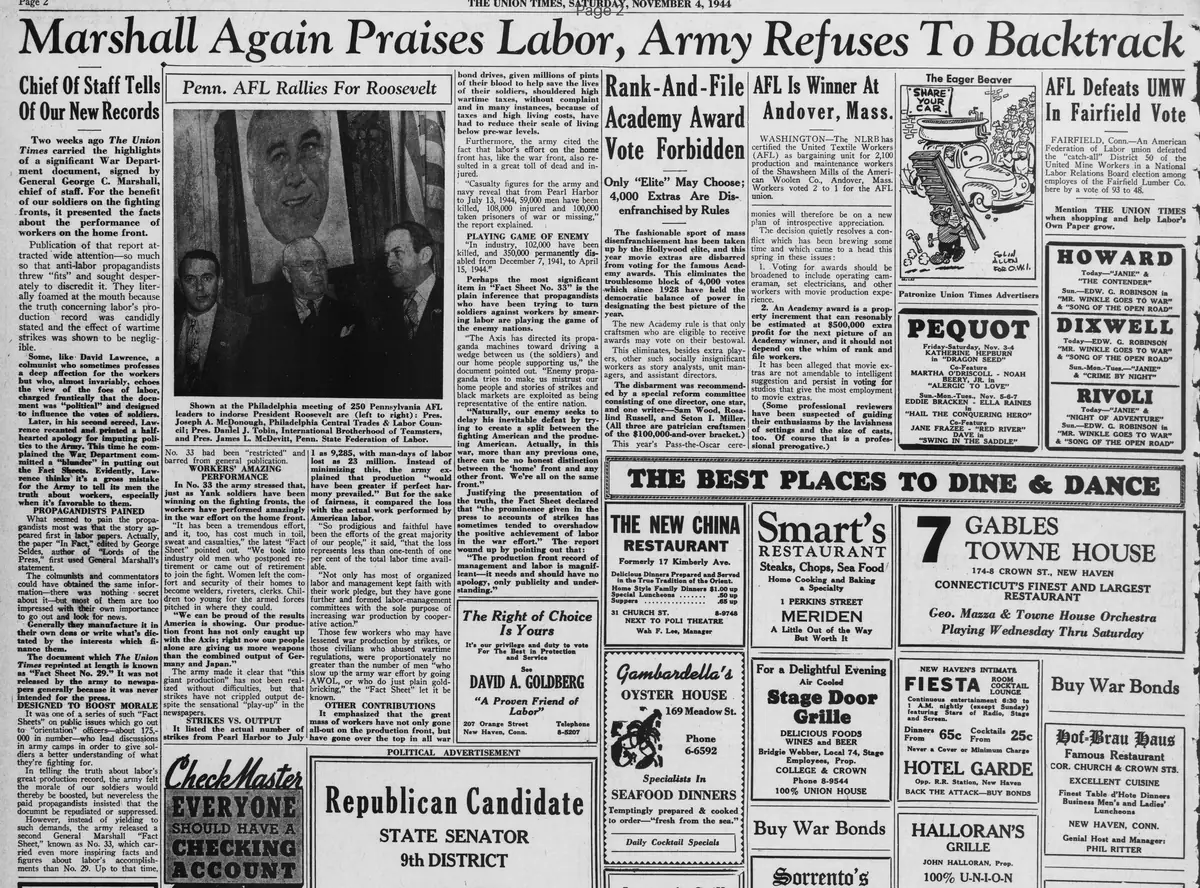
Marshall Again Praises Labor, Army Refuses To Backtrack
Chief Of Staff Tells Of Our New Records
Two weeks ago The Union Times carried the highlights of a significant War Department document, signed by General George C. Marshall, chief of staff. For the benefit of our soldiers on the fighting fronts, it presented the facts about the performance of workers on the home front.
Publication of that report attracted wide attention—so much so that anti-labor propagandists threw 'fits' and sought desperately to discredit it. They literally foamed at the mouth because the truth concerning labor's production record was candidly stated and the effect of wartime strikes was shown to be negligible.
Some, like David Lawrence, a columnist who sometimes professes a deep affection for the workers but who, almost invariably, echoes the view of the foes of labor, charged frantically that the document was 'political' and designed to influence the votes of soldiers. Later, in his second screed, Lawrence recanted and printed a half-hearted apology for imputing politics to the Army. This time he complained the War Department committed a 'blunder' in putting out the Fact Sheets. Evidently, Lawrence thinks it's a gross mistake for the Army to tell its men the truth about workers, especially when it's favorable to them.
PROPAGANDISTS PAINED
What seemed to pain the propagandists most was that the story appeared first in labor papers. Actually, the paper 'In Fact,' edited by George Seldes, author of 'Lords of the Press,' first used General Marshall's statement.
The columnists and commentators could have obtained the same information—there was nothing secret about it—but most of them are too impressed with their own importance to go out and look for news. Generally they manufacture it in their own dens or write what's dictated by the interests which finance them.
The document which The Union Times reprinted at length is known as 'Fact Sheet No. 29.' It was not released by the army to newspapers generally because it was never intended for the press.
DESIGNED TO BOOST MORALE
It was one of a series of such 'Fact Sheets' on public issues which go out to 'orientation' officers—about 175,000 in number—who lead discussions in army camps in order to give soldiers a better understanding of what they're fighting for.
In telling the truth about labor's great production record, the army felt the morale of our soldiers would thereby be boosted, but nevertheless the paid propagandists insisted that the document be repudiated or suppressed. However, instead of yielding to such demands, the army released a second General Marshall 'Fact Sheet,' known as No. 33, which carried even more inspiring facts and figures about labor's accomplishments than No. 29. Up to that time,
barred from general publication.
WORKERS' AMAZING PERFORMANCE
In No. 33 the army stressed that, just as Yank soldiers have been winning on the fighting fronts, the workers have performed amazingly in the war effort on the home front.
'It has been a tremendous effort, and it, too, has cost much in toil, sweat and casualties,' the latest 'Fact Sheet' pointed out. 'We took into industry old men who postponed retirement or came out of retirement to join the fight. Women left the comfort and security of their homes to become welders, riveters, clerks. Children too young for the armed forces pitched in where they could.
'We can be proud of the results America is showing. Our production front has not only caught up with the Axis; right now our people alone are giving us more weapons than the combined output of Germany and Japan.'
The army made it clear that 'this giant production' has not been realized without difficulties, but that strikes have not crippled output despite the sensational 'play-up' in the newspapers.
STRIKES VS. OUTPUT
It listed the actual number of strikes from Pearl Harbor to July 1 as 9,285, with man-days of labor lost as 23 million. Instead of minimizing this, the army explained that production 'would have been greater if perfect harmony prevailed.' But for the sake of fairness, it compared the loss with the actual work performed by American labor.
'So prodigious and faithful have been the efforts of the great majority of our people,' it said, 'that the loss represents less than one-tenth of one per cent of the total labor time available.
'Not only has most of organized labor and management kept faith with their work pledge, but they have gone further and formed labor-management committees with the sole purpose of increasing war production by cooperative action.'
Those few workers who may have lessened war production by strikes, or those civilians who abused wartime regulations, were proportionately no greater than the number of men 'who slow up the army war effort by going AWOL, or who do just plain gold-bricking,' the 'Fact Sheet' let it be known.
OTHER CONTRIBUTIONS
It emphasized that the great mass of workers have not only gone all-out on the production front, but have gone over the top in all war activities.
Furthermore, the army cited the fact that labor's effort on the home front has, like the war front, also resulted in a great toll of dead and injured.
'Casualty figures for the army and navy reveal that from Pearl Harbor to July 13, 1944, 59,000 men have been killed, 108,000 injured and 100,000 taken prisoners of war or missing,' the report explained.
PLAYING GAME OF ENEMY
'In industry, 102,000 have been killed, and 350,000 permanently disabled from December 7, 1941, to April 15, 1944.'
Perhaps the most significant item in 'Fact Sheet No. 33' is the plain inference that propagandists who have been trying to turn soldiers against workers by smearing labor are playing the game of the enemy nations.
'The Axis has directed its propaganda machines toward driving a wedge between us (the soldiers) and our home people supporting us,' the document pointed out. 'Enemy propaganda tries to make us mistrust our home people and stories of strikes and black markets are exploited as being representative of the entire nation.
'Naturally, our enemy seeks to delay his inevitable defeat by trying to create a split between the fighting American and the producing American. Actually, in this war, more than any previous one, there can be no honest distinction between the home front and any other front. We're all on the same front.'
Justifying the presentation of the truth, the Fact Sheet declared that 'the prominence given in the press to accounts of strikes has sometimes tended to overshadow the positive achievement of labor in the war effort.' The report wound up by pointing out that:
'The production front record of management and labor is magnificent. It needs and should have no apology, only publicity and understanding.'
Chief Of Staff Tells Of Our New Records
Two weeks ago The Union Times carried the highlights of a significant War Department document, signed by General George C. Marshall, chief of staff. For the benefit of our soldiers on the fighting fronts, it presented the facts about the performance of workers on the home front.
Publication of that report attracted wide attention—so much so that anti-labor propagandists threw 'fits' and sought desperately to discredit it. They literally foamed at the mouth because the truth concerning labor's production record was candidly stated and the effect of wartime strikes was shown to be negligible.
Some, like David Lawrence, a columnist who sometimes professes a deep affection for the workers but who, almost invariably, echoes the view of the foes of labor, charged frantically that the document was 'political' and designed to influence the votes of soldiers. Later, in his second screed, Lawrence recanted and printed a half-hearted apology for imputing politics to the Army. This time he complained the War Department committed a 'blunder' in putting out the Fact Sheets. Evidently, Lawrence thinks it's a gross mistake for the Army to tell its men the truth about workers, especially when it's favorable to them.
PROPAGANDISTS PAINED
What seemed to pain the propagandists most was that the story appeared first in labor papers. Actually, the paper 'In Fact,' edited by George Seldes, author of 'Lords of the Press,' first used General Marshall's statement.
The columnists and commentators could have obtained the same information—there was nothing secret about it—but most of them are too impressed with their own importance to go out and look for news. Generally they manufacture it in their own dens or write what's dictated by the interests which finance them.
The document which The Union Times reprinted at length is known as 'Fact Sheet No. 29.' It was not released by the army to newspapers generally because it was never intended for the press.
DESIGNED TO BOOST MORALE
It was one of a series of such 'Fact Sheets' on public issues which go out to 'orientation' officers—about 175,000 in number—who lead discussions in army camps in order to give soldiers a better understanding of what they're fighting for.
In telling the truth about labor's great production record, the army felt the morale of our soldiers would thereby be boosted, but nevertheless the paid propagandists insisted that the document be repudiated or suppressed. However, instead of yielding to such demands, the army released a second General Marshall 'Fact Sheet,' known as No. 33, which carried even more inspiring facts and figures about labor's accomplishments than No. 29. Up to that time,
barred from general publication.
WORKERS' AMAZING PERFORMANCE
In No. 33 the army stressed that, just as Yank soldiers have been winning on the fighting fronts, the workers have performed amazingly in the war effort on the home front.
'It has been a tremendous effort, and it, too, has cost much in toil, sweat and casualties,' the latest 'Fact Sheet' pointed out. 'We took into industry old men who postponed retirement or came out of retirement to join the fight. Women left the comfort and security of their homes to become welders, riveters, clerks. Children too young for the armed forces pitched in where they could.
'We can be proud of the results America is showing. Our production front has not only caught up with the Axis; right now our people alone are giving us more weapons than the combined output of Germany and Japan.'
The army made it clear that 'this giant production' has not been realized without difficulties, but that strikes have not crippled output despite the sensational 'play-up' in the newspapers.
STRIKES VS. OUTPUT
It listed the actual number of strikes from Pearl Harbor to July 1 as 9,285, with man-days of labor lost as 23 million. Instead of minimizing this, the army explained that production 'would have been greater if perfect harmony prevailed.' But for the sake of fairness, it compared the loss with the actual work performed by American labor.
'So prodigious and faithful have been the efforts of the great majority of our people,' it said, 'that the loss represents less than one-tenth of one per cent of the total labor time available.
'Not only has most of organized labor and management kept faith with their work pledge, but they have gone further and formed labor-management committees with the sole purpose of increasing war production by cooperative action.'
Those few workers who may have lessened war production by strikes, or those civilians who abused wartime regulations, were proportionately no greater than the number of men 'who slow up the army war effort by going AWOL, or who do just plain gold-bricking,' the 'Fact Sheet' let it be known.
OTHER CONTRIBUTIONS
It emphasized that the great mass of workers have not only gone all-out on the production front, but have gone over the top in all war activities.
Furthermore, the army cited the fact that labor's effort on the home front has, like the war front, also resulted in a great toll of dead and injured.
'Casualty figures for the army and navy reveal that from Pearl Harbor to July 13, 1944, 59,000 men have been killed, 108,000 injured and 100,000 taken prisoners of war or missing,' the report explained.
PLAYING GAME OF ENEMY
'In industry, 102,000 have been killed, and 350,000 permanently disabled from December 7, 1941, to April 15, 1944.'
Perhaps the most significant item in 'Fact Sheet No. 33' is the plain inference that propagandists who have been trying to turn soldiers against workers by smearing labor are playing the game of the enemy nations.
'The Axis has directed its propaganda machines toward driving a wedge between us (the soldiers) and our home people supporting us,' the document pointed out. 'Enemy propaganda tries to make us mistrust our home people and stories of strikes and black markets are exploited as being representative of the entire nation.
'Naturally, our enemy seeks to delay his inevitable defeat by trying to create a split between the fighting American and the producing American. Actually, in this war, more than any previous one, there can be no honest distinction between the home front and any other front. We're all on the same front.'
Justifying the presentation of the truth, the Fact Sheet declared that 'the prominence given in the press to accounts of strikes has sometimes tended to overshadow the positive achievement of labor in the war effort.' The report wound up by pointing out that:
'The production front record of management and labor is magnificent. It needs and should have no apology, only publicity and understanding.'
What sub-type of article is it?
Historical Event
Personal Triumph
What themes does it cover?
Triumph
Justice
Moral Virtue
What keywords are associated?
Labor Production
War Effort
Strikes Impact
Anti Labor Propaganda
Fact Sheets
Worker Casualties
What entities or persons were involved?
General George C. Marshall
David Lawrence
George Seldes
Where did it happen?
United States Home Front
Story Details
Key Persons
General George C. Marshall
David Lawrence
George Seldes
Location
United States Home Front
Event Date
World War Ii, 1941 1944
Story Details
War Department Fact Sheets 29 and 33 by General Marshall highlight labor's exceptional WWII production achievements, minimal strike impacts, worker sacrifices, and counter anti-labor propaganda aiming to divide soldiers and home front.