Thank you for visiting SNEWPapers!
Sign up free
Domestic News
December 30, 1894
The Indianapolis Journal
Indianapolis, Marion County, Indiana
What is this article about?
Prof. C. S. McGiffin pushes for Indiana legislature to appropriate funds for a home for needy blind, citing examples from other states and local needs among 98 blind individuals receiving charity.
Clipping
OCR Quality
95%
Excellent
Full Text
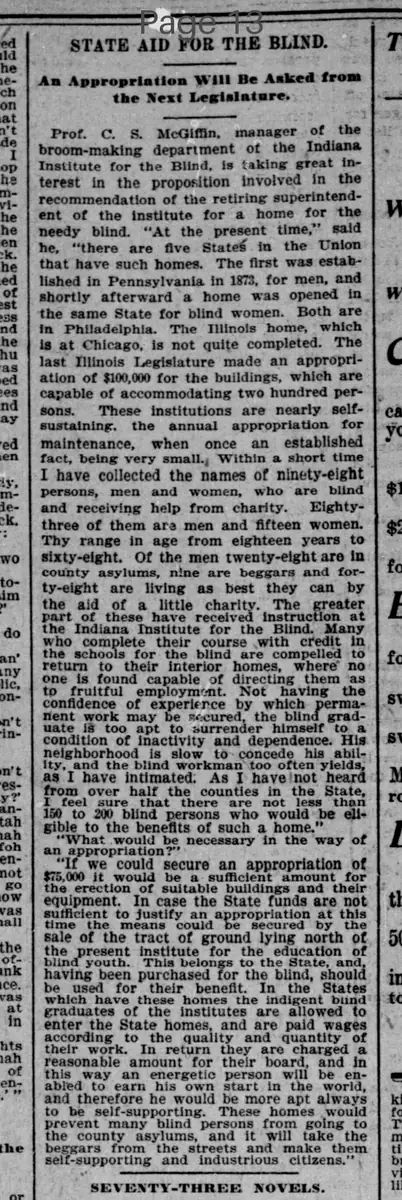
STATE AID FOR THE BLIND.
Appropriation Will Be Asked in the Next Legislature.
Prof. C. S. McGiffin, manager of the broom-making department of the Indiana Institute for the Blind, is taking great interest in the proposition involved in the recommendation of the retiring superintendent of the institute for a home for the needy blind. "At the present time," said he, there are five States in the Union that have such homes. The first was established in Pennsylvania in 1873, for men, and shortly afterward a home was opened in the same State for blind women. Both are in Philadelphia. The Illinois home, which is at Chicago, is not quite completed. The last Illinois Legislature made an appropriation of $100,000 for the buildings, which are capable of accommodating two hundred persons. These institutions are nearly self-sustaining. the annual appropriation for maintenance, when once an established fact, being very small. Within a short time I have collected the names of ninety-eight persons, men and women, who are blind and receiving help from charity. Eighty-three of them are men and fifteen women. They range in age from eighteen years to sixty-eight. Of the men twenty-eight are in county asylums, nine are beggars and forty-eight are living as best they can by the aid of a little charity. The greater part of these have received instruction at the Indiana Institute for the Blind. Many who complete their course with credit in the schools for the blind are compelled to return to their interior homes. where no one is found capable of directing them as to fruitful employment. Not having the confidence of experience by which permanent work may be secured, the blind graduate is too apt to surrender himself to a condition of inactivity and dependence. His neighborhood is slow to concede his ability, and the blind workman too often yields as I have intimated. As I have not heard from over half the counties in the State, I feel sure that there are not less than 150 to 200 blind persons who would be eligible to the benefits of such a home."
"What would be necessary in the way of an appropriation?
If we could secure an appropriation of $75,000 it would be a sufficient amount for the erection of suitable buildings and their equipment. In case the State funds are not sufficient to justify an appropriation at this time the means could be secured by the sale of the tract of ground lying north of the present institute for the education of blind youth. This belongs to the State, and, having been purchased for the blind, should be used for their benefit. In the States which have these homes the indigent blind graduates of the institutes are allowed to enter the State homes, and are paid wages according to the quality and quantity of their work. In return they are charged a reasonable amount for their board, and in this way an energetic person will be enabled to earn his own start in the world, and therefore he would be more apt always to be self-supporting. These homes would prevent many blind persons from going to the county asylums, and it will take the beggars from the streets and make them self-supporting and industrious citizens."
Appropriation Will Be Asked in the Next Legislature.
Prof. C. S. McGiffin, manager of the broom-making department of the Indiana Institute for the Blind, is taking great interest in the proposition involved in the recommendation of the retiring superintendent of the institute for a home for the needy blind. "At the present time," said he, there are five States in the Union that have such homes. The first was established in Pennsylvania in 1873, for men, and shortly afterward a home was opened in the same State for blind women. Both are in Philadelphia. The Illinois home, which is at Chicago, is not quite completed. The last Illinois Legislature made an appropriation of $100,000 for the buildings, which are capable of accommodating two hundred persons. These institutions are nearly self-sustaining. the annual appropriation for maintenance, when once an established fact, being very small. Within a short time I have collected the names of ninety-eight persons, men and women, who are blind and receiving help from charity. Eighty-three of them are men and fifteen women. They range in age from eighteen years to sixty-eight. Of the men twenty-eight are in county asylums, nine are beggars and forty-eight are living as best they can by the aid of a little charity. The greater part of these have received instruction at the Indiana Institute for the Blind. Many who complete their course with credit in the schools for the blind are compelled to return to their interior homes. where no one is found capable of directing them as to fruitful employment. Not having the confidence of experience by which permanent work may be secured, the blind graduate is too apt to surrender himself to a condition of inactivity and dependence. His neighborhood is slow to concede his ability, and the blind workman too often yields as I have intimated. As I have not heard from over half the counties in the State, I feel sure that there are not less than 150 to 200 blind persons who would be eligible to the benefits of such a home."
"What would be necessary in the way of an appropriation?
If we could secure an appropriation of $75,000 it would be a sufficient amount for the erection of suitable buildings and their equipment. In case the State funds are not sufficient to justify an appropriation at this time the means could be secured by the sale of the tract of ground lying north of the present institute for the education of blind youth. This belongs to the State, and, having been purchased for the blind, should be used for their benefit. In the States which have these homes the indigent blind graduates of the institutes are allowed to enter the State homes, and are paid wages according to the quality and quantity of their work. In return they are charged a reasonable amount for their board, and in this way an energetic person will be enabled to earn his own start in the world, and therefore he would be more apt always to be self-supporting. These homes would prevent many blind persons from going to the county asylums, and it will take the beggars from the streets and make them self-supporting and industrious citizens."
What sub-type of article is it?
Charity Or Relief
Politics
What keywords are associated?
Blind Home
State Appropriation
Indiana Blind
Charity For Blind
Self Supporting Blind
What entities or persons were involved?
Prof. C. S. Mcgiffin
Where did it happen?
Indiana
Domestic News Details
Primary Location
Indiana
Key Persons
Prof. C. S. Mcgiffin
Event Details
Prof. C. S. McGiffin, manager of the broom-making department of the Indiana Institute for the Blind, supports the recommendation for a home for the needy blind. He notes five states have such homes, provides statistics on 98 blind persons receiving charity in Indiana, and suggests an appropriation of $75,000 or sale of state land for funding. The homes would make blind graduates self-supporting.