Thank you for visiting SNEWPapers!
Sign up free
The New Hampshire Gazette
Portsmouth, Rockingham County, New Hampshire
What is this article about?
On December 18, 1801, Secretary of the Treasury Albert Gallatin submitted a report to the House of Representatives detailing the permanent revenues of the United States, including estimates for duties on merchandise, tonnage, internal duties, and projections for 1802-1809 averaging around 9.5 million dollars from external sources and 650,000 from internal.
Clipping
OCR Quality
Full Text
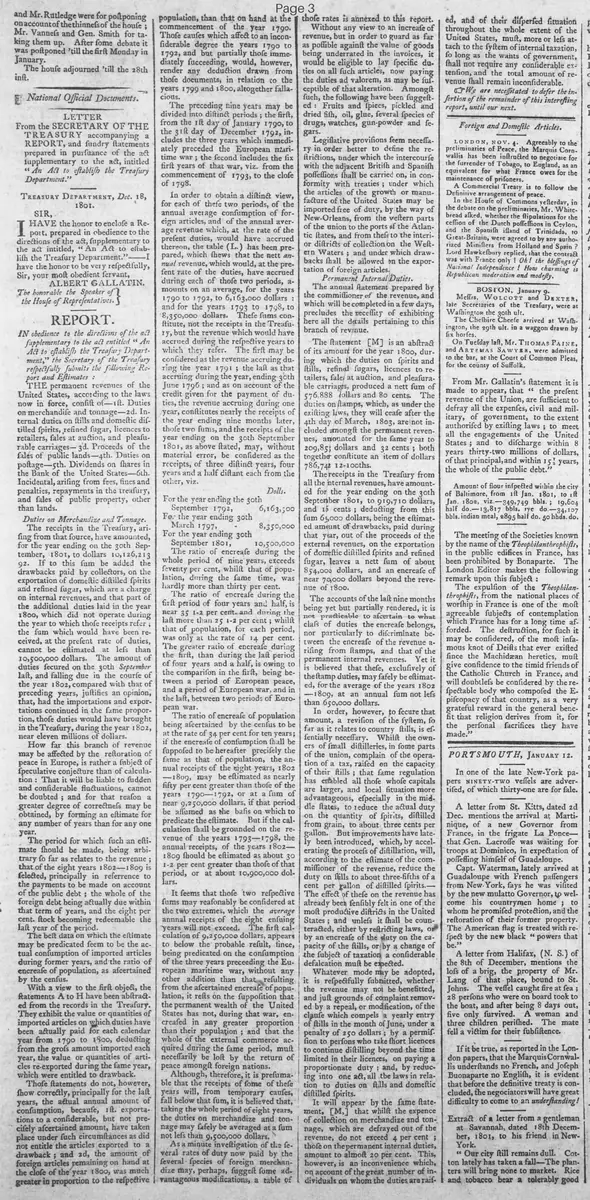
LETTER From the SECRETARY OF THE TREASURY accompanying a REPORT, and sundry Statements prepared in pursuance of the act supplementary to the act, intitled "An Act to establish the Treasury Department."
Treasury Department, Dec. 18, 1801.
SIR,
I have the honor to enclose a Report, prepared in obedience to the directions of the act, supplementary to the act intitled, "An Act to establish the Treasury Department."
I have the honor to be very respectfully, Sir, your most obedient servant,
ALBERT GALLATIN.
The honorable the Speaker of the House of Representatives.
REPORT.
IN obedience to the directions of the act supplementary to the act entitled "An Act to establish the Treasury Department," the Secretary of the Treasury respectfully submits the following Report and Estimates:
THE permanent revenues of the United States, according to the laws now in force, consist of--1st. Duties on merchandise and tonnage--2d. Internal duties on stills and domestic distilled spirits, refined sugar, licences to retailers, sales at auction, and pleasureable carriages--3d. Proceeds of the sales of public lands--4th. Duties on postage--5th. Dividends on shares in the Bank of the United States--6th. Incidental, arising from fees, fines and penalties, repayments in the treasury, and sales of public property, other than lands.
Duties on Merchandize and Tonnage.
The receipts in the Treasury, arising from that source, have amounted, for the year ending on the 30th September, 1801, to dollars 10,126,213 92. If to this sum be added the drawbacks paid by collectors, on the exportation of domestic distilled spirits and refined sugar, which are a charge on internal revenues, and that part of the additional duties laid in the year 1800, which did not operate during the year to which those receipts refer; the sum which would have been received, at the present rate of duties, cannot be estimated at less than 10,500,000 dollars. The amount of duties secured on the 30th September last, and falling due in the course of the year 1802, compared with that of preceding years, justifies an opinion, that, had the importations and exportations continued in the same proportion, those duties would have brought in the Treasury, during the year 1802, near eleven millions of dollars.
How far this branch of revenue may be affected by the restoration of peace in Europe, is rather a subject of speculative conjecture than of calculation: That it will be liable to sudden and considerable fluctuations, cannot be doubted: and for that reason a greater degree of correctness may be obtained, by forming an estimate for any number of years than for any one year.
The period for which such an estimate should be made, being arbitrary so far as relates to the revenue; that of the eight years 1802-1809 is selected, principally in reference to the payments to be made on account of the public debt; the whole of the foreign debt being actually due within that term of years, and the eight per cent. stock becoming redeemable the last year of the period.
The best data on which the estimate may be predicated seem to be the actual consumption of imported articles during former years, and the ratio of increase of population, as ascertained by the census.
With a view to the first object, the statements A to H have been abstracted from the records in the Treasury. They exhibit the value or quantities of imported articles on which duties have been actually paid for each calendar year from 1790 to 1800, deducting from the gross amount imported each year, the value or quantities of articles re-exported during the same year, which were entitled to drawback.
Those statements do not, however, show correctly, principally for the last years, the actual annual amount of consumption, because, 1st. exportations to a considerable, but not precisely ascertained amount, have taken place under such circumstances as did not entitle the articles exported to a drawback; and 2d, the amount of foreign articles remaining on hand at the close of the year 1800, was much greater in proportion to the respective population, than that on hand at the commencement of the year 1790.
Those causes which affect to an inconsiderable degree the years 1790 to 1792, and but partially those immediately succeeding, would, however, render any deduction drawn from those documents, in relation to the years 1799 and 1800, altogether fallacious.
The preceding nine years may be divided into distinct periods; the first, from the 1st day of January 1790, to the 31st day of December 1792, includes the three years which immediately preceded the European maritime war; the second includes the six first years of that war, viz. from the commencement of 1793, to the close of 1798.
In order to obtain a distinct view, for each of these two periods, of the annual average consumption of foreign articles, and of the annual average revenue which, at the rate of the present duties, would have accrued thereon, the table (L.) has been prepared, which shews that the nett annual revenue, which would, at the present rate of the duties, have accrued during each of those two periods, amounts on an average, for the years 1790 to 1792, to 6,163,000 dollars: and for the years 1793 to 1798, to 8,350,000 dollars. These sums constitute, not the receipts in the Treasury, but the revenue which would have accrued during the respective years to which they refer. The first may be considered as the revenue accruing during the year 1791; the last as that accruing during the year, ending 30th June 1796; and as on account of the credit given for the payment of duties, the revenue accruing during one year, constitutes nearly the receipts of the year ending nine months later, those two sums, and the receipts of the year ending on the 30th September 1801, as above stated, may, without material error, be considered as the receipts, of three distinct years, four years and a half distant each from the other, viz.
Dolls.
For the year ending the 30th September 1792, 6,163,500
For the year ending 30th March 1797, 8,350,000
For the year ending 30th September 1801, 10,500,000
The ratio of increase during the whole period of nine years, exceeds seventy per cent, whilst that of population, during the same time, was hardly more than thirty per cent.
The ratio of increase during the first period of four years and half, is near 35 1/2 per cent-and during the last more than 25 1/2 per cent; whilst that of population, for each period, was only at the rate of 14 per cent.
The greater ratio of increase during the first, than during the last period of four years and a half, is owing to the comparison in the first, being between a period of European peace, and a period of European war, and in the last, between two periods of European war.
The ratio of increase of population being ascertained by the census to be at the rate of 3 1/4 per cent for ten years; if the increase of consumption shall be supposed to be hereafter precisely the same as that of population, the annual receipts of the eight years, 1802-1809, may be estimated as nearly fifty per cent greater than those of the years 1790--1792, or at a sum of near 9,250,000 dollars, if that period be assumed as the basis on which to predicate the estimate. But if the calculation shall be grounded on the revenue of the years 1793-1798, the annual receipts, of the years 1802–1809 should be estimated as about 30 1/2 per cent greater than those of that period, or at about 10,900,000 dollars.
It seems that those two respective sums may reasonably be considered as the two extremes, which the average annual receipts of the eight ensuing years will not exceed. The first calculation of 9,250,000 dollars, appears to be below the probable result, since, being predicated on the consumption of the three years preceding the European maritime war, without any other addition than that resulting from the ascertained increase of population, it rests on the supposition that the permanent wealth of the United States has not, during that war, increased in any greater proportion than their population; and that the whole of the external commerce acquired during the same period, must necessarily be lost by the return of peace amongst foreign nations.
Although, therefore, it is presumable that the receipts of some of these years will, from temporary causes, fall below that sum, it is believed that, taking the whole period of eight years, the duties on merchandize and tonnage may safely be averaged at a sum not less than 9,500,000 dollars.
As a minute investigation of the several rates of duty now paid by the several species of foreign merchandize may, perhaps, suggest some advantageous modifications, a table of those rates is annexed to this report. Without any view to an increase of revenue, but in order to guard as far as possible against the value of goods being underrated in the invoices, it would be eligible to lay specific duties on all such articles, now paying the duties ad valorem, as may be susceptible of that alteration. Amongst such, the following have been suggested: Fruits and spices, pickled and dried fish, oil, glue, several species of drugs, watches, gun-powder and segars.
Legislative provisions seem necessary in order better to define the restrictions, under which the intercourse with the adjacent British and Spanish possessions shall be carried on, in conformity with treaties; under which the articles of the growth or manufacture of the United States may be imported free of duty, by the way of New-Orleans, from the western parts of the union to the ports of the Atlantic states, and from these to the interior districts of collection on the Western Waters; and under which drawbacks shall be allowed on the exportation of foreign articles.
Permanent Internal Duties.
The annual statement prepared by the commissioner of the revenue, and which will be completed in a few days, precludes the necessity of exhibiting here all the details pertaining to this branch of revenue.
The statement [M] is an abstract of its amount for the year 1800, during which the duties on spirits and stills, refined sugars, licences to retailers, sales at auction, and pleasurable carriages, produced a nett sum of 576,888 dollars and 80 cents. The duties on stamps, which, as under the existing laws, they will cease after the 4th day of March, 1803, are (not included amongst the permanent revenues,) amounted for the same year to 209,851 dollars and 32 cents; both together constitute an item of dollars 786,742 12-100ths.
The receipts in the Treasury from all the internal revenues, have amounted for the year ending on the 30th September 1801, to 919,710 dollars, and 15 cents; deducting from this sum 6,000 dollars, being the estimated amount of drawbacks, paid during that year, out of the proceeds of the external revenues, on the exportation of domestic distilled spirits and refined sugar, leaves a nett sum of about 854,000 dollars, and an increase of near 79,000 dollars beyond the revenue of 1800.
The accounts of the last nine months being yet but partially rendered, it is not practicable to ascertain to what class of duties the increase belongs, nor particularly to discriminate between the increase of the revenue arising from stamps, and that of the permanent internal revenues. Yet it is believed that these, exclusively of the stamp duties, may safely be estimated, for the average of the years 1802-1809, at an annual sum not less than 650,000 dollars.
In order, however, to secure that amount, a revision of the system, so far as it relates to country stills, is essentially necessary. Whilst the owners of small distilleries, in some parts of the union, complain of the operation of a tax, raised on the capacity of their stills; that same regulation has enabled all those whose capitals are larger, and local situation more advantageous, especially in the middle states, to reduce the actual duty on the quantity of spirits, distilled from grain, to about three cents per gallon. But improvements have lately been introduced, which, by accelerating the process of distillation, will, according to the estimate of the commissioner of the revenue, reduce the duty on stills to about three-fifths of a cent per gallon of distilled spirits.
The effect of these on the revenue has already been sensibly felt in one of the most productive districts in the United States; and unless it shall be counteracted, either by restrictive laws, or by an increase of the duty on the capacity of the stills, or by a change of the subject of taxation a considerable defalcation must be expected.
Whatever mode may be adopted, it is respectfully submitted, whether the revenue may not be benefitted, and just grounds of complaint removed by a repeal, or modification, of the clause which compels a yearly entry of stills in the month of June, under a penalty of 250 dollars; by a permission to persons who take short licences to continue distilling beyond the time limited in their licences, on paying a proportionate duty; and, by reducing into one act, all the laws in relation to duties on stills and domestic distilled spirits.
It will appear by the same statement, [M,] that whilst the expence of collection on merchandize and tonnage, which are defrayed out of the revenue, do not exceed 4 per cent; those on the permanent internal duties, amount to almost 20 per cent. This, however, is an inconvenience which, on account of the great number of individuals on whom the duties are raised, and of their dispersed situation throughout the whole extent of the United States, must, more or less attach to the system of internal taxation, so long as the wants of government, shall not require any considerable extension, and the total amount of revenue shall remain inconsiderable.
We are necessitated to defer the insertion of the remainder of this interesting report, until our next.
What sub-type of article is it?
What keywords are associated?
What entities or persons were involved?
Where did it happen?
Domestic News Details
Primary Location
United States
Event Date
Dec. 18, 1801
Key Persons
Outcome
estimated average annual receipts from duties on merchandise and tonnage for 1802-1809 at 9,500,000 dollars; permanent internal duties at 650,000 dollars; suggestions for legislative modifications to duties and trade restrictions.
Event Details
Secretary of the Treasury Albert Gallatin submitted a report detailing permanent U.S. revenues, including historical data on duties from 1790-1801, projections based on population growth and European peace impacts, and recommendations for revising internal duties on stills and trade provisions with British and Spanish possessions.