Thank you for visiting SNEWPapers!
Sign up free
The National Intelligencer And Washington Advertiser
Washington, District Of Columbia
What is this article about?
Continuation of General Washington's letters to Arthur Young discussing American taxation methods, agricultural practices including sheep farming, and challenges in husbandry. Includes Jefferson's estimates on farm capital employment and Young's comparisons of American vs. English land profits.
Merged-components note: Continuation of George Washington's letters to Arthur Young, including notes from Thomas Jefferson, serialized across pages 1-2 with sequential reading orders.
Clippings
1 of 2
OCR Quality
Full Text
(Continued.)
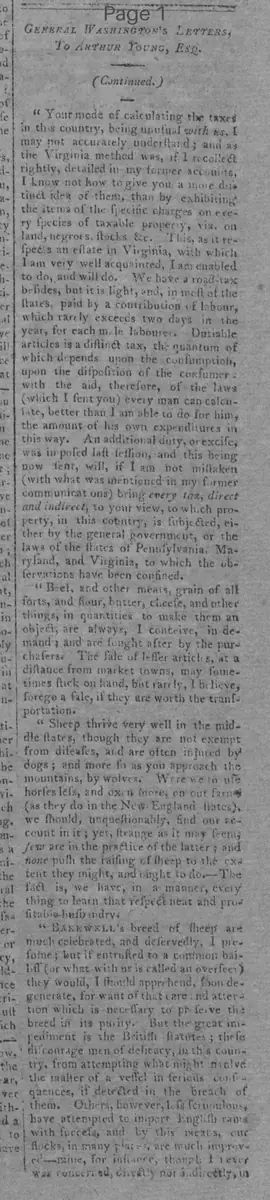
"Your mode of calculating the taxes in this country, being unusual with us, I may not accurately understand; and as the Virginia method was, if I recollect rightly, detailed in my former accounts, I know not how to give you a more distinct idea of them, than by exhibiting the items of the specific charges on every species of taxable property, viz. on land, negroes, stocks &c. This, as it respects an estate in Virginia, with which I am very well acquainted, I am enabled to do, and will do. We have a road-tax besides, but it is light, and, in most of the states, paid by a contribution of labour, which rarely exceeds two days in the year, for each male labourer. Duties on articles is a distinct tax, the quantum of which depends upon the consumption, upon the disposition of the consumer. With the aid, therefore, of the laws (which I sent you) every man can calculate, better than I am able to do for him, the amount of his own expenditures in this way. An additional duty, or excise, was imposed last session, and this being now sent, will, if I am not mistaken (with what was mentioned in my former communications) bring every tax, direct and indirect, to your view, to which property, in this country, is subjected, either by the general government, or the laws of the states of Pennsylvania, Maryland, and Virginia, to which the observations have been confined.
"Beef, and other meats, grain of all sorts, and flour, butter, cheese, and other things, in quantities to make them an object, are always, I conceive, in demand; and are sought after by the purchasers. The sale of larger articles, at a distance from market towns, may sometimes stick on hand, but rarely, I believe, forge a sale, if they are worth the transportation.
"Sheep thrive very well in the middle states, though they are not exempt from diseases, and are often injured by dogs; and more so as you approach the mountains, by wolves. Were we to use horses less, and oxen more, on our farms (as they do in the New England states), we should, unquestionably, find our account in it; yet, strange as it may seem; few are in the practice of the latter: and none push the raising of sheep to the extent they might, and ought to do.-- The fact is, we have, in a manner, every thing to learn that respects neat and profitable husbandry
"BAKEWELL's breed of sheep are much celebrated, and deservedly, I presume; but if entrusted to a common bailiff (or what with us is called an overseer) they would, I should apprehend, soon degenerate, for want of that care and attention which is necessary to preserve this breed in its purity. But the great impediment is the British statutes; these discourage men of delicacy, in this Country, from attempting what might involve the master of a vessel in serious consequences, if detected in the breach of them. Others, however, less scrupulous, have attempted to import English rams with success, and by this means, our flocks, in many places, are much improved--Commissary, for instance, though I never was concerned, directly nor indirectly, in the importation of one. further than by buying lambs which have descended from the in.
Our modes of system we have none are so different from yours, generally speaking, and our business being carried on so much within ourselves, so little by hiring, and still less by calculation, that I frankly confess to you, I am unable to solve your query respecting sheep-walks, or how many sheep an acre of woodland pasture would support. I shall have pleasure, at all times, as far as I possess the means, or can command them, to give you every information that can contribute to your own satisfaction, or that of a friend ; but I am so thoroughly persuaded of my inability to throw new lights upon any branch of husbandry, in a country where it is so well understood as in England, and that any thing I could write to you on that subject, would only serve to expose the defective practice of my countrymen, and be considered as the beacon of our ignorance, that I am rather disinclined to see any production of mine in a work where so much useful information is conveyed to the public, as is to be found in your Annals of Agriculture.
With very great esteem,
I am, Sir,
Your most obedient servant,
G. WASHINGTON.
[Subjoined to this letter, are several communications received by General Washington from respectable farmers in different parts of the United States replete with information, but which appears to have been, for the most part, intended to give information abroad. We shall confine our notice to the following remarks of Mr. Jefferson:]
Mr. Young calculates the employment of 3040l. worth of land, and 1200l. farmer's capital, making an aggregate capital of 4240l. in England, which he makes yield five per cent. extra, or ten per cent. upon the whole. I will calculate, in the Virginia way, the employment of the same capital, on a supposition of good management, in the manner of the country.
I. supposing negro labourers to be hired.
2. Supposing them to be bought.
1. Suppose labourers to be hired; one half men, at 18l.; the other half women, at 14l. for labour, subsistence, clothing (I always mean sterling money.)
four per cent. increase
of negroes, more than
keeping up original
number,
60 0 0
Real profit, over and above
the five per cent. above
charged,
£559 10 0
which is nine per cent. extra, or 14 per cent. on the whole capital.
In the preceding estimate, I have supposed that 200 bushels of wheat may be sold for every labourer employed, which may be thought too high. I know it is too high for common land, and common management; but I know also, that on good land, and with good management, it has been done, through a considerable neighbourhood, and for many years. On the other hand, I have over-rated the cost of labouring negroes, and I presume the taxes also are over-rated. I have observed, that our families of negroes double in about twenty-five years, which is an increase of the capital invested in them, of four per cent. over and above keeping up the original stock.
[Accompanying the letters are notes and remarks by Mr. Young, from which we elect the following encouraging comparison between the production and neat profit of American and English land :
We may thus compare England and America, supposing 300 acres bought and farmed by the purchaser:
ENGLAND.
L. s. d.
Produce of 300 acres, 15
: rents, at 12s. or 3l. : .-.. 900 .0 0
: . :D:duct :
Land-tax 3s. in the . s.d.
pound, "at a 4s. :
cess on 180l. 27 0,0
Rates 4s: 6d, " ".40 10 0
Tytl.e 4s. 6d.* : · 40 10.0
., •'On an average this would be too low ; and
if gathered, it would be good.
Roads,
Assessed taxes,
14.10
C.785 10
Deduct further :
Labour, "
Interest of soil,"
at 5 per cent.
252:
Int, 1200l.," for-
mer's capital
60
What sub-type of article is it?
What themes does it cover?
What keywords are associated?
What entities or persons were involved?
Literary Details
Title
General Washington's Letters To Arthur Young, Esq (Continued.)
Author
G. Washington
Subject
On American Taxes, Agriculture, And Sheep Farming
Form / Style
Letters With Economic Calculations
Key Lines