Thank you for visiting SNEWPapers!
Sign up free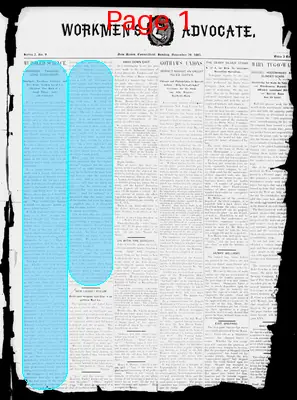
Editorial
November 29, 1885
Workmen's Advocate
New Haven, New Haven County, Connecticut
What is this article about?
This satirical editorial mocks economists' inconsistent explanations for economic crises, such as sun-spots, crop failures, taxation, currency, and free trade, while decrying wealth concentration in the industrial system and its resulting inequality.
Clipping
OCR Quality
95%
Excellent
Full Text
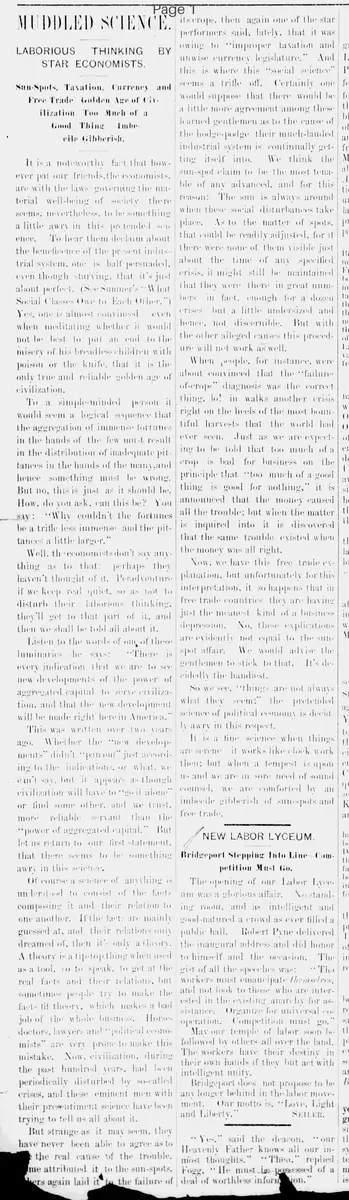
MUDDLED SCIENCE.
LABORIOUS THINKING BY STAR ECONOMISTS.
Sun-Spots, Taxation, Currency and Free Trade Delude Age of Civilization. Too Much of a Good Thing In the Balance. Imbecile Gibberish.
It is a noteworthy fact that however pat our friends, the economists, are with the laws governing the material well-being of society there seems, nevertheless, to be something a little awry in this pretended science. To hear them declaim about the beneficence of the present industrial system, one is half persuaded, even though starving, that it's just about perfect. (See Sumner's What Social Classes Owe to Each Other.)
Yes, one is almost convinced even when meditating whether it would not be best to put an end to the misery of his breadless children with poison or the knife, that it is the only true and reliable golden age of civilization.
To a simple-minded person it would seem a logical sequence that the aggregation of immense fortunes in the hands of the few must result in the distribution of inadequate pittances in the hands of the many, and hence something must be wrong.
But no, this is just as it should be. How, do you ask, can this be? You say: "Why couldn't the fortunes be a trifle less immense and the pittances a little larger."
Well, the economists don't say anything as to that; perhaps they haven't thought of it. Peradventure if we keep real quiet, so as not to disturb their laborious thinking they'll get to that part of it, and then we shall be told all about it.
Listen to the words of one of these luminaries. He says: "There is every indication that ye are to see new developments of the power of aggregated capital to serve civilization, and that the new development will be made right here in America."
This was written over two years ago. Whether the "new developments" didn't "pan out" just according to the indications, or what, we can't say, but it appears as though civilization will have to "go it alone" or find some other, and we trust, more reliable servant than the "power of aggregated capital." But let us return to our first statement, that there seems to be something awry in this science.
Of course a science of anything is understood to consist of the facts composing it and their relation to one another. If the facts are mainly guessed at, and their relations only dreamed of, then it's only a theory.
A theory is a tip-top thing when used as a tool, so to speak, to get at the real facts and their relations, but sometimes people try to make the facts fit the theory, which makes a bad job of the whole business. Horse-doctors, lawyers and "political economists" are very prone to make this mistake. Now, civilization, during the past hundred years, has been periodically disturbed by so-called crises, and these eminent men with their pretentious science have been trying to tell us all about it.
But strange as it may seem, they have never been able to agree as to the real cause of the trouble. One attributed it to the sun-spots. Others again laid it to the failure of its crops, then again one of the star performers said, lately, that it was owing to "improper taxation and unwise currency legislation." And this is where this "social science" seems a trifle off. Certainly one would suppose that there would be a little more agreement among these learned gentlemen as to the cause of the hodge-podge their much-lauded industrial system is continually getting itself into. We think the sun-spot claim to be the most tenable of any advanced, and for this reason: The sun is always around when these social disturbances take place. As to the matter of spots, that could be readily adjusted, for if there were none of them visible just about the time of any specified crisis, it might still be maintained that they were there in great numbers in fact, enough for a dozen crises but a little undersized and hence, not discernible. But with the other alleged causes this procedure will not work as well.
When people, for instance, were about convinced that the "failure-of-crops" diagnosis was the correct thing, lo! in walks another crisis right on the heels of the most bountiful harvests that the world had ever seen. Just as we are expecting to be told that too much of a crop is bad for business on the principle that "too much of a good thing is good for nothing," it is announced that the money caused all the trouble: but when the matter is inquired into it is discovered that the same trouble existed when the money was all right.
Now, we have this free trade explanation, but unfortunately for this interpretation, it so happens that in free trade countries they are having just the meanest kind of a business depression. No, these explanations are evidently not equal to the sun spot affair. We would advise the gentlemen to stick to that. It's decidedly the handiest.
So we see, "things are not always what they seem;" the pretended science of political economy is decidedly awry in this respect.
It is a fine science when things are serene it works like clock work then; but when a tempest is upon us and we are in sore need of sound counsel, we are comforted by an imbecile gibberish of sun-spots and free trade.
LABORIOUS THINKING BY STAR ECONOMISTS.
Sun-Spots, Taxation, Currency and Free Trade Delude Age of Civilization. Too Much of a Good Thing In the Balance. Imbecile Gibberish.
It is a noteworthy fact that however pat our friends, the economists, are with the laws governing the material well-being of society there seems, nevertheless, to be something a little awry in this pretended science. To hear them declaim about the beneficence of the present industrial system, one is half persuaded, even though starving, that it's just about perfect. (See Sumner's What Social Classes Owe to Each Other.)
Yes, one is almost convinced even when meditating whether it would not be best to put an end to the misery of his breadless children with poison or the knife, that it is the only true and reliable golden age of civilization.
To a simple-minded person it would seem a logical sequence that the aggregation of immense fortunes in the hands of the few must result in the distribution of inadequate pittances in the hands of the many, and hence something must be wrong.
But no, this is just as it should be. How, do you ask, can this be? You say: "Why couldn't the fortunes be a trifle less immense and the pittances a little larger."
Well, the economists don't say anything as to that; perhaps they haven't thought of it. Peradventure if we keep real quiet, so as not to disturb their laborious thinking they'll get to that part of it, and then we shall be told all about it.
Listen to the words of one of these luminaries. He says: "There is every indication that ye are to see new developments of the power of aggregated capital to serve civilization, and that the new development will be made right here in America."
This was written over two years ago. Whether the "new developments" didn't "pan out" just according to the indications, or what, we can't say, but it appears as though civilization will have to "go it alone" or find some other, and we trust, more reliable servant than the "power of aggregated capital." But let us return to our first statement, that there seems to be something awry in this science.
Of course a science of anything is understood to consist of the facts composing it and their relation to one another. If the facts are mainly guessed at, and their relations only dreamed of, then it's only a theory.
A theory is a tip-top thing when used as a tool, so to speak, to get at the real facts and their relations, but sometimes people try to make the facts fit the theory, which makes a bad job of the whole business. Horse-doctors, lawyers and "political economists" are very prone to make this mistake. Now, civilization, during the past hundred years, has been periodically disturbed by so-called crises, and these eminent men with their pretentious science have been trying to tell us all about it.
But strange as it may seem, they have never been able to agree as to the real cause of the trouble. One attributed it to the sun-spots. Others again laid it to the failure of its crops, then again one of the star performers said, lately, that it was owing to "improper taxation and unwise currency legislation." And this is where this "social science" seems a trifle off. Certainly one would suppose that there would be a little more agreement among these learned gentlemen as to the cause of the hodge-podge their much-lauded industrial system is continually getting itself into. We think the sun-spot claim to be the most tenable of any advanced, and for this reason: The sun is always around when these social disturbances take place. As to the matter of spots, that could be readily adjusted, for if there were none of them visible just about the time of any specified crisis, it might still be maintained that they were there in great numbers in fact, enough for a dozen crises but a little undersized and hence, not discernible. But with the other alleged causes this procedure will not work as well.
When people, for instance, were about convinced that the "failure-of-crops" diagnosis was the correct thing, lo! in walks another crisis right on the heels of the most bountiful harvests that the world had ever seen. Just as we are expecting to be told that too much of a crop is bad for business on the principle that "too much of a good thing is good for nothing," it is announced that the money caused all the trouble: but when the matter is inquired into it is discovered that the same trouble existed when the money was all right.
Now, we have this free trade explanation, but unfortunately for this interpretation, it so happens that in free trade countries they are having just the meanest kind of a business depression. No, these explanations are evidently not equal to the sun spot affair. We would advise the gentlemen to stick to that. It's decidedly the handiest.
So we see, "things are not always what they seem;" the pretended science of political economy is decidedly awry in this respect.
It is a fine science when things are serene it works like clock work then; but when a tempest is upon us and we are in sore need of sound counsel, we are comforted by an imbecile gibberish of sun-spots and free trade.
What sub-type of article is it?
Satire
Economic Policy
What keywords are associated?
Political Economy
Economic Crises
Sun Spots
Free Trade
Aggregated Capital
Industrial System
Wealth Inequality
What entities or persons were involved?
Economists
Sumner
Editorial Details
Primary Topic
Critique Of Political Economy And Explanations For Economic Crises
Stance / Tone
Satirical Mockery Of Economists
Key Figures
Economists
Sumner
Key Arguments
Aggregation Of Immense Fortunes Leads To Inadequate Distribution For The Many
Economists Praise The Industrial System Despite Evident Misery
Explanations For Crises Vary And Disagree: Sun Spots, Crop Failures, Improper Taxation, Unwise Currency Legislation, Free Trade
Sun Spot Theory Is Sarcastically Deemed Most Tenable Due To The Sun's Constant Presence
Free Trade Fails As Explanation Since Depressions Occur In Free Trade Countries