Thank you for visiting SNEWPapers!
Sign up free
Letter to Editor
December 19, 1794
Gazette Of The United States And Daily Evening Advertiser
Philadelphia, Philadelphia County, Pennsylvania
What is this article about?
A letter critiquing the anti-federalist campaign from 1793, linking it to the Whiskey Rebellion in western Pennsylvania. It praises congressional support for order, laments delayed local opposition, and questions southern commitment to republican principles amid slavery.
Clipping
OCR Quality
98%
Excellent
Full Text
For the Gazette of the United States.
MR. FENNO,
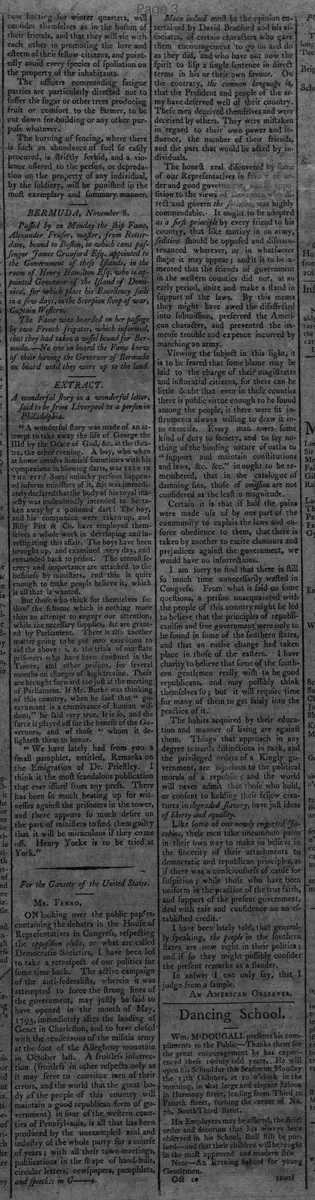
ON looking over the public papers, containing the debates in the House of Representatives in Congress, respecting the opposition clubs, or what are called Democratic Societies, I have been led to take a retrospect of our politics for some time back. The active campaign of the anti-federalists, wherein it was attempted to force the strong lines of the government, may justly be said to have opened in the month of May, 1793, immediately after the landing of Genet in Charleston, and to have closed with the rendezvous of the militia army at the foot of the Allegheny mountain in October last. A fruitless insurrection (fruitless in other respects only as it may serve to convince men of their errors, and the world that the great body of the people of this country will maintain a good republican form of government) in four of the western counties of Pennsylvania, is all that has been produced by the unexampled zeal and industry of the whole party for a course of years; with all their town-meetings, publications in the shape of hand-bills, circular letters, newspapers, pamphlets, and speeches in C-g.
Mean indeed must be the opinion entertained by David Bradford and his associates, of certain characters who gave them encouragement to go on and do as they did, and who have not now the spirit to slip a single sentence in direct terms in his or their own favour. On the contrary, the common language is, that the President and people of the army have deserved well of their country. These men deceived themselves and were deceived by others. They were mistaken in regard to their own power and influence, the number of their friends, and the part that would be acted by individuals.
The honest zeal discovered by some of our Representatives in favour of order and good government, as a opposition to the views of those men who direct and govern the societies, was highly commendable. It ought to be adopted as a first principle by every friend to his country, that like mutiny in an army, sedition should be opposed and discountenanced wherever, or in whatsoever shape it may appear; and it is to be lamented that the friends of government in the western counties did not, at an early period, unite and make a stand in support of the laws. By this means they might have awed the disaffected into submission, preserved the American character, and prevented the immense trouble and expense incurred by marching an army.
Viewing the subject in this light, it is to be feared that some blame may be laid to the charge of their magistrates and influential citizens, for there can be little doubt that even in these counties there is public virtue enough to be found among the people, if there were fit instruments always willing to draw it into exercise. Every man owes some kind of duty to society, and to say nothing of the binding nature of oaths to support and maintain constitutions and laws, &c. &c." it ought to be remembered, that in the catalogue of damning sins, those of omission are not considered as the least in magnitude.
Certain it is that if half the pains were made use of by one part of the community to explain the laws and enforce obedience to them, that there is taken by another to excite clamours and prejudices against the government, we would have no insurrections.
I am sorry to find that there is still so much time unnecessarily wasted in Congress. From what is said on some questions, a person unacquainted with the people of this country might be led to believe that the principles of republicanism and free government were only to be found in some of the southern states, and that an entire change had taken place in those of the eastern. I have charity to believe that some of the southern gentlemen really wish to be good republicans, and may possibly think themselves so; but it will require time for many of them to get fairly into the practice of it.
The habits acquired by their education and manner of living are against them. Things that approach in any degree towards distinctions in rank, and the privileged orders of a Kingly government, are injurious to the political morals of a republic; and the world will never admit that those who hold, or consent to holding their fellow creatures in degraded slavery, have just ideas of liberty and equality.
Like some of our newly imported Jacobins, these men take uncommon pains in their own way to make us believe in the sincerity of their attachments to democratic and republican principles, as if there was a consciousness of cause for suspicion; while those who have been uniform in the practice of the true faith, and support of the present government, deal with ease and confidence on an established credit.
I have been lately told, that generally speaking, the people in the southern states are now right in their politics; and if so they might possibly consider the present remarks as a slander. In answer I can only say, that I judge from a sample.
An American Observer.
MR. FENNO,
ON looking over the public papers, containing the debates in the House of Representatives in Congress, respecting the opposition clubs, or what are called Democratic Societies, I have been led to take a retrospect of our politics for some time back. The active campaign of the anti-federalists, wherein it was attempted to force the strong lines of the government, may justly be said to have opened in the month of May, 1793, immediately after the landing of Genet in Charleston, and to have closed with the rendezvous of the militia army at the foot of the Allegheny mountain in October last. A fruitless insurrection (fruitless in other respects only as it may serve to convince men of their errors, and the world that the great body of the people of this country will maintain a good republican form of government) in four of the western counties of Pennsylvania, is all that has been produced by the unexampled zeal and industry of the whole party for a course of years; with all their town-meetings, publications in the shape of hand-bills, circular letters, newspapers, pamphlets, and speeches in C-g.
Mean indeed must be the opinion entertained by David Bradford and his associates, of certain characters who gave them encouragement to go on and do as they did, and who have not now the spirit to slip a single sentence in direct terms in his or their own favour. On the contrary, the common language is, that the President and people of the army have deserved well of their country. These men deceived themselves and were deceived by others. They were mistaken in regard to their own power and influence, the number of their friends, and the part that would be acted by individuals.
The honest zeal discovered by some of our Representatives in favour of order and good government, as a opposition to the views of those men who direct and govern the societies, was highly commendable. It ought to be adopted as a first principle by every friend to his country, that like mutiny in an army, sedition should be opposed and discountenanced wherever, or in whatsoever shape it may appear; and it is to be lamented that the friends of government in the western counties did not, at an early period, unite and make a stand in support of the laws. By this means they might have awed the disaffected into submission, preserved the American character, and prevented the immense trouble and expense incurred by marching an army.
Viewing the subject in this light, it is to be feared that some blame may be laid to the charge of their magistrates and influential citizens, for there can be little doubt that even in these counties there is public virtue enough to be found among the people, if there were fit instruments always willing to draw it into exercise. Every man owes some kind of duty to society, and to say nothing of the binding nature of oaths to support and maintain constitutions and laws, &c. &c." it ought to be remembered, that in the catalogue of damning sins, those of omission are not considered as the least in magnitude.
Certain it is that if half the pains were made use of by one part of the community to explain the laws and enforce obedience to them, that there is taken by another to excite clamours and prejudices against the government, we would have no insurrections.
I am sorry to find that there is still so much time unnecessarily wasted in Congress. From what is said on some questions, a person unacquainted with the people of this country might be led to believe that the principles of republicanism and free government were only to be found in some of the southern states, and that an entire change had taken place in those of the eastern. I have charity to believe that some of the southern gentlemen really wish to be good republicans, and may possibly think themselves so; but it will require time for many of them to get fairly into the practice of it.
The habits acquired by their education and manner of living are against them. Things that approach in any degree towards distinctions in rank, and the privileged orders of a Kingly government, are injurious to the political morals of a republic; and the world will never admit that those who hold, or consent to holding their fellow creatures in degraded slavery, have just ideas of liberty and equality.
Like some of our newly imported Jacobins, these men take uncommon pains in their own way to make us believe in the sincerity of their attachments to democratic and republican principles, as if there was a consciousness of cause for suspicion; while those who have been uniform in the practice of the true faith, and support of the present government, deal with ease and confidence on an established credit.
I have been lately told, that generally speaking, the people in the southern states are now right in their politics; and if so they might possibly consider the present remarks as a slander. In answer I can only say, that I judge from a sample.
An American Observer.
What sub-type of article is it?
Political
Persuasive
Reflective
What themes does it cover?
Politics
Morality
Slavery Abolition
What keywords are associated?
Whiskey Rebellion
Anti Federalists
Democratic Societies
Republicanism
Southern Politics
Slavery
Sedition
Genet
What entities or persons were involved?
An American Observer
Mr. Fenno
Letter to Editor Details
Author
An American Observer
Recipient
Mr. Fenno
Main Argument
the anti-federalist campaign against the government, culminating in the fruitless whiskey rebellion, failed due to misjudged support; local leaders should have opposed sedition earlier to prevent it, and southern claims to republicanism are undermined by slavery.
Notable Details
References Genet's Landing In May 1793
Mentions David Bradford And Associates
Critiques Democratic Societies And Town Meetings
Laments Congressional Time Wasting
Contrasts Eastern And Southern States On Republican Principles