Thank you for visiting SNEWPapers!
Sign up free
The Daily Madisonian
Washington, District Of Columbia
What is this article about?
Editorial in the Natchitoches Free Trader defends President John Tyler against Federalist criticism for a letter criticizing the Clay Whig faction in Congress, which has attacked him for adhering to Republican principles, refusing a national bank, and vetoing measures, leading to threats of impeachment and government shutdown.
Clipping
OCR Quality
Full Text
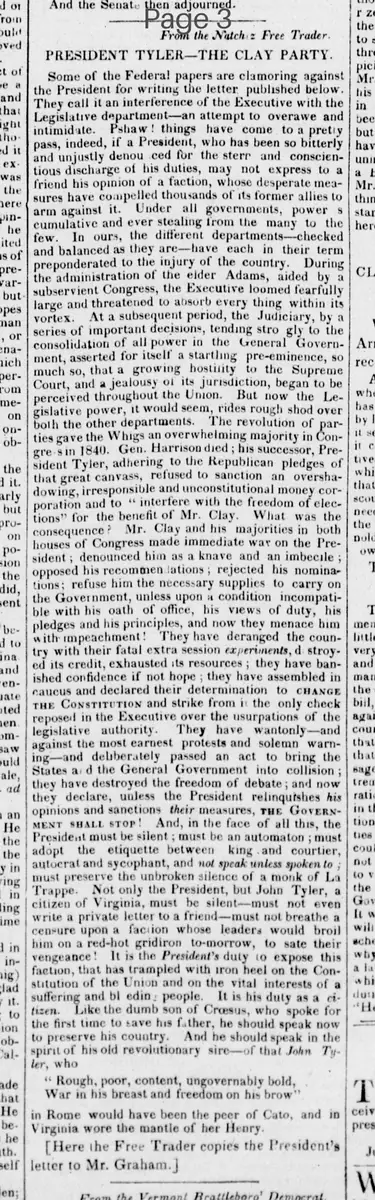
PRESIDENT TYLER—THE CLAY PARTY
Some of the Federal papers are clamoring against the President for writing the letter published below. They call it an interference of the Executive with the Legislative department—an attempt to overawe and intimidate. Pshaw! things have come to a pretty pass, indeed, if a President, who has been so bitterly and unjustly denounced for the stern and conscientious discharge of his duties, may not express to a friend his opinion of a faction, whose desperate measures have compelled thousands of its former allies to arm against it. Under all governments, power is cumulative and ever stealing from the many to the few. In ours, the different departments—checked and balanced as they are—have each in their term preponderated to the injury of the country. During the administration of the elder Adams, aided by a subservient Congress, the Executive loomed fearfully large and threatened to absorb everything within its vortex. At a subsequent period, the Judiciary, by a series of important decisions, tending strongly to the consolidation of all power in the General Government, asserted for itself a startling pre-eminence, so much so, that a growing hostility to the Supreme Court, and a jealousy of its jurisdiction, began to be perceived throughout the Union. But now the Legislative power, it would seem, rides rough shod over both the other departments. The revolution of parties gave the Whigs an overwhelming majority in Congress in 1840. Gen. Harrison died; his successor, President Tyler, adhering to the Republican pledges of that great canvass, refused to sanction an overshadowing, irresponsible and unconstitutional money corporation and to "interfere with the freedom of elections" for the benefit of Mr. Clay. What was the consequence? Mr. Clay and his majorities in both houses of Congress made immediate war on the President; denounced him as a knave and an imbecile; rejected his nominations; refused him the necessary supplies to carry on the Government, unless upon a condition incompatible with his oath of office, his views of duty, his pledges and his principles, and now they menace him with impeachment! They have deranged the country with their fatal extra session experiments, destroyed its credit, exhausted its resources; they have banished confidence if not hope; they have assembled in caucus and declared their determination to change The Constitution and strike from it the only check reposed in the Executive over the usurpations of the legislative authority. They have wantonly—and against the most earnest protests and solemn warning—and deliberately passed an act to bring the States and the General Government into collision; they have destroyed the freedom of debate; and now they declare, unless the President relinquishes his opinions and sanctions their measures, THE GOVERNMENT SHALL STOP! And, in the face of all this, the President must be silent; must be an automaton; must adopt the etiquette between king and courtier, autocrat and sycophant, and not speak unless spoken to; must preserve the unbroken silence of a monk of La Trappe. Not only the President, but John Tyler, a citizen of Virginia, must be silent—must not even write a private letter to a friend—must not breathe a censure upon a faction whose leaders would broil him on a red-hot gridiron to-morrow, to sate their vengeance! It is the President's duty to expose this faction, that has trampled with iron heel on the Constitution of the Union and on the vital interests of a suffering and bleeding people. It is his duty as a citizen. Like the dumb son of Croesus, who spoke for the first time to save his father, he should speak now to preserve his country. And he should speak in the spirit of his old revolutionary sire—of that John Tyler, who
"Rough, poor, content, ungovernably bold,
War in his breast and freedom on his brow
in Rome would have been the peer of Cato, and in
Virginia wore the mantle of her Henry"
Here the Free Trader copies the President's letter to Mr. Graham.
What sub-type of article is it?
What themes does it cover?
What keywords are associated?
What entities or persons were involved?
Where did it happen?
Story Details
Key Persons
Location
United States
Event Date
1840 1842
Story Details
The editorial defends President Tyler's right to criticize the Clay Whig faction in Congress, which has attacked him for refusing to support a national bank and other measures, leading to denunciations, rejected nominations, threats of impeachment, and attempts to undermine the executive branch.