Thank you for visiting SNEWPapers!
Sign up free
Editorial
August 26, 1953
The Northwest Times
Seattle, King County, Washington
What is this article about?
George Nishimura, a Nisei, describes life in postwar Japan: economic hardships but social belonging, English skills aiding jobs, vibrant entertainment, and reasons many return to Canada despite positives. Recommends short visits for stimulation.
Clipping
OCR Quality
100%
Excellent
Full Text
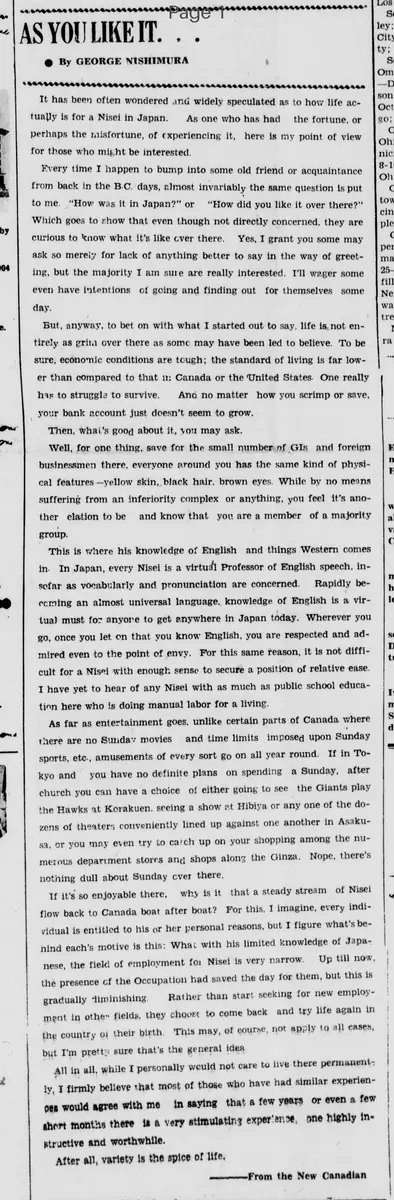
AS YOU LIKE IT.
• By GEORGE NISHIMURA
It has been often wondered and widely speculated as to how life actually is for a Nisei in Japan.
As one who has had the fortune, or perhaps the misfortune, of experiencing it, here is my point of view for those who might be interested.
Every time I happen to bump into some old friend or acquaintance from back in the B.C. days, almost invariably the same question is put to me. "How was it in Japan?" or "How did you like it over there?"
Which goes to show that even though not directly concerned, they are curious to know what it's like over there. Yes, I grant you some may ask so merely for lack of anything better to say in the way of greeting, but the majority I am sure are really interested. I'll wager some even have intentions of going and finding out for themselves some day.
But, anyway, to begin with what I started out to say, life is not entirely as grim over there as some may have been led to believe. To be sure, economic conditions are tough; the standard of living is far lower than compared to that in Canada or the United States. One really has to struggle to survive.
And no matter how you scrimp or save, your bank account just doesn't seem to grow.
Then, what's good about it, you may ask.
Well, for one thing, save for the small number of GIs and foreign businessmen there, everyone around you has the same kind of physical features - yellow skin, black hair, brown eyes. While by no means suffering from an inferiority complex or anything, you feel it's another elation to be and know that you are a member of a majority group.
This is where his knowledge of English and things Western comes in. In Japan, every Nisei is a virtual Professor of English speech, insofar as vocabulary and pronunciation are concerned.
Rapidly becoming an almost universal language, knowledge of English is a virtual must for anyone to get anywhere in Japan today. Wherever you go, once you let on that you know English, you are respected and admired even to the point of envy. For this same reason, it is not difficult for a Nisei with enough sense to secure a position of relative ease.
I have yet to hear of any Nisei with as much as public school education here who is doing manual labor for a living.
As far as entertainment goes, unlike certain parts of Canada where there are no Sunday movies and time limits imposed upon Sunday sports, etc., amusements of every sort go on all year round. If in Tokyo and you have no definite plans on spending a Sunday, after church you can have a choice of either going to see the Giants play the Hawks at Korakuen, seeing a show at Hibiya or any one of the dozens of theaters conveniently lined up against one another in Asakusa, or you may even try to catch up on your shopping among the numerous department stores and shops along the Ginza. Nope, there's nothing dull about Sunday over there.
If it's so enjoyable there, why is it that a steady stream of Nisei flow back to Canada boat after boat? For this, I imagine, every individual is entitled to his or her personal reasons, but I figure what's behind each's motive is this: What with his limited knowledge of Japanese, the field of employment for Nisei is very narrow.
Up till now the presence of the Occupation had saved the day for them, but this is gradually diminishing.
Rather than start seeking for new employment in other fields, they choose to come back and try life again in the country of their birth. This may, of course, not apply to all cases, but I'm pretty sure that's the general idea.
All in all, while I personally would not care to live there permanently, I firmly believe that most of those who have had similar experiences would agree with me in saying that a few years or even a few short months there is a very stimulating experience, one highly instructive and worthwhile.
After all, variety is the spice of life.
From the New Canadian
• By GEORGE NISHIMURA
It has been often wondered and widely speculated as to how life actually is for a Nisei in Japan.
As one who has had the fortune, or perhaps the misfortune, of experiencing it, here is my point of view for those who might be interested.
Every time I happen to bump into some old friend or acquaintance from back in the B.C. days, almost invariably the same question is put to me. "How was it in Japan?" or "How did you like it over there?"
Which goes to show that even though not directly concerned, they are curious to know what it's like over there. Yes, I grant you some may ask so merely for lack of anything better to say in the way of greeting, but the majority I am sure are really interested. I'll wager some even have intentions of going and finding out for themselves some day.
But, anyway, to begin with what I started out to say, life is not entirely as grim over there as some may have been led to believe. To be sure, economic conditions are tough; the standard of living is far lower than compared to that in Canada or the United States. One really has to struggle to survive.
And no matter how you scrimp or save, your bank account just doesn't seem to grow.
Then, what's good about it, you may ask.
Well, for one thing, save for the small number of GIs and foreign businessmen there, everyone around you has the same kind of physical features - yellow skin, black hair, brown eyes. While by no means suffering from an inferiority complex or anything, you feel it's another elation to be and know that you are a member of a majority group.
This is where his knowledge of English and things Western comes in. In Japan, every Nisei is a virtual Professor of English speech, insofar as vocabulary and pronunciation are concerned.
Rapidly becoming an almost universal language, knowledge of English is a virtual must for anyone to get anywhere in Japan today. Wherever you go, once you let on that you know English, you are respected and admired even to the point of envy. For this same reason, it is not difficult for a Nisei with enough sense to secure a position of relative ease.
I have yet to hear of any Nisei with as much as public school education here who is doing manual labor for a living.
As far as entertainment goes, unlike certain parts of Canada where there are no Sunday movies and time limits imposed upon Sunday sports, etc., amusements of every sort go on all year round. If in Tokyo and you have no definite plans on spending a Sunday, after church you can have a choice of either going to see the Giants play the Hawks at Korakuen, seeing a show at Hibiya or any one of the dozens of theaters conveniently lined up against one another in Asakusa, or you may even try to catch up on your shopping among the numerous department stores and shops along the Ginza. Nope, there's nothing dull about Sunday over there.
If it's so enjoyable there, why is it that a steady stream of Nisei flow back to Canada boat after boat? For this, I imagine, every individual is entitled to his or her personal reasons, but I figure what's behind each's motive is this: What with his limited knowledge of Japanese, the field of employment for Nisei is very narrow.
Up till now the presence of the Occupation had saved the day for them, but this is gradually diminishing.
Rather than start seeking for new employment in other fields, they choose to come back and try life again in the country of their birth. This may, of course, not apply to all cases, but I'm pretty sure that's the general idea.
All in all, while I personally would not care to live there permanently, I firmly believe that most of those who have had similar experiences would agree with me in saying that a few years or even a few short months there is a very stimulating experience, one highly instructive and worthwhile.
After all, variety is the spice of life.
From the New Canadian
What sub-type of article is it?
Nisei Experiences
Postwar Japan
What keywords are associated?
Nisei
Japan
Life
Economic Conditions
English Knowledge
Employment
Entertainment
Return To Canada
What entities or persons were involved?
Nisei
Japan
Canada
Occupation
Editorial Details
Primary Topic
Personal Experiences Of A Nisei In Japan
Stance / Tone
Balanced View Highlighting Positives Despite Challenges
Key Figures
Nisei
Japan
Canada
Occupation
Key Arguments
Economic Conditions Are Tough With Low Standard Of Living
Social Elation From Being In Majority Group With Similar Physical Features
Knowledge Of English Provides Respect And Employment Advantages
No Nisei With Public School Education Does Manual Labor
Entertainment Available Year Round Including Sundays
Limited Japanese Knowledge Narrows Employment Fields As Occupation Diminishes
Many Return To Canada Due To Employment Limitations
Short Stay In Japan Is Stimulating And Worthwhile