Thank you for visiting SNEWPapers!
Sign up free
The Hillsborough Recorder
Hillsboro, Orange County, North Carolina
What is this article about?
Detailed report of U.S. House of Representatives proceedings from December 7-13, 1820, focusing on debates over Missouri's admission to the Union, which was ultimately rejected (79-93). Includes other resolutions on government expenses, navy discipline, tariffs, military inquiries, and treasury reports.
Merged-components note: These components form a continuous report on U.S. Congress proceedings regarding the Missouri admission debate, spanning pages 1 and 2 in sequential reading order.
Clippings
1 of 2
OCR Quality
Full Text
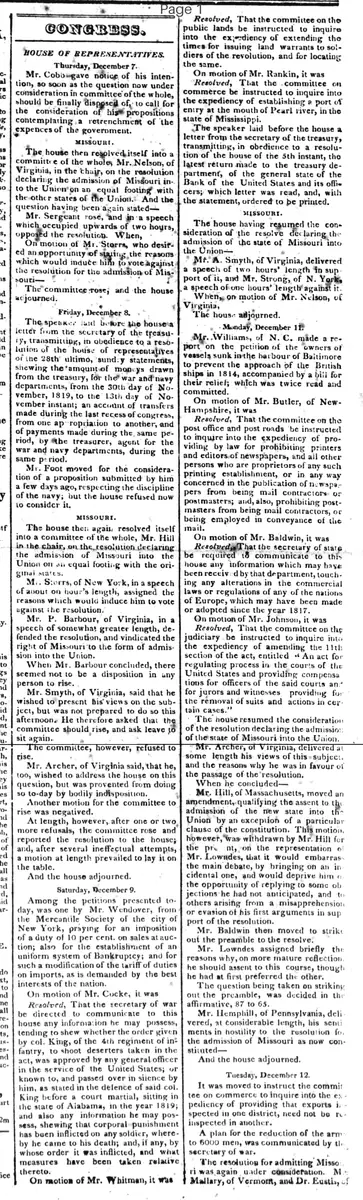
HOUSE OF REPRESENTATIVES.
Thursday, December 7.
Mr. Cobb gave notice of his intention, so soon as the question now under consideration in committee of the whole should be finally disposed of, to call for the consideration of his propositions contemplating a retrenchment of the expenses of the government.
MISSOURI.
The house then resolved itself into a committee of the whole, Mr. Nelson, of Virginia, in the chair, on the resolution declaring the admission of Missouri into the Union on an equal footing with the other states of the Union. And the question having been again stated Mr. Sergeant rose, and in a speech which occupied upwards of two hours, opposed the resolution. When, On motion of Mr. Storrs, who desired an opportunity of stating the reasons which would induce him to vote against the resolution for the admission of Missouri The committee rose; and the house adjourned.
Friday, December 8.
The speaker laid before the house a letter from the secretary of the treasury, transmitting, in obedience to a resolution of the house of representatives of the 28th ultimo, sundry statements, shewing the amount of moneys drawn from the treasury, for the war and navy departments, from the 30th day of November, 1819, to the 13th day of November instant; an account of transfers made during the last recess of congress, from one appropriation to another, and of payments made during the same period, by the treasurer, agent for the war and navy departments, during the same period.
Mr. Foot moved for the consideration of a proposition submitted by him a few days ago, respecting the discipline of the navy; but the house refused now to consider it.
MISSOURI.
The house then again resolved itself into a committee of the whole, Mr. Hill in the chair, on the resolution declaring the admission of Missouri into the Union on an equal footing with the original states.
Mr. Storrs, of New York, in a speech of about two hours' length, assigned the reasons which would induce him to vote against the resolution.
Mr. P. Barbour, of Virginia, in a speech of somewhat greater length, defended the resolution, and vindicated the right of Missouri to the form of admission into the Union.
When Mr. Barbour concluded, there seemed not to be a disposition in any person to rise.
Mr. Smyth, of Virginia, said that he wished to present his views on the subject, but was not prepared to do so this afternoon. He therefore asked that the committee should rise, and ask leave to sit again.
The committee, however, refused to rise.
Mr. Archer, of Virginia said, that he, too, wished to address the house on this question, but was prevented from doing so to-day by bodily indisposition.
Another motion for the committee to rise was negatived.
At length, however, after one or two more refusals, the committee rose and reported the resolution to the house; and, after several ineffectual attempts, a motion at length prevailed to lay it on the table.
And the house adjourned.
Saturday, December 9.
Among the petitions presented to-day, was one by Mr. Wendover, from the Mercantile Society of the city of New York, praying for an imposition of a duty of 10 per cent. on sales at auction; also for the establishment of an uniform system of Bankruptcy; and for such a modification of the tariff of duties on imports, as is demanded by the best interests of the nation.
On motion of Mr. Cocke, it was Resolved, That the secretary of war be directed to communicate to this house any information he may possess, tending to shew whether the order given by col. King, of the 4th regiment of infantry, to shoot deserters taken in the act, was approved by any general officer in the service of the United States; or known to, and passed over in silence by him, as stated in the defence of said col. King before a court martial, sitting in the state of Alabama, in the year 1819; and also any information he may possess, shewing that corporal punishment has been inflicted on any soldier, whereby he came to his death; and, if any, by whose order it was inflicted, and what measures have been taken relative thereto.
On motion of Mr. Whitman, it was
Resolved, That the committee on the public lands be instructed to inquire into the expediency of extending the times for issuing land warrants to soldiers of the revolution, and for locating the same.
On motion of Mr. Rankin, it was Resolved, That the committee on commerce be instructed to inquire into the expediency of establishing a port of entry at the mouth of Pearl river, in the state of Mississippi.
The speaker laid before the house a letter from the secretary of the treasury, transmitting, in obedience to a resolution of the house of the 5th instant, the latest return made to the treasury department, of the general state of the Bank of the United States and its officers; which letter was read, and, with the statement, ordered to be printed.
MISSOURI.
The house having resumed the consideration of the resolve declaring the admission of the state of Missouri into the Union
Mr. A. Smyth, of Virginia, delivered a speech of two hours' length in support of it, and Mr. Strong, of N. York a speech of one hour's length against it.
When, on motion of Mr. Nelson, of Virginia,
The house adjourned.
Monday, December 11.
Mr. Williams, of N. C. made a report on the petition of the owners of vessels sunk in the harbour of Baltimore to prevent the approach of the British ships in 1814, accompanied by a bill for their relief; which was twice read and committed.
On motion of Mr. Butler, of New. Hampshire, it was Resolved, That the committee on the post office and post roads be instructed to inquire into the expediency of providing by law for prohibiting printers and editors of newspapers, and all other persons who are proprietors of any such printing establishment, or in any way concerned in the publication of newspapers from being mail contractors or postmasters; and, also, prohibiting postmasters from being mail contractors, or being employed in conveyance of the mail.
On motion of Mr. Baldwin, it was Resolved That the secretary of state be required to communicate to this house any information which may have been received by that department, touching any alterations in the commercial laws or regulations of any of the nations of Europe, which may have been made or adopted since the year 1817.
On motion of Mr. Johnson, it was Resolved, That the committee on the judiciary be instructed to inquire into the expediency of amending the 11th section of the act, entitled An act for regulating process in the courts of the United States and providing compensations for officers of the said courts and for jurors and witnesses providing for the removal of suits and actions in certain cases.
The house resumed the consideration of the resolution declaring the admission of the state of Missouri into the Union.
Mr. Archer, of Virginia, delivered at some length his views of this subject. and the reasons why he was in favour of the passage of the resolution.
When he concluded- Mr. Hill, of Massachusetts, moved an amendment, qualifying the assent to the admission of the new state into the Union by an exception of a particular clause of the constitution. This motion, however, was withdrawn by Mr. Hill for the present, on the representation of Mr. Lowndes, that it would embarrass the main debate, by bringing on an incidental one, and would deprive him of the opportunity of replying to some objections he had not anticipated, and others arising from a misapprehension or evasion of his first arguments in support of the resolution.
Mr. Baldwin then moved to strike out the preamble to the resolve.
Mr. Lowndes assigned briefly the reasons why, on more mature reflection. he should assent to this course, though he had at first preferred the other.
The question being taken on striking out the preamble, was decided in the affirmative, 87 to 65.
Mr. Hemphill, of Pennsylvania, delivered, at considerable length, his sentiments in hostility to the resolution for the admission of Missouri as now constituted— And the house adjourned.
Tuesday, December 12.
It was moved to instruct the committee on commerce to inquire into the expediency of providing that exports inspected in one district, need not be re-inspected in another.
A plan for the reduction of the army to 6000 men, was communicated by the secretary of war.
The resolution for admitting Missouri was again, under consideration. Mr. Mallary, of Vermont, and Dr. Eustis, of Massachusetts, spoke against it, and Mr. McLane, of Delaware, in its favor.
Wednesday, December 13.
Mr. Smith, of North Carolina, appeared and took his seat.
Mr. Harrison, of Kentucky, took his seat two or three days ago.
The following memorials praying that the alteration of the tariff of duties on imports proposed at the last Session may not take place, were this day presented:
By Mr. Barbour, from the merchants, agriculturists, and other inhabitants, of the town of Fredericksburg and the adjacent county in Virginia.
By Mr. Jones, from the delegates of the United Agricultural Society of Prince George, Sussex, Surry, Petersburg, Brunswick, Dinwiddie and Isle of Wight, in Virginia.
By Mr. Brevard, sundry resolutions adopted at a numerous and respectable meeting of the inhabitants of Kershaw district, in South Carolina.
By Mr. Whitman, from a convention of delegates from the agricultural and commercial sections of the state of Maine.
The Speaker laid before the house the following letter from the secretary of the treasury, transmitting, in obedience to a resolution of the house of representatives of the 15th of May, 1820, a list of the officers of the customs, which may be abolished without detriment to the public interest; which was referred to the committee on commerce.
Treasury Department,
9th December, 1820.
Sir--In obedience to a resolution of the house of representatives of the 15th of May, 1820, directing the secretary of the treasury "to report to the house, at the next session of congress, such offices of the customs, as may be properly suppressed on account of their inutility, or from any other cause," I have the honor to report a list of offices which it is believed may be abolished without detriment to the public interest.
The information upon which this report is founded, was submitted to the Senate of the United States, on the 3d day of December, 1818, with the list hereto annexed, in conformity with a resolution of that honorable house, and may be referred to in No. 27 of the reports of the 2d session of the 15th congress.
In the collection of the revenue, persons are employed to weigh, measure, gauge, and mark, all merchandize imported into the United States susceptible of these different operations, the fees for which are defined by law, and form a large item in the expenses of collection.
It is ascertained that for these services there was paid during the year 1819 the sum of $16,426 71. It is also ascertained that in one of the principal ports, these services are performed exclusively by the inspectors, who receive three dollars a day throughout the year, for their services as inspectors. The law regulating the compensation of the inspectors of the customs authorizes the allowance of three dollars a day for the days that they are actually employed. But they cannot be considered as actually employed as inspectors every day in the year, when during the same time they are employed as weighers, measurers, gaugers, and markers, and actually receive for such services about two thousand four hundred dollars a year.
In several of the ports, the inspectors have voluntarily offered to perform, without compensation, such services.
It is confidently believed that the inspectors employed in the several districts of the United States, at this time, are entirely competent to discharge these duties, in addition to those now required of them. The abolition of the fees for weighing, measuring, gauging, and marking, will reduce the expenses at least $100,000 dollars a year, whilst the abolition of the offices presented in the list annexed to this report will not reduce it more than about $8,000 dollars.
It is therefore respectfully submitted that it is expedient to repeal so much of the second section of the act to establish the compensation of the officers employed in the collection of the duties on imports and tonnage and for other purposes, passed March the 2d, 1799; and of all other acts which allow fees for weighing, measuring, gauging, and marking of merchandize or packages imported into the United States, and that these services be rendered by the inspectors of the customs.
I remain, with respect, your obedient servant,
WILLIAM H. CRAWFORD.
The Hon. W. Taylor,
Speaker of the House of Representatives.
The resolution from the Senate, "declaring the admission, of the State of Missouri into the Union," was read the first time and ordered to lie on the table.
Mr. Tracy submitted the following resolution, which, pursuant to the rule just adopted, lies on the table one day of course for consideration:
Resolved, That the secretary of war be directed to lay before this house a list of all the lands and buildings which have been purchased by the U. States, for military purposes, from the first day of July, 1812, to the present time; the cost of each site, and the buildings as far as they may be practicable; to give the estimated present value; also indicating those which, in the judgment of the secretary, may be sold without injury to the public defence.
CONSTITUTION OF MISSOURI.
The house then resumed the consideration of the resolution declaring the admission of the state of Missouri into the Union.
Mr. Beecher, of Ohio, delivered at considerable length, his sentiments in opposition to the passage of the resolution.
Mr. Cook, of Illinois, briefly assigned the reasons which would induce him to vote against the resolution.
Mr. Lowndes replied, in a speech of two hours, to the arguments opposed to the passage of the resolution, and in vindication of the report of the committee.
Mr. Sergeant rejoined, in a few explanatory remarks; and with his remarks the debate ended—not, however, before Mr. Gross, of New York, had intimated his intention to move the previous question, with a view to close the debate.
The question was then taken, "shall the resolution be engrossed, and ordered to be read a third time?" Yeas 79, nays 93.
And the resolution for the admission of the state of Missouri into the Union was rejected.
Mr. Lowndes then rose, and said that he did not wish to be disrespectful to the majority of the house, as declared on the vote just taken, but he now felt it to be his duty, to call on them, having rejected the resolution proposed by the committee of their appointment, to devise and propose to the house the means necessary to protect the territory, the property, and all the rights of the United States, in the Missouri country.
A motion being made to adjourn, was decided affirmatively; and, at a little before sunset—
The house adjourned.
6
What sub-type of article is it?
What keywords are associated?
What entities or persons were involved?
Domestic News Details
Event Date
December 7 13, 1820
Key Persons
Outcome
resolution for missouri's admission rejected, 79 yeas to 93 nays. various resolutions introduced and referred to committees; treasury report on customs offices submitted.
Event Details
Proceedings of the U.S. House of Representatives over several days, primarily debating the resolution for admitting Missouri into the Union on equal footing. Speeches for and against by multiple members. Other business included notices on government retrenchment, treasury statements, navy discipline, petitions on tariffs and auctions, military inquiries, land warrants, ports of entry, post office regulations, judicial amendments, army reduction, and memorials against tariff changes.