Thank you for visiting SNEWPapers!
Sign up free
Literary
January 29, 1909
The Democratic Advocate
Westminster, Carroll County, Maryland
What is this article about?
In rural Florida, a poor young backwoodsman, supporting his family on meager wages, falls in love with a widow. He borrows money to afford a marriage license, endures hardships to reach the post office, and marries in simple attire amid swampy terrain, celebrating with basic fare but great happiness.
Clipping
OCR Quality
95%
Excellent
Full Text
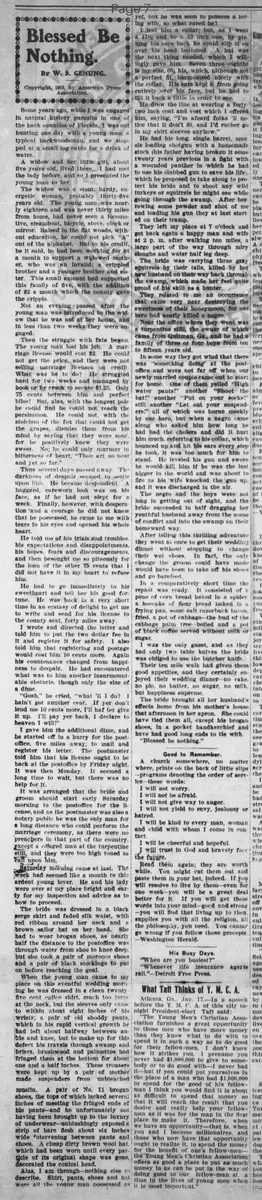
Blessed Be Nothing
By W. S. GENUNG.
Copyright, 1909, by American Press Association.
Some years ago, while I was engaged in natural history pursuits in one of the back counties of Florida, I was out hunting one day with a young man, a typical backwoodsman, and we stopped at a small log cabin for a drink of water.
A widow and her little girl, about five years old, lived here. I had met the lady before, and so I presented the young man to her.
The widow was a stout, hardy, energetic woman, probably thirty-five years old. The young man was nearly eighteen and was never thirty miles from home, had never seen a locomotive, steamboat, bicycle, stove, clock or mirror. Raised in the flat woods, without education, he could not pick "A" out of the alphabet. But to his credit, be it said, he had been working for $6 a month to support a widowed mother, who was an invalid; a crippled brother and a younger brother and sister. This small amount had supported this family of five, with the addition of $2 a month which the county gave the cripple.
Not an evening passed after the young man was introduced to the widow that he was not at her house, and in less than two weeks they were engaged.
Then the struggle with fate began. The young man lost his job. A marriage license would cost $2. He could not get the price, and they were not selling marriage licenses on credit. What was he to do? He struggled hard for two weeks and managed by hook or by crook to secure $1.25. Only 75 cents between him and perfect bliss! But, alas, with the longest pole he could find he could not reach the persimmon. He could not, with the stoicism of the fox that could not get the grapes, dismiss them from his mind by saying that they were sour, for he positively knew they were sweet. No: he could only murmur in bitterness of heart, "Thou art so near and yet so far."
Thus several days passed away. The darkness of despair seemed to settle upon him. He became despondent. A haggard, careworn look was on his face, as if he had not slept for a week. Finally, however, with desperation and a courage he did not know that he possessed, he came to me with tears in his eyes and opened his whole heart.
He told me of his trials and troubles, his expectations and disappointments, his hopes, fears and discouragements, and then besought me so piteously for the loan of the other 75 cents that I did not have it in my heart to refuse him.
He had to go immediately to his sweetheart and tell her his good fortune. He was back in a very short time in an ecstasy of delight to get me to write and send for his license to the county seat, forty miles away.
I wrote and directed the letter and told him to put the two dollar fee in it and register it for safety. I also told him that registering and postage would cost him 10 cents more. Again his countenance changed from happiness to despair. He had encountered what was to him another insurmountable obstacle, though only the size of a dime.
"Gosh," he cried, "what 'll I do? I bain't got another cent. If yer don't lend me 10 cents more, I'll haf ter give it up. I'll payyer back. I declare to heaven I will!"
I gave him the additional dime, and he started off in a hurry for the post office, five miles away, to mail and register his letter. The postmaster told him that his license ought to be back at the postoffice by Friday night. It was then Monday. It seemed a long time to wait, but there was no help for it.
It was arranged that the bride and groom should start early Saturday morning to the postoffice for the license, and as the postmaster was also a notary public he was the only man for a long distance who could perform the marriage ceremony, as there were no preachers in that part of the country, except a colored man at the turpentine still, and they were too high toned to call upon him.
Saturday morning came at last. The week had seemed like a month to this ardent young lover. He and his lady were over at my place bright and early for my inspection and advice as to how to proceed.
The bride was dressed in a black serge skirt and faded silk waist, with red ribbon around her neck and a brown sailor hat on her head. She had to wear brogan shoes, as nearly half the distance to the postoffice was through water from shoe to knee deep, but she took a pair of morocco shoes and a pair of black stockings to put on before reaching the goal.
When the young man came to my place on this eventful wedding morning he was dressed in a clean twenty-five cent calico shirt, much too large at the neck, but the sleeves only came to within about eight inches of his wrists; a pair of old shoddy pants which in his rapid vertical growth he had left about halfway between an elbow and knee, but to make up for this defect his travels through swamp and briers, brushwood and palmettos had fringed them at the bottom for about one and a half inches. These trousers were kept up by a pair of another made suspenders from unbleached muslin. A pair of No. 11 brogan shoes, the tops of which lacked several inches of meeting the fringed ends of his pants—and he unfortunately not having been brought up to the luxury of underwear—unblushingly exposed a strip of bare flesh about six inches wide intervening between pants and shoes. A cheap dirty brown wool hat, which had been worn until every particle of its original shape was gone, decorated the conical head.
Alas, I am through—nothing else to describe. Shirt, pants, shoes and hat were all the young man possessed as yet, but he was soon to possess a loving wife, so what cared he?
I lent him a collar; but, as I wear a 17 and he a 13 inch one, by pinning his ears back he could slip it on over his head buttoned. A hat was the next thing needed, which I willingly gave him. Seven three-eighths is my size, 6¼ his, which, although not a perfect fit, harmonized nicely with the collar. His ears kept it from going entirely over his face, but he had to tilt it back a little in order to see.
He drew the line at wearing a forty-two inch coat and vest which I offered him, saying, "I'm afeard folks 'll notice that it don't fit, and I'd ruther go in my shirt sleeves anyhow."
He had his long, single barrel, muzzle loading shotgun with a homemade stock (his father having broken it some twenty years previous in a fight with a wounded panther in which he had to use his clubbed gun to save his life), which he proposed to take along to protect his bride and to shoot any wild turkeys or squirrels he might see while going through the swamp. After borrowing some powder and shot of me and loading his gun they at last started on their tramp.
They left my place at 7 o'clock and got back again a happy man and wife at 2 p. m. after walking ten miles, a large part of the way through miry sloughs and water half leg deep.
The bride was carrying three gray squirrels by their tails, killed by her new husband on their way back through the swamp, which made her feel quite proud of his skill as a hunter.
They related to me an occurrence that came very near destroying the sweetness of their honeymoon, for our hero had nearly killed a negro.
Near the office where they went was a turpentine still, the owner of which came from Quitman, Ga., and he had a family of three or four boys from ten to fifteen years old.
In some way they got wind that there was something doing at the postoffice and were not far off when our newly married couple came out to start for home. One of them yelled "High water pants!" another "Shoot the hat!" another "Put on your socks!" still another "Let out your suspenders!" all of which was borne meekly by our hero, but when a negro came along who asked him how long he had had the cholera and did it hurt him much, referring to his collar, which bounced up and hit his ears every step he took, it was too much for him to stand. He leveled his gun and swore he would kill him if he was the last nigger in the world and was about to fire as his wife knocked the gun up, and it was discharged in the air.
The negro and the boys were not long in getting out of sight, and the bride succeeded in half dragging her youthful husband away from the scene of conflict and into the swamp on their homeward way.
After telling this thrilling adventure they went in at once to get their wedding dinner without stopping to change their wet shoes. In fact, the only change the groom could have made would have been to take off his shoes and go barefoot.
In a comparatively short time the repast was ready. It consisted of a pone of corn bread baked in a spider, a hoecake of flour bread baked in the frying pan, some salt razorback bacon fried, a pot of cabbage—the bud of the cabbage palm tree—boiled and a pot of black coffee served without milk or sugar.
I was the only guest, and as they had only two table knives the bride was obliged to use the butcher knife. Their ten mile walk had given them good appetites, and they certainly enjoyed their wedding dinner—no cake, no pie, no butter, no sugar, no milk, but happiness supreme.
The bride brought all her husband's effects home from his mother's house that afternoon in her apron. She could have tied them all, except his brogan shoes, in a pocket handkerchief and have had good long ends to tie with.
"Blessed be nothing."
By W. S. GENUNG.
Copyright, 1909, by American Press Association.
Some years ago, while I was engaged in natural history pursuits in one of the back counties of Florida, I was out hunting one day with a young man, a typical backwoodsman, and we stopped at a small log cabin for a drink of water.
A widow and her little girl, about five years old, lived here. I had met the lady before, and so I presented the young man to her.
The widow was a stout, hardy, energetic woman, probably thirty-five years old. The young man was nearly eighteen and was never thirty miles from home, had never seen a locomotive, steamboat, bicycle, stove, clock or mirror. Raised in the flat woods, without education, he could not pick "A" out of the alphabet. But to his credit, be it said, he had been working for $6 a month to support a widowed mother, who was an invalid; a crippled brother and a younger brother and sister. This small amount had supported this family of five, with the addition of $2 a month which the county gave the cripple.
Not an evening passed after the young man was introduced to the widow that he was not at her house, and in less than two weeks they were engaged.
Then the struggle with fate began. The young man lost his job. A marriage license would cost $2. He could not get the price, and they were not selling marriage licenses on credit. What was he to do? He struggled hard for two weeks and managed by hook or by crook to secure $1.25. Only 75 cents between him and perfect bliss! But, alas, with the longest pole he could find he could not reach the persimmon. He could not, with the stoicism of the fox that could not get the grapes, dismiss them from his mind by saying that they were sour, for he positively knew they were sweet. No: he could only murmur in bitterness of heart, "Thou art so near and yet so far."
Thus several days passed away. The darkness of despair seemed to settle upon him. He became despondent. A haggard, careworn look was on his face, as if he had not slept for a week. Finally, however, with desperation and a courage he did not know that he possessed, he came to me with tears in his eyes and opened his whole heart.
He told me of his trials and troubles, his expectations and disappointments, his hopes, fears and discouragements, and then besought me so piteously for the loan of the other 75 cents that I did not have it in my heart to refuse him.
He had to go immediately to his sweetheart and tell her his good fortune. He was back in a very short time in an ecstasy of delight to get me to write and send for his license to the county seat, forty miles away.
I wrote and directed the letter and told him to put the two dollar fee in it and register it for safety. I also told him that registering and postage would cost him 10 cents more. Again his countenance changed from happiness to despair. He had encountered what was to him another insurmountable obstacle, though only the size of a dime.
"Gosh," he cried, "what 'll I do? I bain't got another cent. If yer don't lend me 10 cents more, I'll haf ter give it up. I'll payyer back. I declare to heaven I will!"
I gave him the additional dime, and he started off in a hurry for the post office, five miles away, to mail and register his letter. The postmaster told him that his license ought to be back at the postoffice by Friday night. It was then Monday. It seemed a long time to wait, but there was no help for it.
It was arranged that the bride and groom should start early Saturday morning to the postoffice for the license, and as the postmaster was also a notary public he was the only man for a long distance who could perform the marriage ceremony, as there were no preachers in that part of the country, except a colored man at the turpentine still, and they were too high toned to call upon him.
Saturday morning came at last. The week had seemed like a month to this ardent young lover. He and his lady were over at my place bright and early for my inspection and advice as to how to proceed.
The bride was dressed in a black serge skirt and faded silk waist, with red ribbon around her neck and a brown sailor hat on her head. She had to wear brogan shoes, as nearly half the distance to the postoffice was through water from shoe to knee deep, but she took a pair of morocco shoes and a pair of black stockings to put on before reaching the goal.
When the young man came to my place on this eventful wedding morning he was dressed in a clean twenty-five cent calico shirt, much too large at the neck, but the sleeves only came to within about eight inches of his wrists; a pair of old shoddy pants which in his rapid vertical growth he had left about halfway between an elbow and knee, but to make up for this defect his travels through swamp and briers, brushwood and palmettos had fringed them at the bottom for about one and a half inches. These trousers were kept up by a pair of another made suspenders from unbleached muslin. A pair of No. 11 brogan shoes, the tops of which lacked several inches of meeting the fringed ends of his pants—and he unfortunately not having been brought up to the luxury of underwear—unblushingly exposed a strip of bare flesh about six inches wide intervening between pants and shoes. A cheap dirty brown wool hat, which had been worn until every particle of its original shape was gone, decorated the conical head.
Alas, I am through—nothing else to describe. Shirt, pants, shoes and hat were all the young man possessed as yet, but he was soon to possess a loving wife, so what cared he?
I lent him a collar; but, as I wear a 17 and he a 13 inch one, by pinning his ears back he could slip it on over his head buttoned. A hat was the next thing needed, which I willingly gave him. Seven three-eighths is my size, 6¼ his, which, although not a perfect fit, harmonized nicely with the collar. His ears kept it from going entirely over his face, but he had to tilt it back a little in order to see.
He drew the line at wearing a forty-two inch coat and vest which I offered him, saying, "I'm afeard folks 'll notice that it don't fit, and I'd ruther go in my shirt sleeves anyhow."
He had his long, single barrel, muzzle loading shotgun with a homemade stock (his father having broken it some twenty years previous in a fight with a wounded panther in which he had to use his clubbed gun to save his life), which he proposed to take along to protect his bride and to shoot any wild turkeys or squirrels he might see while going through the swamp. After borrowing some powder and shot of me and loading his gun they at last started on their tramp.
They left my place at 7 o'clock and got back again a happy man and wife at 2 p. m. after walking ten miles, a large part of the way through miry sloughs and water half leg deep.
The bride was carrying three gray squirrels by their tails, killed by her new husband on their way back through the swamp, which made her feel quite proud of his skill as a hunter.
They related to me an occurrence that came very near destroying the sweetness of their honeymoon, for our hero had nearly killed a negro.
Near the office where they went was a turpentine still, the owner of which came from Quitman, Ga., and he had a family of three or four boys from ten to fifteen years old.
In some way they got wind that there was something doing at the postoffice and were not far off when our newly married couple came out to start for home. One of them yelled "High water pants!" another "Shoot the hat!" another "Put on your socks!" still another "Let out your suspenders!" all of which was borne meekly by our hero, but when a negro came along who asked him how long he had had the cholera and did it hurt him much, referring to his collar, which bounced up and hit his ears every step he took, it was too much for him to stand. He leveled his gun and swore he would kill him if he was the last nigger in the world and was about to fire as his wife knocked the gun up, and it was discharged in the air.
The negro and the boys were not long in getting out of sight, and the bride succeeded in half dragging her youthful husband away from the scene of conflict and into the swamp on their homeward way.
After telling this thrilling adventure they went in at once to get their wedding dinner without stopping to change their wet shoes. In fact, the only change the groom could have made would have been to take off his shoes and go barefoot.
In a comparatively short time the repast was ready. It consisted of a pone of corn bread baked in a spider, a hoecake of flour bread baked in the frying pan, some salt razorback bacon fried, a pot of cabbage—the bud of the cabbage palm tree—boiled and a pot of black coffee served without milk or sugar.
I was the only guest, and as they had only two table knives the bride was obliged to use the butcher knife. Their ten mile walk had given them good appetites, and they certainly enjoyed their wedding dinner—no cake, no pie, no butter, no sugar, no milk, but happiness supreme.
The bride brought all her husband's effects home from his mother's house that afternoon in her apron. She could have tied them all, except his brogan shoes, in a pocket handkerchief and have had good long ends to tie with.
"Blessed be nothing."
What sub-type of article is it?
Prose Fiction
What themes does it cover?
Love Romance
Agriculture Rural
Moral Virtue
What keywords are associated?
Rural Marriage
Backwoods Poverty
Humorous Wedding
Florida Swamp
Simple Bliss
What entities or persons were involved?
By W. S. Genung.
Literary Details
Title
Blessed Be Nothing
Author
By W. S. Genung.
Key Lines
"Thou Art So Near And Yet So Far."
"Gosh," He Cried, "What 'Ll I Do? I Bain't Got Another Cent. If Yer Don't Lend Me 10 Cents More, I'll Haf Ter Give It Up. I'll Payyer Back. I Declare To Heaven I Will!"
"Blessed Be Nothing."